
An Off-page SEO checklist is a practical framework for auditing, prioritizing, and improving the external signals that influence your site’s authority, trust, and search visibility. The problem is that many teams treat off-page SEO as a backlink task list, even though the real work also includes competitor gaps, brand mentions, reputation signals, and page-level support. In this article, we break down an off page SEO checklist by priority, so you can review what already exists, fix weak signals, and decide what is actually worth building next.
What Is An Off Page SEO Checklist?
An off page SEO checklist is a structured way to review and improve the signals outside your own website that affect how search engines understand your authority, credibility, and relevance.
That definition matters because many teams still reduce off-page SEO to one activity: build more backlinks. Backlinks are still one of the clearest off-page signals, but they are not the whole picture. Off-page performance also depends on who mentions your brand, what kinds of referring domains support your pages, whether your reputation signals are consistent, and whether the pages receiving that support are actually worth strengthening.
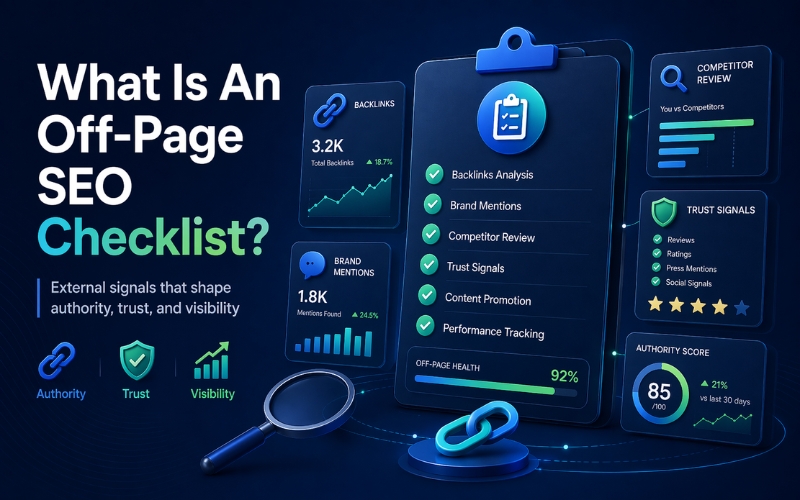
A useful off page SEO checklist should help you answer five practical questions:
- What off-page signals do we already have?
- Which signals are weak, missing, or misaligned?
- Which pages need stronger external support first?
- Which activities are actually worth doing for this site?
- What changed after the work was done?
That is the real purpose of a checklist. It is not to create more activity. It is to make off-page decisions clearer, more selective, and more useful.
>>> BOOK NOW: Buy Backlinks, Buy Guest Posts & Backlink Services | SEONetwork
A Practical Off Page SEO Checklist By Priority
If you want a version you can actually use, this is the off page SEO checklist in working order.
First Priority: Audit What Already Exists
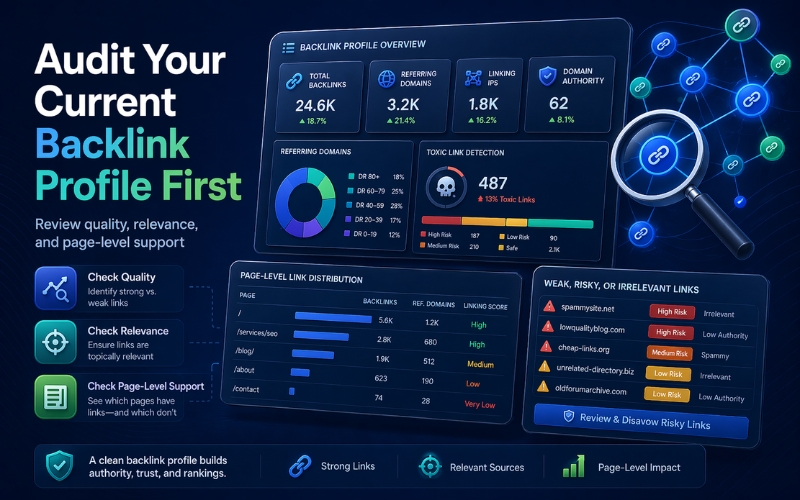
Before building anything new, review your current backlink profile, your strongest and weakest supported pages, your referring-domain quality, and any obvious risky or irrelevant signals already attached to the site.
Second Priority: Compare Competitor Gaps
Review which external signals are supporting the pages already winning in your target SERPs. Look at referring-domain patterns, mention types, editorial links, and site-level trust signals rather than just total link count.
Third Priority: Build Or Reclaim What Matters Most
Focus on relevant backlinks, unlinked brand mentions, lost links, and the specific external signals that support the pages you care about most. Do not build everything at once. Prioritize what clearly fits the site and the business.
Fourth Priority: Review Trust And Reputation Signals
If the business depends on local presence, third-party trust pages, citations, reviews, or professional ecosystem mentions, include those in the checklist too. For some sites, those signals matter more than another generic backlink campaign.
Fifth Priority: Measure What Changed
Track referring-domain quality, page-level ranking movement, brand mentions, referral traffic, and broader search visibility. Separate activity from impact. A checklist is only useful if it helps the team understand what actually improved.
This is a natural place to link to a related internal guide on what makes a quality backlink if you have one.
Audit Your Current Backlink Profile First
Before starting any new off-page work, review what already exists. Weak assumptions at this stage usually create weak decisions later.
Review Referring Domains And Link Quality
Start by checking the referring domains already pointing to your site. The raw number matters less than the pattern behind it.
Look at whether the domains are topically relevant, whether the linking pages are credible, and whether the overall distribution feels believable. A smaller, more relevant profile can be much stronger than a large profile filled with low-value or off-topic links.
Identify Weak, Irrelevant, Or Risky Signals
Not every link helps. Some add little value, and some create avoidable noise.
Review whether the profile includes thin sites, irrelevant pages, obvious paid-placement environments, or low-quality directories that do not make sense for the business. The goal is not to panic over every weak signal. The goal is to understand whether the existing profile is supporting trust and relevance or simply creating clutter.
Check Which Important Pages Are Under-Supported
Do not review backlinks only at the domain level.
Some sites look healthy overall but still leave important commercial, category, or resource pages under-supported. In that case, the issue is not total link count. The issue is how poorly the support is distributed across the URLs that matter most.
>>> DIVE DEEPER: Best Link Building Quality vs Quantity: What Matters More for SEO?
Compare Competitor Off-Page Gaps
A useful off page SEO checklist should always include competitive context. Without that, it becomes much harder to tell whether your off-page profile is actually weak or just feels incomplete.
Compare Referring-Domain Patterns And Topical Coverage
Start by reviewing the sites and pages already ranking in the SERPs you care about.
Ask what kinds of referring domains support their strongest pages. Are they earning links from industry blogs, news sites, niche resources, associations, local directories, or data-led content references? The useful question is not who has more links. It is what type of off-page support is helping them compete.
Review The Mix Of Signals Competitors Earn
Strong competitors often earn more than one kind of signal.
They may have editorial backlinks, guest contributions, digital PR mentions, review signals, industry citations, or unlinked brand references. Looking at that mix helps you see whether your current strategy is too narrow.
Prioritize Only The Gaps That Actually Matter
Do not try to copy every external signal your competitors have built.
Focus on the gaps tied most closely to the pages you want to improve. If competitors have relevant editorial support pointing to equivalent category pages and yours are under-supported, that matters more than chasing every mention you can find.
>>> READ MORE: How Many Backlinks Do I Need to Rank? – SEONetwork
Build Relevant Links To The Right Pages
Backlinks still matter, but a strong off page SEO checklist should push teams to build better support, not just more of it.
Prioritize Relevance And Page Context
A relevant backlink from a credible page usually does more than a larger set of weak placements.
Search engines evaluate more than raw link existence. They look at source quality, topic alignment, and page context. A backlink placed naturally inside useful content tends to send a stronger signal than one sitting on a weak page with little editorial purpose.
Check Where The Support Is Pointing
The destination matters as much as the source.
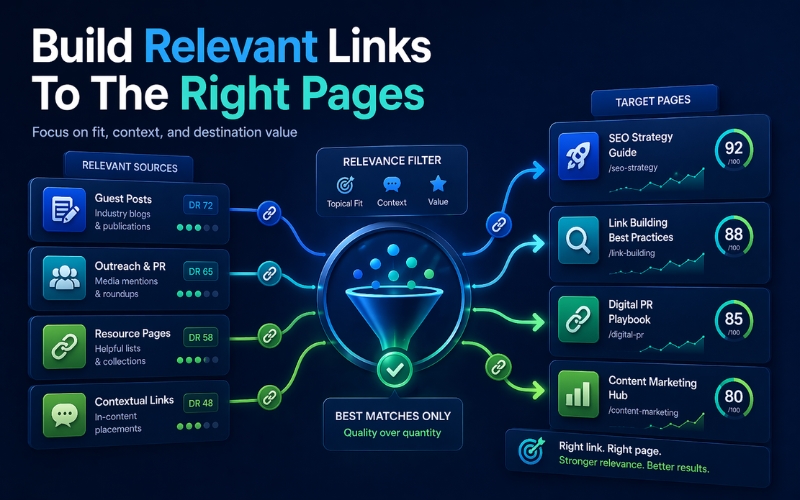
If most off-page signals point to the homepage while important category, service, or informational pages remain under-supported, the profile may look stronger than it actually is. A good checklist should help you map external support to the URLs that matter most.
Use More Than One Acquisition Method
Do not rely on one tactic alone.
Depending on the site and niche, useful off-page work may include manual outreach, guest posting, digital PR, resource-page outreach, reclaimable mentions, industry partnerships, or directories that genuinely fit the business. This is a natural place to link to a related guide on manual outreach link building or oursource backlink building if you have one.
Reclaim Signals You Already Earned
One of the most overlooked parts of an off page SEO checklist is reclaiming value that already exists but is not being used fully.
Reclaim Unlinked Brand Mentions
If your brand, product, research, or team is already being mentioned elsewhere, some of those references can become stronger signals.
Not every mention deserves a link request, but when the page is relevant and the context fits, reclaiming unlinked mentions can be one of the cleaner and more efficient off-page improvements available.
Recover Lost Or Broken Backlinks
Sometimes the weakness in your off-page profile comes from links you already had.
Pages get removed, URLs change, articles get updated, and previously live placements disappear. Reviewing lost backlinks can recover value much more efficiently than starting every campaign from zero.
Refresh Assets Worth Supporting Again
Older guides, studies, or resources sometimes still deserve external support.
If a page has earned links or mentions before, refreshing it can strengthen both the page itself and the off-page signals around it. This is especially useful when the original asset still has topical value but no longer feels current enough to deserve fresh references.
Review Brand, Reputation, And Contextual Trust Signals
A good off page SEO checklist should not stop at backlinks. External trust also comes from how the brand appears across the wider web.
Monitor Brand Mentions Across Relevant Sources
Brand mentions can matter even when they are not linked.
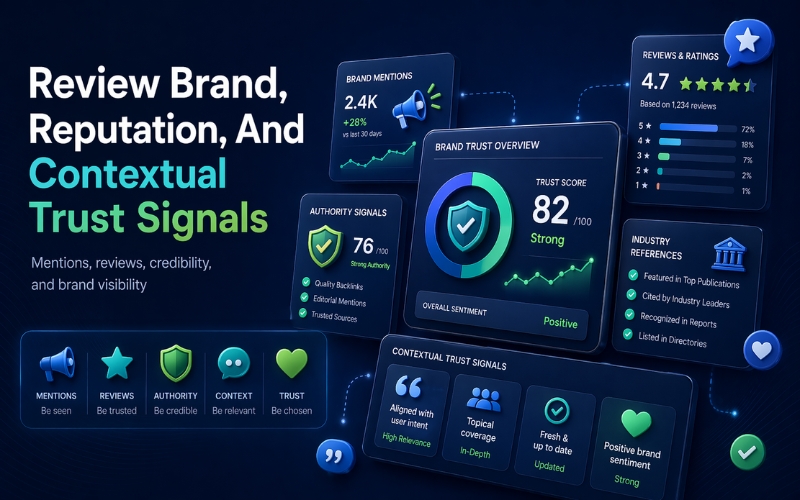
If your business is being referenced in industry articles, niche roundups, partner pages, community discussions, or publisher lists, that contributes to broader visibility and entity clarity. Monitoring those mentions helps you understand whether the brand is gaining external presence in the right places.
Check Reputation Signals When They Matter To The Business
For some sites, review signals, third-party trust pages, and consistent public-facing information are part of off-page strength.
This matters more in local, service-based, high-trust, or expert-led industries where authority is shaped by both links and reputation signals.
Add Local And Community Signals Only When They Truly Matter
Not every site needs the same off-page checklist.
A local service business may need citation consistency, listing accuracy, and review coverage. A B2B SaaS site may care more about editorial mentions and niche references. A publisher may need stronger authority signals around topic clusters. The checklist should reflect the site and business model, not force every tactic into every campaign.
Use One Quality Standard Across Every Off-Page Signal
An off page SEO checklist should not just tell you what to do. It should help you judge whether the signals you are building are worth having.
Ask Whether The Signal Is Relevant
Does the placement, citation, or mention make sense for your niche, page priorities, and audience?
If the answer is weak, the signal is usually weaker than it looks on paper.
Ask Whether The Source Is Credible
A credible signal usually comes from a page or source that serves a real audience, has reasonable editorial quality, and fits naturally into the topic.
This is where many off-page campaigns lose quality. They keep counting activity while the actual sources become harder to defend.
Ask Whether The Signal Supports Real Visibility
The point of off-page SEO is not simply to accumulate references. It is to strengthen search visibility, trust, discoverability, and page-level support in a believable way. If the signal does none of those things, it probably does not belong on the priority list.
>>> EXPLORE FURTHER: Does Google Reviews Help SEO?
Track What Changed After Off-Page SEO Work
A checklist is only useful if it leads to better decisions and better outcomes. Measurement needs to be part of the workflow, not an afterthought.
Monitor Referring-Domain Quality Over Time
Track how the profile changes, but review the quality of those changes too.
Growth in referring domains matters more when the new sources are relevant, credible, and connected to the pages you care about.
Watch Page-Level Ranking Movement
Do not evaluate off-page SEO only at the domain level.
Watch what happens to the specific pages and topic clusters the campaign was supposed to support. Page-level movement is often more useful than broad site-level visibility changes.
Review Mentions, Referral Traffic, And Search Visibility
Some useful outcomes show up outside pure ranking changes.
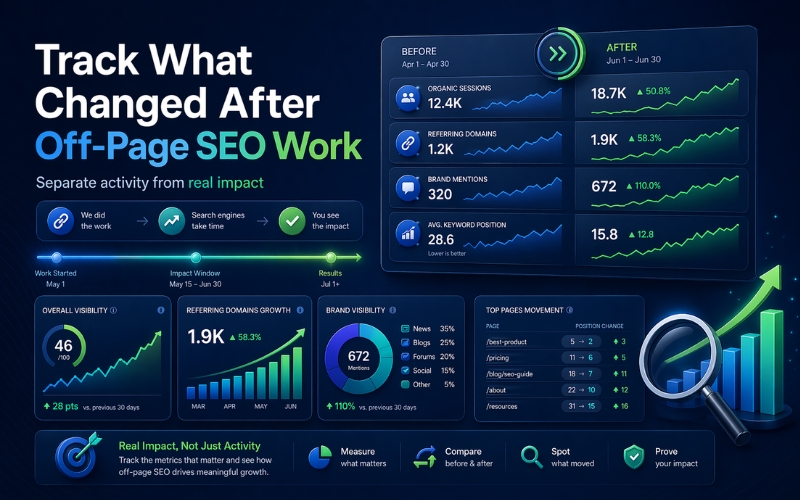
Referral traffic, branded search growth, publisher references, and stronger mention patterns can all indicate that your external visibility is improving in the right places.
Separate Activity From Impact
This is one of the most important parts of the checklist.
Many teams are good at tracking what they did. Fewer are good at tracking what actually changed because of it. Off-page work should be reviewed by usefulness, not just by output volume.
>>> DIVE DEEPER: How Long Does It Take For Backlinks To Work? A Realistic SEO Timeline
Common Off Page SEO Checklist Mistakes
Many off page SEO checklists go wrong because they confuse motion with progress.
Treating Off-Page SEO As Link Count Only
This is the most common problem. A checklist that only asks how many links were built is too narrow to guide real decisions.
Using The Same Checklist For Every Site
A SaaS company, a local business, a publisher, and a B2B service site do not need the same off-page priorities. A checklist should reflect the business model, the SERP, and the pages that matter most.
Ignoring Link Quality And Page Fit
A backlink can look good in a report and still be weak in practice if the topic relevance, page context, or target-page fit is poor.
Skipping Competitor Gap Analysis
Without competitive context, teams often do off-page work without knowing which signals actually matter in the SERP they are trying to enter.
Doing Activity Without Clear Measurement
This is where checklists become performative. The work gets done, but no one can explain whether it improved visibility, trust, or page support in a meaningful way.
Conclusion
A strong off page SEO checklist does more than organize tasks. It helps the team decide what deserves attention first, which weak signals need cleanup, and which activities are not worth repeating.
That usually means auditing what already exists, comparing competitor gaps, building support around the right pages, reclaiming value you already earned, and measuring outcomes at the page level instead of counting activity alone.
If the off-page process still feels scattered, the issue is usually not a lack of tactics. It is the lack of one clear standard for reviewing and prioritizing the signals that actually support rankings and trust.
Check our Link Building Marketplace for the most balance and safest link building strategies.
FAQ
What Should Be Included In An Off Page SEO Checklist?
A useful off page SEO checklist should include backlink profile review, competitor gap analysis, page-level support checks, mention and reputation review, and measurement of off-page impact over time.
Is Off-Page SEO Only About Backlinks?
No. Backlinks are important, but off-page SEO also includes brand mentions, citations, reviews, digital PR, and other external signals that affect trust and visibility.
How Often Should You Review Your Off-Page SEO?
Most teams should review core off-page signals regularly, especially after link acquisition campaigns, major content pushes, or noticeable competitive changes in the SERP.
What Are The Most Important Off-Page SEO Signals?
The most important signals usually include relevant backlinks, credible referring domains, brand mentions, reputation signals, and strong external references tied to the pages that matter most.
How Do You Know If Off-Page SEO Is Working?
Look at page-level ranking movement, referring-domain quality, branded visibility, referral traffic, and whether the signals being built actually support the pages and topics you want to strengthen.

I’m Jackson Avery, and I have 5 years of experience in content SEO. At SEONetwork, I share practical SEO knowledge, insights, and content strategies to help readers better understand search intent, content optimization, and sustainable organic growth.