
Does Google Reviews help SEO? Yes, Google reviews can help SEO, especially in local SEO. Reviews can strengthen local visibility, improve trust, and help a business stand out more clearly in Search and Maps.
SEONetwork sees the strongest value when reviews are treated as both a visibility signal and a trust signal. They are not a magic ranking shortcut, but they can make a real difference when a business wants to improve local presence, strengthen credibility, and support pages that are already worth finding.
The Direct Answer Most Businesses Actually Need
If you want the short, practical answer, it is this: Google reviews help SEO most clearly in local search, not as a blanket promise that every website page will rank higher just because the business has more stars.
That matters because it gives businesses a much better way to interpret the topic. If your goal is stronger visibility in local packs, Google Maps, and branded local search, reviews matter in a real way. If your goal is broader organic performance for website pages, the effect is less direct. Reviews may still support trust, click behavior, and conversion confidence, but their clearest SEO value is usually tied to local visibility.
So the working rule is simple: if you are a local business, Google reviews are not optional trust cosmetics. They are part of the local SEO foundation.
Why Google Reviews Matter More Than Many Businesses Expect
A lot of businesses still treat reviews as reputation management only. That is too narrow.
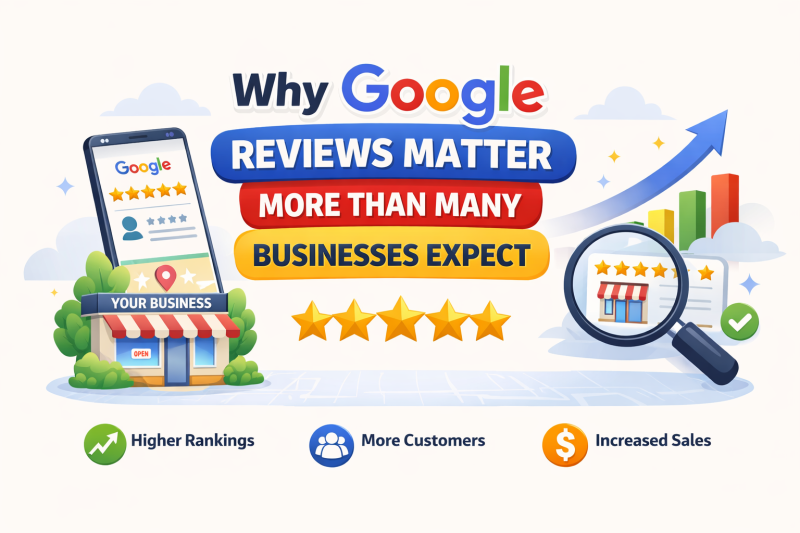
Reviews matter in at least three different ways.
First, they can affect local visibility because review count and positive ratings contribute to local prominence. Second, they affect decision-making because they are visible directly in Search and Maps where users are already comparing options. Third, they affect trust signals because active reviews and thoughtful replies make a business look more real, current, and responsive.
This is why businesses that ignore reviews often misread the problem. They think they are only neglecting social proof, when in practice they may also be weakening a real part of local SEO performance.
How Google Reviews Help Local SEO Specifically
The clearest SEO value of Google reviews is in local search.
Local visibility depends on multiple factors, but reviews are clearly part of the picture. More reviews, stronger ratings, and a healthier profile presence can all help a business look more prominent and trustworthy in local results.
That does not mean reviews act like a simple volume switch where more automatically means first position. Local SEO still depends on relevance, distance, business category fit, and overall profile quality. But reviews are still an active part of that system.
This is why local businesses should stop asking whether reviews “count at all.” They do. The more useful question is whether your review profile is strong enough, recent enough, and trustworthy enough to support the prominence side of local visibility.
>>> READ MORE: Off Page SEO Checklist: What To Review, Build, And Improve
What Google Reviews Usually Do Not Do on Their Own
The biggest mistake in this topic is assuming reviews do everything.
Reviews can help local SEO. They can help a business stand out. They can improve trust and support the local prominence picture. But they do not replace page quality, category relevance, strong site architecture, or useful on-site content.
A five-star profile does not solve a weak landing page or a badly optimized local service page.
The safest interpretation is this: Google reviews are a meaningful local SEO asset, but they work best when the rest of the local setup is already credible.
Why Responding to Reviews Matters Too
Many businesses focus only on getting more reviews and ignore what happens after the review is published.
Replying to customer reviews shows that the business values feedback. It also helps the profile feel more active and more trustworthy. In practice, a business with active, useful review responses often feels more credible than a business with the same rating and no visible engagement at all.
SEONetwork generally sees this as a compounding effect. The review itself gives a signal. The reply adds more context. Together, they make the profile stronger for both visibility and user confidence.
How to Get More Google Reviews Without Creating Risk
This is where businesses often get careless.
The safest review growth strategy is not to push harder. It is to make the request process easier and more consistent.
A practical model for real businesses looks like this:
- Ask after a genuine completed interaction
- Make the request easy with a direct review link or QR code
- Keep the language neutral instead of asking only for five-star feedback
- Review and reply consistently
- Do not offer incentives or try to suppress negative feedback
That model is slower than fake growth tactics, but it is safer, cleaner, and much more likely to build a review profile that actually supports local SEO over time.
>>> READ MORE: How Many Backlinks Do I Need to Rank?
Where Google Reviews Matter Most Across Different Page Types
Because this topic is practical, it helps to be clear about where reviews matter most on the site side.
Blog posts
Google reviews are usually not the main SEO lever for blog posts. A blog article ranks more on topic coverage, helpfulness, and relevance than on whether your Business Profile has more reviews.
That said, blog content can still benefit indirectly when strong reviews improve overall brand trust and make readers more willing to click deeper into the site.
Service pages
Service pages are where review signals often matter much more in practice. If a local service business appears in Search or Maps with stronger review count, better ratings, and active replies, users are more likely to view the business as credible before they even land on the page.
Once they do land, the review context makes the service page easier to trust.
Category pages
Category-style pages are usually less directly affected by Google review volume than Business Profiles or local service pages. Reviews still help the wider brand and local presence, but category page SEO is more dependent on site structure, page usefulness, and intent match.
The practical takeaway is that reviews support the ecosystem around these pages more than they directly boost them.
If you need a decision rule, it is this: Google reviews help most clearly where local intent and business trust are central to the click.
One Important Limitation: Reviews on Your Own Site Are Different
Some businesses confuse Google reviews, Business Profile reviews, and on-site review markup as if they all work the same way. They do not.
A strong Google review profile does not automatically mean your own website pages will show review stars in normal organic results. Business Profile reviews and organic review snippets are separate contexts.
The practical lesson is simple: do not confuse a strong Google review profile with guaranteed review-star treatment for your own pages in search results.
Common Mistakes Businesses Make With Google Reviews and SEO
One common mistake is treating reviews as a one-time campaign instead of an ongoing business signal. Review profiles get weaker when they look stale, even if the historical average is good.
Another mistake is chasing only positive reviews and ignoring the value of balance. A mix of genuine feedback often feels more believable than a profile that looks overly polished.
A third mistake is offering incentives. That creates risk and weakens review quality over time.
A fourth mistake is leaving reviews unanswered for long periods. Review replies add trust and help the business look more engaged.
A fifth mistake is expecting reviews to fix everything else. Reviews can help local prominence, but they do not replace complete business information, accurate categories, verification, or strong destination pages.
What Businesses Should Actually Do Next
If you run a local business, the next step is not to obsess over one perfect review count target. There is no single magic number that guarantees stronger rankings.
The better next step is to improve the parts of the review process you actually control:
- Make sure your Business Profile is accurate and complete
- Ask real customers for reviews consistently
- Make it easy to leave them
- Reply helpfully and regularly
- Treat reviews as an ongoing trust and visibility asset
SEONetwork sees this as a practical local growth system. The businesses that benefit most from reviews are usually not the ones trying to manufacture them. They are the ones using reviews to reinforce a real, visible, well-maintained presence.
Google reviews do help SEO, but most clearly in local SEO.
That makes reviews more than reputation decoration. They are part of local prominence, profile trust, and user decision-making. The strongest approach is to build them steadily, keep them genuine, respond to them well, and treat them as one part of a stronger local SEO foundation rather than a shortcut by themselves.
SEONetwork usually sees better local SEO outcomes when businesses stop treating Google reviews as a side task and start treating them as part of page readiness, profile quality, and real-world trust. When the profile, the reviews, and the destination pages all support each other, visibility becomes much easier to convert into action.
Check our Link Building Marketplace for the most balance and safest link building strategies.
FAQs
Do Google reviews help SEO directly?
They most clearly help local SEO because stronger review signals can support local visibility and profile prominence.
Do more Google reviews improve ranking?
They can help local ranking, but they are not the only factor. Relevance, distance, and overall profile quality still matter.
Can I offer incentives for Google reviews?
No. The safest approach is to request honest reviews from real customers without offering rewards.
Do review replies matter for SEO?
Replies matter because they improve trust, make the profile look active, and help the business stand out more clearly.
Will embedding my own Google reviews on my site give me review stars in organic results?
Not necessarily. Your Business Profile review strength and your website’s organic review appearance are not the same thing.
>>> YOU MAY ALSO LIKE:
- Buy Backlinks, Buy Guest Posts & Backlink Services | SEONetwork
- How Long Does It Take For Backlinks To Work? A Realistic SEO Timeline – SEONetwork

I’m Jackson Avery, and I have 5 years of experience in content SEO. At SEONetwork, I share practical SEO knowledge, insights, and content strategies to help readers better understand search intent, content optimization, and sustainable organic growth.