
Best link building quality vs quantity usually comes down to one core principle: quality matters more first, but quantity still matters as competition increases. Relevant, contextual backlinks often support rankings better than large volumes of weak or unrelated links. Still, websites in competitive SERPs usually need enough referring domains and consistent link growth to compete effectively. This article explains how to evaluate both and how to balance them in a realistic SEO strategy.
What Link Quality And Quantity Actually Mean?
The debate around link-building quality vs quantity often gets simplified too much.
Some teams assume a few strong backlinks are enough in every case. Others focus on volume and treat more links as automatic progress. In practice, neither view is reliable on its own. To make better decisions, it helps to define both terms clearly.
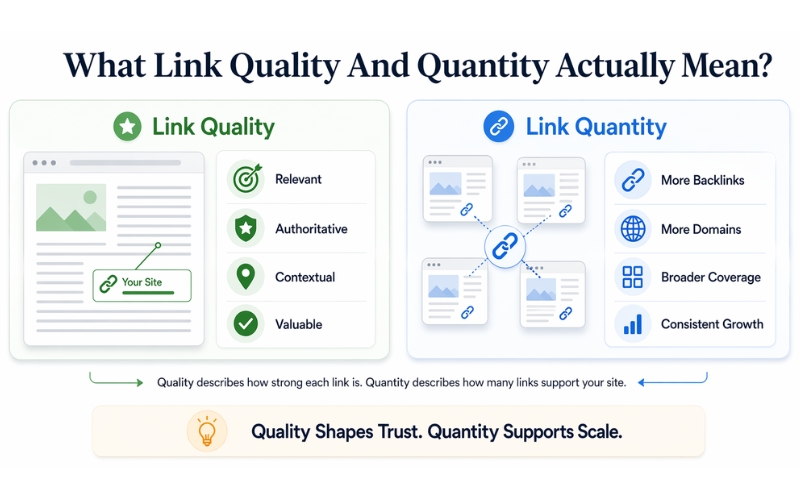
What Link Quality Means
Link quality is not just about a strong number in a third-party SEO tool.
A high-quality backlink usually comes from a website that is relevant to your topic, appears in content that has real value, and points to a page that fits naturally within that context. It should feel editorially justified rather than mechanically inserted.
In most cases, link quality comes down to five practical factors:
- Topical Relevance
- Website Quality
- Placement Context
- Anchor Text Naturalness
- Landing Page Fit
A backlink from a relevant site with a clear audience and useful content will usually do more than a random mention from a site that has no meaningful connection to your niche.
What Link Quantity Means
Link quantity refers to scale.
That can mean the total number of backlinks pointing to a website, the number of referring domains, or the pace at which new links are acquired over time. In most strategic SEO work, referring domains usually matter more than raw backlink counts because links from multiple unique websites often say more than repeated links from the same source.
Quantity is easy to count, which is one reason it often gets too much attention. But volume without quality usually creates noise instead of a stronger backlink profile.
Why Quality Usually Matters More?
For most SEO campaigns, quality should come first.
Relevant Links Usually Carry Stronger Value
A backlink becomes more useful when the source website and source page actually make sense for the page you are trying to support.
If you are trying to rank a page about guest posting, a contextual backlink from a website covering SEO, digital marketing, or content strategy is usually more valuable than a link from a general lifestyle site with no clear topical overlap.
That does not mean every backlink must come from the exact same niche. It means the connection should be logical. The stronger the relevance, the easier it is for the placement to support the target page in a way that looks natural and useful.
Better Placements Usually Outperform Random Volume
The site itself matters, but the page and placement matter too.
A backlink placed naturally inside a useful article is generally more valuable than a link buried on a thin page, a low-quality directory, or an article that exists mainly to host outbound links. Even when two websites look similar at the domain level, the better placement often produces more value.
This is one reason a smaller number of strong placements often outperforms a larger batch of weaker ones.
Chasing Volume Too Early Often Lowers Standards
When teams focus on quantity first, quality control usually starts to slip.
They accept weaker websites, stretch relevance, tolerate poor article quality, or overuse aggressive anchors. In some cases, they point links to pages that are not strong enough to benefit from them in the first place.
The result is a backlink profile that may look active on paper, but does not help rankings as much as expected. A better approach is to set clear standards first, then scale once those standards are stable.
>>> GET QUALITY LINKS RIGHT HERE: Buy Backlinks, Buy Guest Posts & Backlink Services | SEONetwork
When Quantity Starts To Matter More?
Quality leads the strategy, but quantity still matters in real SEO work.
Competitive SERPs Usually Require Enough Referring Domains
In tougher search results, a few great backlinks are rarely enough on their own.
If the top-ranking pages for your target terms are supported by a broad set of relevant referring domains, you will usually need enough comparable support to compete meaningfully. This does not mean copying a competitor’s raw numbers. It means understanding whether the gap comes from stronger links, broader link coverage, or both.
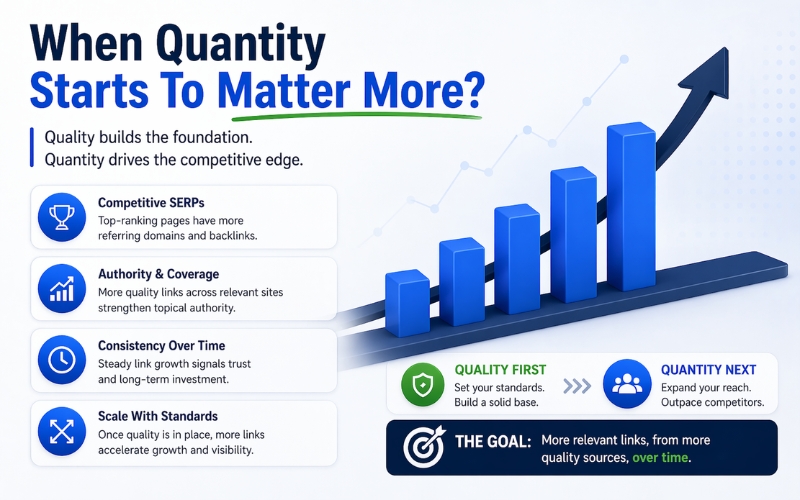
Once competition increases, quantity matters more because authority is rarely built by only a handful of wins.
Link Building Needs Consistency Over Time
Link building is not just about how many links you have. It is also about how the profile develops.
A website that gains relevant backlinks steadily over time often looks healthier than a website that shows a short burst of link activity and then stops. Growth does not need to follow a perfect monthly pattern, but consistency matters because it reflects a more sustainable SEO effort.
This is one of the places where quantity becomes important. If you want ongoing growth, you usually need repeated execution, not isolated placements.
Scale Helps When The Process Is Already Strong
Once your team knows how to evaluate quality properly, scale becomes a real advantage.
If you can consistently assess website relevance, content quality, placement fit, and anchor usage, then scaling your output can help support more landing pages, strengthen topic clusters, and build a healthier referring domain profile over time.
The issue is not the scale itself. The issue is scaling before the filtering process is good enough.
How To Evaluate Link Quality In Practice
When evaluating the best link-building quality vs quantity approach, the goal is not to chase a fixed number of backlinks, but to understand what level of quality and scale your market actually requires.
Topical Relevance
Start with the clearest question: Does this website make sense for the page you want to support?
A site does not need to mirror your niche exactly, but the relationship should be easy to explain. If the connection between the source page and the destination page feels weak or forced, the placement is less likely to be valuable.
Website Quality
A useful website does not need to look perfect, but it should look real, active, and built for an audience.
Review the site’s content quality, publishing patterns, structure, and overall usability. Ask whether the site appears to serve a genuine purpose or whether it is mainly built to sell placements.
Common warning signs include:
- Thin Or Repetitive Content
- Inconsistent Topical Focus
- Weak Site Structure
- Overloaded Outbound Links
- Pages With Little Standalone Value
A site can have strong surface metrics and still be a weak placement if the actual content environment is poor.
Placement Context
Context matters at the page level.
A strong backlink usually sits inside a paragraph where it supports the point being made. The article itself should still have value even if the backlink were removed. If the content reads like it was written only to host links, the placement is less convincing and often less useful.
Anchor Text And Landing Page Fit
Anchor text should make sense inside the sentence and match the target page naturally.
If the anchor is too aggressive, too repetitive, or disconnected from the surrounding content, the placement becomes harder to justify. In most cases, a natural anchor that supports the topic is a better long-term choice than forcing exact-match phrasing too often.
Comparative Judgment
This is where a lot of teams make poor decisions.
A lower-metric website with stronger relevance and cleaner context may be more useful than a higher-metric site with weak topical alignment. Third-party metrics can help with prioritization, but they should support judgment, not replace it.
>>> READ MORE: Manual Outreach Link Building: How It Works And When It Still Makes Sense
How To Judge The Right Amount Of Quantity
There is no universal backlink target that works across every site type or industry.
Avoid Arbitrary Numbers
Targets like “we need 50 backlinks” may sound concrete, but they do not tell you whether those links are enough, relevant enough, or strategically useful.
A local business, a SaaS company, and a publisher in a competitive affiliate niche do not need the same type of backlink profile. The right quantity depends on the competitive environment and the type of pages you are trying to rank.
Compare Against The SERP
A more useful way to think about quantity is to compare your profile with the pages already ranking for the keywords you care about.
Look at:
- How Many Relevant Referring Domains Support Those Pages
- What Types Of Sites Link To Them
- Whether Those Links Are Strongly Topical Or Broadly General
- Whether The Ranking Gap Appears To Come From Better Links, More Links, Or Both
This gives you a more realistic benchmark than chasing a generic link count.
Define A Healthy Scale Threshold
Before increasing output, decide what still counts as acceptable.
That threshold usually includes:
- Relevant Websites
- Solid Content Quality
- Contextual Placements
- Natural Anchor Use
- Clear Fit Between The Source Page And The Destination Page
Once these filters are clear, scaling becomes much easier without turning the strategy into a volume-only exercise.
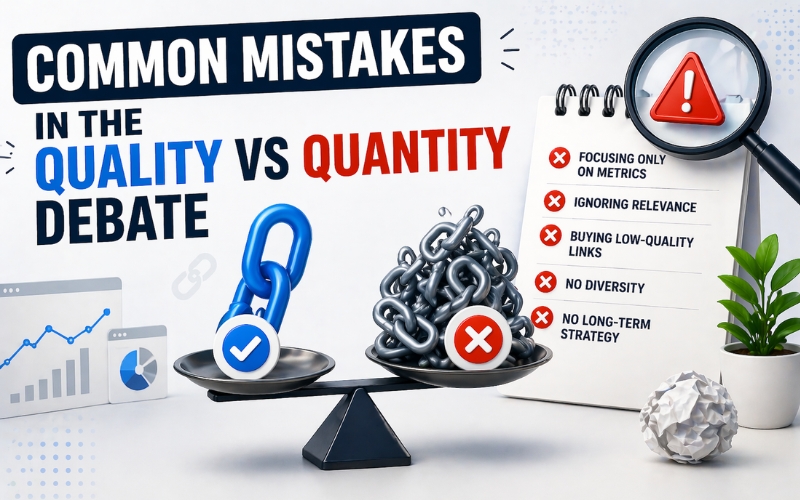
Common Mistakes In The Quality Vs Quantity Debate
A lot of wasted time and budget in link building comes from comparing the wrong things.
Treating All Backlinks As Equal
A backlink is not valuable just because it exists. Some links can materially support a page. Others contribute very little.
Using DR Or DA As The Only Quality Filter
Third-party metrics can help you screen opportunities, but they do not tell the whole story. A relevant, well-placed link on a solid website can be more useful than a higher-metric placement with weak context.
Scaling Before The Process Is Ready
If your team has not clearly defined what a good placement looks like, adding more volume usually makes the campaign harder to control.
Ignoring The Target Page
Even a good backlink has limited impact if it points to a page with weak search intent alignment, thin content, or poor internal support. Link building works best when the destination page is already worth strengthening.
Expecting Backlinks To Fix Everything
Backlinks matter, but they are not a substitute for strong content, good site structure, clear search intent alignment, and solid internal linking.
A Practical Framework To Balance Quality And Quantity
The strongest link-building strategies usually follow a sequence instead of chasing everything at once.
Step 1: Define The Goal
Start by being specific about what the links are meant to support.
Are you trying to improve rankings for one page, strengthen a topic cluster, expand authority across a section, or support broader visibility for the website? The answer will shape how you judge both quality and scale.
Step 2: Review The Current Backlink Profile
Before building more links, understand what is already there.
In some cases, the real issue is not low volume but weak topical relevance. In others, the site may already have decent-quality links but still lack enough referring domain breadth to compete in harder SERPs.
Step 3: Set Minimum Quality Criteria
This is the point where link building becomes more repeatable.
Define the minimum standard for website relevance, content quality, placement context, anchor naturalness, and target-page fit. These filters help teams make faster decisions and reduce inconsistency as campaigns grow.
Step 4: Scale Gradually
Once the quality baseline is stable, increase output in a controlled way.
Monitor which types of placements are supporting rankings most effectively. Refine your criteria as you learn more. Expand where the logic supports it, not simply where more inventory is available.
How SEONetwork Helps Teams Manage This More Clearly
One of the hardest parts of link building is not understanding the difference between quality and quantity. It is evaluating placement opportunities consistently once campaigns start to scale.
That is where a more structured workflow helps.
SEONetwork helps advertisers compare websites more clearly, review placement opportunities in context, and manage backlink execution in a more organized way. For teams trying to maintain quality standards while still building enough scale, that structure makes link building decisions easier to evaluate and easier to manage.
Conclusion
So, what is the best link-building quality vs quantity strategy? In most cases, quality should come first, then quantity should scale only after clear standards are in place.
Relevant websites, stronger placement context, and a clear fit between the source page and the destination page usually matter more than raw volume. At the same time, quantity still matters once competition increases, especially when higher-ranking pages are supported by more relevant referring domains and more consistent link growth.
The best strategy is not to choose one side forever. It is to build around quality first, then scale without lowering the standard.
Check our Link Building Marketplace for the most balance and safest link building strategies.
FAQ
1. What is the best link building quality vs quantity strategy?
The best strategy is usually to prioritize quality first, then scale quantity once your standards for relevance, placement quality, and target-page fit are clear.
2. When does link quantity start to matter more?
Quantity matters more in competitive SERPs, especially when top-ranking pages are supported by a broader set of relevant referring domains. At that point, scale matters, but only if quality stays under control.
3. How do you evaluate backlink quality?
The main factors are topical relevance, website quality, placement context, anchor text naturalness, and how well the link fits the target page. A backlink should make sense editorially, not just exist for SEO.
4. How many backlinks are enough?
There is no universal number. The right amount depends on your niche, your competitors, and the gap between your current backlink profile and the pages already ranking for your target keywords.
5. Can too many low-quality backlinks hurt SEO?
Yes. A large volume of weak or irrelevant backlinks can make your profile look noisy and contribute very little to ranking growth. In some cases, it can also create risk if the pattern looks overly manufactured.
>>> YOU MAY ALSO LIKE:
- Link Building Prices: What You Should Expect To Pay And Why Costs Vary
- Off Page SEO Checklist: What To Review, Build, And Improve – SEONetwork