
Selling backlinks means accepting payment to place links on your website, usually through sponsored posts, paid guest content, link insertions, or marketplace placements. For publishers, it can create an additional revenue stream, but it can also create editorial, trust, and SEO risks when handled carelessly. The safest approach is to treat paid backlinks as controlled placements with clear relevance, strong content standards, transparent link policies, and full editorial review.
What Does Selling Backlinks Actually Mean?
Selling backlinks means a website owner or publisher receives payment to place a link to another website. That link may appear inside a sponsored article, a paid guest post, an existing article, a resource page, or a partner mention.
Not every paid link works the same way. Some placements are mainly advertising. Some are part of sponsored content. SEO teams request some because they want visibility, referral traffic, or exposure from a relevant publisher.
The important distinction is intent and execution. A paid placement that is relevant, useful to readers, editorially reviewed, and properly qualified is different from selling links at scale to any buyer who asks. Google Search Central says paid links should be qualified with rel="sponsored" or rel="nofollow" so they are not treated as attempts to pass ranking signals.
For publishers, the goal should not be to sell as many links as possible. The goal should be to monetize carefully without weakening the website’s audience trust, topical focus, or long-term search value.
Should Publishers Sell Backlinks?
Publishers can sell backlinks or sponsored placements, but only when they can protect editorial standards first. A website with real readers, a focused niche, and useful content has more to lose than a thin site built only for link sales.
Selling backlinks may make sense when your website already has a defined audience, consistent content quality, and clear topical authority. In that situation, sponsored posts or paid placements can be part of broader website monetization, alongside ads, affiliate content, partnerships, or newsletter sponsorships.
It can also make sense when advertiser requests are genuinely relevant to your readers. For example, a marketing blog may reasonably publish sponsored content from a SaaS tool, outreach platform, analytics product, or content workflow service if the article provides real value.
Selling backlinks becomes risky when the process is driven only by payment. If a website starts accepting every niche, publishing thin sponsored articles, using over-optimized anchor text, or linking to unrelated commercial pages, it can begin to look like a link farm. Google’s spam policies include buying or selling links for ranking purposes as link spam, so publishers should avoid selling links in a way that looks designed primarily to manipulate search rankings.
Editorial control is what separates a legitimate sponsored placement from careless link selling. Publishers should decide which topics fit, which links are acceptable, how links are labeled, and whether the content meets publication standards.
What Makes A Website Ready To Sell Backlinks?
Before trying to sell backlinks, publishers should evaluate whether their site is actually ready. A website does not need to be huge, but it should have enough quality, focus, and audience value to justify paid placements.
A strong publisher site should have signs of real audience activity. That may include organic traffic, direct readers, newsletter subscribers, social engagement, referral traffic, or a visible community. Buyers often look at metrics such as DR, DA, organic traffic, referring domains, and niche relevance. Those metrics matter, but they are not the whole story. A smaller site with a focused audience can be more valuable than a broad site with inflated metrics and weak engagement.
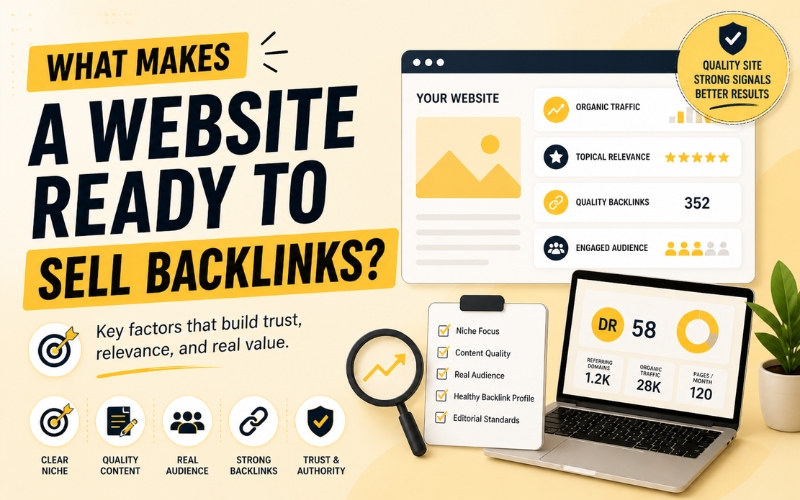
A clear niche also matters. If your site covers marketing, SaaS, ecommerce, finance, travel, health, or technology, your placement rules should match that focus. A site that publishes every topic from casino to pets to software to fashion will look less trustworthy.
A publisher should also have minimum standards for sponsored posts and paid guest content. Good standards may include original content, clear topic relevance, natural link placement, limited external links, useful examples, and final editorial approval. If a paid article would not be acceptable as a regular article, it should not be accepted just because money is involved.
Set Rules Before You Accept Paid Links
The best time to set backlink rules is before the first request arrives. Clear rules make it easier to reject poor-fit buyers, avoid awkward negotiations, and protect your website from inconsistent decisions.
Start by listing the industries and topics you are willing to accept. These should be directly related or reasonably adjacent to your site’s audience. For example, a marketing website might accept content about SEO, content marketing, SaaS tools, digital PR, ecommerce growth, analytics, and outreach. It may reject gambling, adult, payday loans, unrelated coupons, or thin affiliate pages.
Next, define your link attribute policy. Publishers should decide how they will handle paid link attributes before they list their website, respond to advertisers, or join a marketplace. Google Search Central recommends rel="sponsored" for advertisements or paid placements, and rel="nofollow" can also be used to qualify links when needed.
Anchor text rules are also important. Over-optimized anchors like “best cheap CRM software” or “buy backlinks online” can make the placement look forced, especially if repeated across multiple articles. Safer anchor styles include brand names, natural phrase anchors, partial-match anchors, and contextual anchors that fit the sentence.
Finally, limit link volume per article. A sponsored article should not become a link dump. Every link should have a clear reason to exist for the reader.
Choose The Right Backlink Selling Model
There are several ways to sell backlinks or sponsored placements. The right model depends on your website, editorial process, and level of control.
Sponsored posts are one of the cleanest models when handled properly. The article is published as sponsored content and includes one or more relevant links to the advertiser. This works best when the publisher controls topic approval, content quality, disclosure, and link attributes.
Paid guest posts usually involve a buyer submitting an article for publication. This can work, but it requires careful review. Publishers should check whether the article is original, useful, relevant, and written for the site’s audience. If your site accepts guest content regularly, it helps to have a clear guest posting strategy so paid submissions do not lower the quality of your editorial calendar.
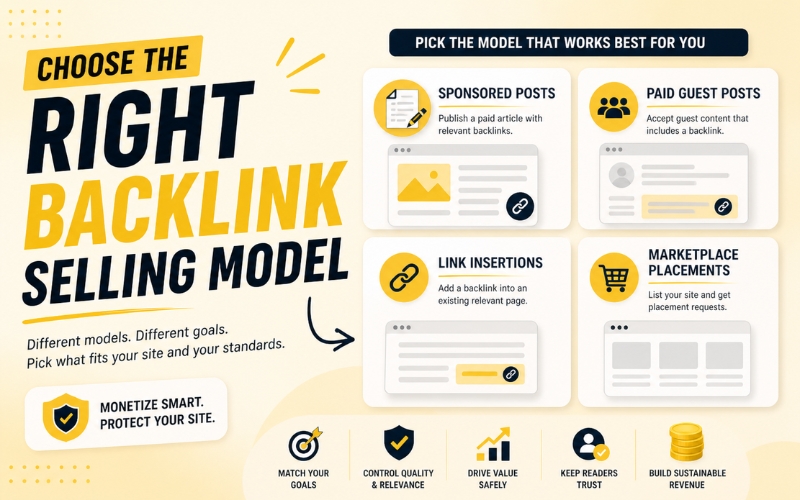
Link insertions involve adding a backlink to an existing article. This can be useful when the link genuinely improves the article, but it is easy to abuse. Only accept link insertions when the destination page is relevant and the link adds context.
Marketplace placements allow publishers to list their site and receive placement requests through a structured system. For publishers who want to sell backlinks through a more organized process, a marketplace can help centralize publisher details, placement options, and advertiser requests.
Some requests may not be backlink placements at all. If the content is mainly announcement-driven, publishers may need to consider whether a press release is a better format for that specific campaign instead of forcing the content into a sponsored guest post. For more context, see Are Press Releases Still Relevant?
Prepare Your Publisher Profile Before Selling
Before selling placements, prepare the information advertisers need to evaluate your site. A clear profile helps attract better-fit requests and reduces repeated questions.
Your profile should explain what your site covers, who reads it, and what types of topics perform well. Advertisers do not only care about metrics. They want to know whether their brand, content, and landing page fit your audience.
Include useful details such as:
- Main niche
- Audience type
- Monthly traffic range
- Top countries
- Content categories
- Publishing frequency
- Accepted placement types
- Rejected categories
- Link attribute policy
- Editorial review process
Make your placement options easy to understand. For example, you may offer sponsored articles, paid guest posts, link insertions, resource mentions, or content partnerships. If you work through a guest post marketplace, clear placement types make it easier for advertisers to compare options and submit the right request.
Your publisher profile should also include basic content and link rules. Mention accepted topics, minimum content standards, anchor text rules, review timelines, and whether you reserve the right to edit or reject submissions. The clearer your rules are, the easier it becomes to reject poor-fit requests without long back-and-forth discussion.
How To Price Backlinks And Sponsored Placements
Backlink pricing should reflect more than domain authority. A fair price depends on the value, risk, effort, and visibility of the placement.
Common pricing factors include:
- Website niche
- Organic traffic
- Audience quality
- Domain authority or domain rating
- Content quality
- Placement type
- Whether writing is included
- Editorial review effort
- Link position
- Placement duration
- Historical performance of similar content
A niche site with a loyal audience and clean editorial standards may justify strong pricing even if its authority metrics are lower than a broad general blog. On the other hand, a high-DR site with thin content and unrelated outbound links may be less valuable than it looks.
Publishers should create a pricing range rather than one fixed number for every request. Sponsored posts, link insertions, guest posts, and content packages can require different levels of work and review.
It is also worth separating content production from placement. If the publisher writes or edits the article, the price should reflect that effort. If the buyer provides the content, the publisher still needs to price the editorial review, formatting, compliance check, and publication process.
Where To Sell Backlinks
Once your rules, profile, and pricing are ready, the next step is choosing where to receive backlink or sponsored placement requests.
Many publishers receive direct emails from SEO teams, agencies, founders, and marketers asking about sponsored posts or link insertions. Direct requests can be useful, but they require strong filtering. Do not accept a request just because the buyer has a budget. Check the website, destination page, topic fit, anchor text, and content quality first.
A media kit or advertising page can help advertisers understand your audience, content options, and rules. This page should position your offering as sponsored content, advertising, partnerships, or publisher opportunities. Avoid language such as “buy dofollow backlinks” or “guaranteed SEO links.” That kind of wording can attract low-quality buyers and create an obvious footprint.
Backlink marketplaces connect advertisers and publishers in a more structured environment. SEONetwork is positioned as a marketplace that helps advertisers and publishers find, compare, and manage placement opportunities in a clearer workflow. For publishers, that structure can make selling placements more manageable, but it does not replace editorial judgment.
Professional networks can also generate placement opportunities. LinkedIn, SEO communities, niche founder groups, and partner networks can lead to sponsored content requests from more relevant buyers. A blogger outreach platform can also support discovery and communication when advertisers are looking for publisher relationships, guest post placements, or content partnerships.
How To Review A Backlink Request Before Accepting It
A backlink request should pass a review process before you accept payment. This protects your site and helps maintain consistent editorial standards.
Start with the buyer’s website. Is it a real business, useful resource, or relevant publication? Does it match your niche or audience? Does it look trustworthy? Be careful with websites that are thin, misleading, overloaded with affiliate pages, or unrelated to your readers.
Next, review the exact destination page. A buyer may have a decent homepage but want to link to a weak commercial page. Ask whether the page is useful, relevant to the article, aligned with the anchor text, and appropriate for your readers.
Then review the anchor text. It should fit naturally in the article. Avoid anchors that are too aggressive, too commercial, or disconnected from the surrounding sentence. If an advertiser insists on an exact-match anchor that does not read naturally, that is a warning sign.
Finally, check content quality. If the buyer provides content, review it like any other editorial submission. Look for generic writing, weak claims, poor formatting, keyword stuffing, or obvious AI filler. The article should be useful even without the backlink.
This review process is also useful for understanding how advertisers find publishers. Many advertisers use guest post search operators to discover sites, which is why publishers often receive similar outreach patterns and repeated pitch formats.
How To Publish Paid Backlinks Without Damaging Your Site
Publishing paid backlinks safely requires restraint. Even after approving a request, publishers should control how the content appears on the site.
Keep final editorial approval. Place links only where they fit naturally. Use proper link attributes for paid placements. Avoid publishing too many sponsored posts in a row. Keep regular editorial content active. Avoid linking to unrelated or questionable sites. Audit old sponsored links regularly.
This is where a broader off page seo checklist can help publishers think beyond individual placements and review how sponsored links, guest posts, outreach, and external signals fit into a cleaner SEO process.
The point is not to avoid monetization. The point is to avoid turning the site into a placement inventory with no editorial identity. A publisher’s long-term value depends on trust, relevance, and reader confidence.
Common Mistakes When Selling Backlinks
Selling backlinks carelessly can create problems quickly. Most issues come from weak filtering, unclear policies, or short-term thinking.
The first mistake is selling links to any website. Accepting every buyer makes your site look unfocused. If your website covers B2B marketing but starts linking to gambling, coupons, loans, or unrelated affiliate pages, your topical consistency suffers.
The second mistake is promising dofollow links for SEO value. Paid placements should be qualified when needed. A publisher should not make promises that conflict with long-term site quality or search guidelines.
The third mistake is accepting over-optimized anchor text. Exact-match anchors can look unnatural, especially when repeated across many paid placements.
The fourth mistake is publishing low-quality sponsored content. If readers repeatedly see thin, generic, or irrelevant paid articles, they may trust the publisher less.
The fifth mistake is pricing only by DR or DA. These metrics are useful proxies, but they do not measure editorial quality, audience trust, relevance, or placement fit.
How To Sell Backlinks: Quick Checklist
To sell backlinks responsibly:
- Build a website with real audience value.
- Define accepted niches and rejected categories.
- Create clear sponsored content guidelines.
- Use
rel="sponsored"ornofollowfor paid placements when appropriate. - Review every buyer website and destination page.
- Avoid spammy or over-optimized anchor text.
- Keep full editorial control over content.
- Price placements based on relevance, traffic, quality, and effort.
- Use marketplaces, direct requests, or partnerships to find buyers.
- Audit outbound links regularly.
- Reject requests that could weaken your site’s trust.
Selling backlinks should be selective. A publisher’s long-term value depends on trust, relevance, and content quality, not just the number of paid placements accepted.
Conclusion: Sell Backlinks Selectively, Not Carelessly
Selling backlinks can create revenue for publishers, but it should never come at the cost of website quality. The best approach is to set clear rules, review every request, protect editorial standards, and use proper link attributes for paid placements.
A strong publisher does not sell links to everyone. It accepts relevant opportunities that make sense for the audience, the article, and the website’s long-term positioning.
If you want a more structured way to manage publisher opportunities, SEONetwork can help connect advertisers and publishers through a link building marketplace built around clearer placement discovery and review.
For a related advertiser-side workflow, read How To Find Guest Post Opportunities That Are Worth Pursuing.
FAQ
Is Selling Backlinks Allowed?
Selling backlinks for advertising or sponsorship is not automatically a problem if the links are handled transparently and qualified properly. Google Search Central recommends marking paid links with rel="sponsored" or rel="nofollow" so they are not treated as attempts to manipulate ranking signals.
How Much Should I Charge For A Backlink?
Backlink pricing depends on niche, organic traffic, audience quality, domain authority, content quality, placement type, writing effort, and editorial review. Publishers should not price only by DR or DA because relevance and reader value often matter more.
Should You Sell Dofollow Backlinks?
Publishers should be careful about selling dofollow backlinks for SEO value. Paid links should generally use proper attributes such as rel="sponsored" or nofollow when there is a commercial relationship.
Where Can I Sell Backlinks?
Publishers can sell backlinks or sponsored placements through direct advertiser requests, media kit pages, professional networks, partnerships, and backlink marketplaces. The best channel depends on your niche, audience, editorial process, and quality standards.
What Is The Safest Way To Sell Backlinks?
The safest way to sell backlinks is to accept only relevant placements, keep editorial control, use natural anchor text, apply proper link attributes, reject low-quality buyers, and audit outbound links regularly.

I’m Jackson Avery, and I have 5 years of experience in content SEO. At SEONetwork, I share practical SEO knowledge, insights, and content strategies to help readers better understand search intent, content optimization, and sustainable organic growth.