
Guest post opportunities are relevant websites, publishers, or editorial openings where an external contribution can be accepted and published. The strongest opportunities are not always the sites that openly say “write for us.” They are placements with topical relevance, editorial standards, real audience value, and a natural reason to include your expertise. This guide explains how to find guest post opportunities, qualify them before outreach, and build a prospecting process focused on securing better placements rather than longer lists.
What Counts As A Guest Post Opportunity?
A guest post opportunity is any website, publisher, editor, contributor program, content gap, or relationship that could lead to a relevant article being published on a third-party site.
Many teams define guest post opportunities too narrowly. They only search for pages with phrases like “write for us,” “submit a guest post,” or “contribute to our blog.” Those pages can be useful, but they are only one source. Some strong opportunities come from blogs that publish outside experts, competitor backlink sources, guest author patterns, niche communities, publisher marketplaces, or direct relationships with editors.

The better question is not only whether a site accepts guest posts. The better question is whether the site is relevant, credible, and editorially suitable enough to make the placement worth pursuing.
A strong guest post opportunity should connect three things: the publisher’s audience, your content idea, and your SEO or brand goal. If one of those does not fit, the placement may look useful on paper but deliver little value in practice.
Start With Clear Guest Posting Criteria
Before searching for guest post opportunities, define what a good placement looks like for your campaign. Without clear criteria, prospecting can turn into a long list of websites with no real prioritization.
Start with your target niche and audience. A relevant guest post opportunity should have a logical connection to your topic, product, service, or market. That does not always mean the website must be in the exact same industry. A close adjacent niche can also work if the article angle makes sense.
For example, a SaaS company may not only target SaaS blogs. It may also consider websites about startups, productivity, business operations, marketing, or workflow automation, depending on the topic and target page.
A worthwhile opportunity usually has:
- Clear topical alignment
- Useful and edited content
- A consistent publishing focus
- Real signs of organic visibility or readership
- A natural reason to mention your topic
- Reasonable outbound link behavior
- A link context that would make sense to readers
If you are still building the larger framework behind your outreach work, this guide on Guest Posting Strategy: How To Build Links Without Chasing Low-Quality Placements can help you plan guest posting as part of a more structured SEO process.
Use Google Search Operators To Find Guest Post Opportunities
Google search operators are one of the simplest ways to find guest post opportunities. They help you uncover pages that mention contributor guidelines, guest author programs, or editorial submission details.
Start with basic searches such as:
[your niche] "write for us"
[your niche] "submit a guest post"
[your niche] "guest post guidelines"
[your niche] "contribute to our blog"
[your niche] "become a contributor"
[your niche] "guest author"
[your niche] "editorial guidelines"
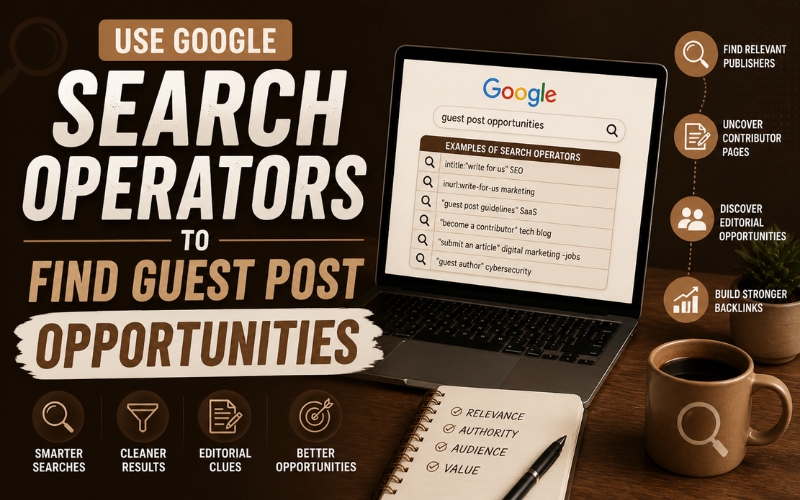
You can also use advanced operators to reduce irrelevant results:
intitle:"write for us" [your niche]
inurl:write-for-us [your niche]
inurl:guest-post [your niche]
site:.com "guest post guidelines" [your niche]
"become a contributor" "[your niche]"
"submit an article" "[your niche]" -jobs
"guest post" "[your niche]" -casino -coupon -directory
These searches are useful for building an initial list, but they should not be your only method. Public “write for us” pages are often heavily prospected, and some low-quality sites optimize specifically for those terms.
To find better opportunities, search for editorial clues beyond public submission pages:
"guest author" "[your niche]"
"contributed by" "[your niche]"
"author bio" "[your niche]"
"expert contribution" "[your niche]"
"contributor" "[your niche]"
These phrases can reveal websites that have accepted outside contributors before, even if they do not have a public guest post page.
Analyze Competitor Backlinks And Guest Author Patterns
Competitor backlinks can reveal websites that already link to similar businesses, topics, or content types. This makes them useful for finding guest post targets that have already been proven in your niche.
Start with competitors that have similar link goals, not only the biggest brands in your market. Look at direct competitors, content competitors, ranking pages for your target topics, and brands that publish guest content regularly.
When reviewing backlinks, look for patterns such as:
- Articles with external author bios
- Contextual links inside blog posts
- Contributor names that appear on multiple sites
- Posts with phrases like “guest author,” “contributed by,” or “written by”
- Content published on third-party industry blogs
Do not copy competitor links blindly. A competitor may have links from sites that are irrelevant, outdated, overloaded with sponsored posts, or weak from an editorial standpoint. Before adding a competitor backlink source to your prospect list, check whether the site is still active, relevant, useful, and suitable for your audience.
You can also follow active guest authors in your niche. If one author has published across several relevant websites, those websites may be open to outside contributions. Search the author’s name with phrases like “guest post,” “contributor,” “author bio,” or your niche keyword. This method is slower than scraping “write for us” pages, but it often leads to cleaner prospects.
Use Communities, Social Platforms, And Content Gaps
Not all guest post opportunities appear in Google search results. Some are discussed in LinkedIn posts, X threads, Facebook groups, Reddit communities, Slack groups, private networks, or niche forums.
Search for phrases such as:
"looking for contributors"
"accepting guest posts"
"guest post opportunity"
"contribute to our blog"
"looking for expert quotes"
"looking for guest authors"
Add your niche to make the results more relevant. For LinkedIn, look for posts from content managers, SEO managers, editors, founders, and publication owners. On Reddit and Facebook groups, pay attention to community rules before responding.

Specific calls for contributors are usually stronger than generic “guest posts accepted” claims. A useful call may mention a topic, deadline, audience, content series, expert quote request, or preferred contributor type.
You should also review content gaps on target websites. A strong guest post idea usually fits the site’s existing direction while adding something new. If a site already has several articles about link building basics, a better pitch may focus on a more specific angle, such as evaluating link relevance before outreach.
Different sites also prefer different formats. Some publish how-to guides, while others prefer opinion pieces, expert commentary, research summaries, checklists, or trend articles. If the content is mainly company news, a launch update, or a public announcement, a guide on how to write press release content may be more useful than forcing the idea into a guest post pitch.
Use SEO Tools And Marketplaces To Expand Your Prospect List
Manual search is useful, but it can be slow. SEO tools and structured marketplaces can help expand your prospect list, validate opportunities, and compare options more efficiently.
SEO tools can help you:
- Export competitor backlinks
- Find websites ranking for niche topics
- Identify blogs with organic traffic
- Review top-linked content in your industry
- Estimate traffic and keyword visibility
- Check suspicious traffic patterns
Tools can speed up discovery, but they cannot fully judge editorial fit. A site may look strong in metrics and still be a poor guest post opportunity if the content is thin, the audience is irrelevant, or outbound links look unnatural.
Manual prospecting can also become difficult when teams need to compare many publisher options, niches, pricing details, and placement conditions. A structured marketplace can help organize publisher discovery, comparison, and review. It should not replace manual judgment, but it can reduce the friction of scattered outreach notes, unclear placement options, and inconsistent prospect tracking.
The stronger approach is to combine data with human review. Use tools and marketplaces to discover options, then inspect the website, content quality, topical fit, and outbound link patterns before adding it to your outreach list.
Qualify Guest Post Opportunities Before Outreach
A prospect is not a real opportunity until it passes a quality review. This step should happen before outreach, not after a publisher responds.
Start with topical relevance. A website does not need to cover your exact product category, but it should have a reasonable connection to your topic or audience. If the relationship feels forced, the guest post may be difficult to justify editorially.
Then review organic traffic and ranking signals. You do not need every opportunity to have massive traffic, but the site should show signs of real search visibility or audience value. Be cautious with sites that have sudden traffic drops, irrelevant ranking keywords, many indexed pages with little value, or content that looks made only for links.
Editorial quality matters as much as metrics. Review recent articles and ask whether the content is useful, edited, consistent, and relevant. A site with poor editorial standards may accept your pitch easily, but that does not mean the placement is valuable.
Finally, check outbound link patterns. A healthy article may link to relevant tools, studies, brands, or examples. A weak article may link to unrelated commercial pages, casinos, coupons, adult content, or random websites across different industries. Paid or sponsored placements should also be handled transparently according to the publisher’s editorial rules and your own link policy.
Build A Guest Post Prospecting Sheet
A prospecting sheet helps turn research into a repeatable workflow. It does not need to be complicated, but it should help you compare opportunities consistently.
Track fields such as:
- Website name
- Website URL
- Contact page or editor contact
- Niche or category
- Relevance score
- DR or DA
- Estimated organic traffic
- Guest post page or contributor evidence
- Content quality notes
- Outbound link notes
- Suggested topic idea
- Target destination page
- Outreach status
- Publication status
- Final URL
You can also score each opportunity from 1 to 5 based on topical relevance, editorial quality, audience fit, organic visibility, link context, and strategic value.
This helps you avoid wasting time on easy but low-value opportunities. A smaller list of qualified prospects is usually more useful than a large list of weak sites.
Common Mistakes When Finding Guest Post Opportunities
The biggest problem with guest post prospecting is not a lack of websites. It is the lack of filtering.
One common mistake is relying only on “write for us” searches. These searches are useful, but many low-quality guest post sites optimize for those terms because they want to attract link buyers.
Another mistake is choosing sites based only on DR or DA. Authority metrics can help with comparison, but they do not prove quality. A high-DR site can still be irrelevant, spammy, or overloaded with paid content. A lower-DR niche site may provide a stronger placement if it has topical relevance, real readers, and cleaner editorial standards.
You should also avoid sites that look like link farms. Warning signs include articles across too many unrelated niches, excessive outbound links, thin content, no clear audience, weak author bios, and unnatural anchor text patterns.
Finally, do not send the same pitch to every website. A generic pitch suggests that you did not review the publisher’s audience, content style, or topic needs. Better prospecting should lead to better outreach.
How To Find Guest Post Opportunities: Quick Checklist
To find better guest post opportunities:
- Define your target niche, audience, and campaign goal
- Use Google search operators to find contributor pages
- Search for editorial clues beyond “write for us”
- Analyze competitor backlinks for proven targets
- Find active guest authors in your niche
- Search communities and social platforms for contributor calls
- Review content gaps on target websites
- Use SEO tools or marketplaces for discovery and validation
- Check topical relevance, organic visibility, and editorial quality
- Review outbound link patterns before outreach
- Track and score prospects in a structured sheet
- Remove weak, spammy, or irrelevant sites
A good prospect list should be useful, not just long. The strongest guest post opportunities are the ones that make sense for the publisher, the reader, and your SEO goal.
Conclusion: Prioritize Better Guest Post Opportunities, Not Longer Lists
Finding guest post opportunities is not about collecting as many websites as possible. It is about finding relevant, credible, and useful placements that can support a clear SEO or brand goal.
The best process combines several discovery methods: search operators, competitor backlink analysis, guest author research, communities, content gap review, SEO tools, and structured marketplaces. Each method can help you find new prospects, but every opportunity still needs manual review before outreach.
A strong prospecting workflow gives you more control. It helps you avoid weak sites, prioritize better publishers, and build guest post campaigns around relevance rather than volume. If your team is comparing opportunities across many publishers, SEONetwork can help bring more structure to the discovery and review process as a link building marketplace.
For publishers looking at the other side of guest posting and sponsored placement workflows, SEONetwork also supports site owners who want to sell backlinks through a more organized marketplace model.
>>> EXPLORE FURTHER: Learn how to sell backlinks while keeping publisher quality, editorial relevance, and placement standards clear.
FAQ
What Is The Best Way To Find Guest Post Opportunities?
The best way to find guest post opportunities is to combine Google search operators, competitor backlink analysis, guest author research, niche communities, SEO tools, and marketplace data. Relying only on “write for us” searches can limit your prospect list and increase the risk of low-quality placements.
How Do I Find Guest Post Sites In My Niche?
To find guest post sites in your niche, search for niche-specific contributor pages, analyze competitor backlinks, follow active guest authors, review relevant industry blogs, and look for communities where editors or site owners request expert contributions. After finding prospects, check topical relevance, editorial quality, organic visibility, and outbound link behavior.
Are “Write For Us” Pages Still Useful For Guest Posting?
Yes, “write for us” pages can still be useful, but they should not be your only source of guest post opportunities. Many strong publishers do not have public submission pages, while many low-quality sites optimize specifically for “write for us” searches.
How Do I Know If A Guest Post Opportunity Is Good?
A good guest post opportunity has topical relevance, useful content, editorial standards, signs of real visibility or readership, and a natural context for your link. If the site looks unrelated, thin, spammy, or overloaded with outbound links, it is usually not worth pursuing.
Should I Use Competitor Backlinks To Find Guest Post Targets?
Yes, competitor backlinks can help you find proven guest post targets, especially when competitors have earned links from relevant blogs or niche publications. However, you should not copy links blindly. Review each website for topical relevance, editorial quality, traffic signals, and outbound link patterns before adding it to your prospect list.
Can A Marketplace Help Find Guest Post Opportunities Faster?
Yes, a structured marketplace can help teams find and compare guest post opportunities faster, especially when manual prospecting becomes too slow. A marketplace can make publisher discovery and comparison more organized, but teams should still review topical relevance, content quality, and link context before choosing a placement.

I’m Jackson Avery, and I have 5 years of experience in content SEO. At SEONetwork, I share practical SEO knowledge, insights, and content strategies to help readers better understand search intent, content optimization, and sustainable organic growth.