
How long does it take for SEO to work? The short answer: most websites start seeing meaningful movement in rankings and traffic somewhere between three and six months. For more competitive niches or newer sites, that window extends to six to twelve months or longer.
But that range only tells part of the story. The actual timeline depends heavily on where your site stands today, how competitive your niche is, and how much quality SEO work is being done consistently. This guide breaks down what to expect at each stage, what speeds things up or slows them down, and how to tell whether your SEO is working even before rankings visibly move.
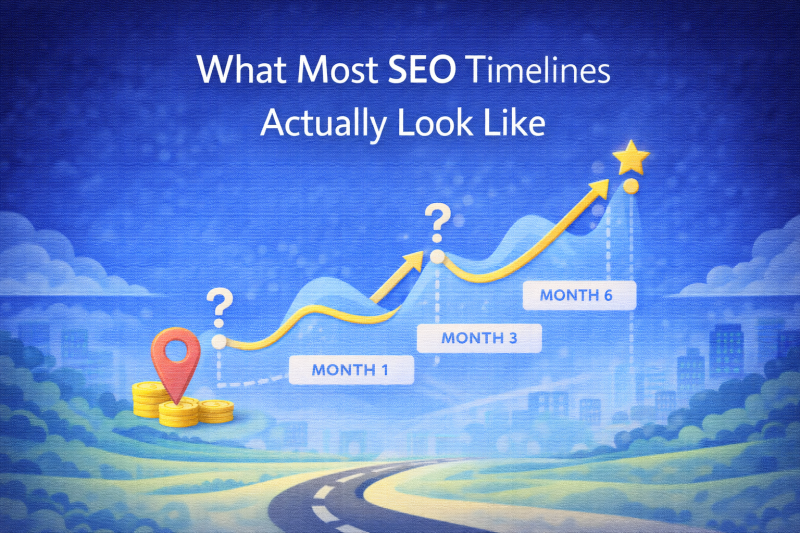
What do most SEO timelines actually look like?
SEO does not switch on at a fixed point. It builds gradually, and different types of progress happen at different stages.
Months 0 to 3: foundations and early signals
In the first three months, the focus is on getting the basics right: fixing technical issues, publishing optimised content, and making sure Google can crawl and index your site correctly. You may not see ranking movement yet, but this is when the groundwork gets laid.
Google needs time to discover new content, assess its quality, and factor it into rankings. For a new site, this stage can feel like nothing is happening. That is normal. What matters is that impressions in Google Search Console start to climb, more pages get indexed, and crawl activity increases.
Months 3 to 6: early movement
This is typically when SEO starts to show visible signs of working. Rankings begin to shift, particularly for lower-competition and long-tail keywords. Organic traffic may still be modest, but the direction should be upward.
If you are not seeing any movement at this point, it is worth auditing whether the work being done is actually addressing the right issues, whether content is matching search intent, and whether there are unresolved technical problems holding the site back.
Months 6 to 12: meaningful organic growth
For most sites doing SEO consistently and correctly, this is the window where organic traffic becomes a reliable channel. Target keywords move into positions that generate real clicks, and some of that traffic begins to convert.
This stage also tends to compound. Content published in month two starts ranking in month seven. Backlinks built earlier begin contributing to authority. The work done upfront starts paying off in visible ways.
Month 12 and beyond: sustained growth
SEO results accumulate over time. A site that has been doing solid SEO for twelve months is in a fundamentally stronger position than one that started three months ago, not just because of rankings, but because of the content library, backlink profile, and domain authority built up along the way.
The important distinction to keep in mind: SEO starting to work and SEO delivering business results are not the same moment. You might see ranking movement at month four, but meaningful revenue impact could come at month nine or later depending on your conversion funnel and the keywords you are targeting.
Factors that affect how long SEO takes
Two sites doing the same SEO work can see very different timelines. These are the variables that explain most of that gap.
Domain age and existing authority
An established site with an existing backlink profile and indexed content will see results faster than a brand new domain. New sites go through what is sometimes called a sandbox period, where Google takes longer to trust and rank their content. This is not a penalty, it is simply how the system works.
Competition in your niche
A local service business targeting a mid-sized city is competing in a very different environment from an e-commerce site going after high-volume commercial keywords. Lower competition means faster results. In highly competitive niches, twelve to eighteen months before seeing significant traction is realistic, not unusual.
Content quality and publishing frequency
Publishing content that genuinely serves search intent, at a consistent pace, shortens the timeline. Thin content, keyword-stuffed pages, or content that does not match what the searcher is actually looking for will not rank regardless of how long you wait.
Technical SEO health
A site with crawl errors, slow load times, broken internal links, or indexing issues will underperform relative to its content quality. Technical problems act as a ceiling on what SEO can achieve. Fixing them early removes friction from the entire process.
Backlink profile
Backlinks remain one of the strongest ranking signals. Sites with more authoritative and relevant backlinks tend to rank faster and hold positions more reliably. Building a quality backlink profile takes time, which is one reason SEO results do not arrive overnight.
How much work is actually being done
There is a significant difference between running SEO properly and doing just enough to say it is being done. Inconsistent publishing, slow technical fixes, and minimal link building will produce slow, unpredictable results. Consistent, well-prioritised work produces a more predictable curve.
>>> DIVE DEEPER: How to Do SEO Optimization: A Step-by-Step Guide – SEONetwork
Does Yoast SEO make results come faster?
This is a common question, and it comes from a reasonable but understandable misunderstanding of what Yoast actually does.
Yoast SEO is a WordPress plugin that helps you implement on-page SEO elements correctly: title tags, meta descriptions, canonical URLs, XML sitemaps, structured data, and readability checks. It is a useful tool for making sure your on-page setup is technically sound.
What Yoast does not do is directly influence how quickly Google ranks your content. The plugin creates the conditions for good on-page SEO, but it does not replace the need for quality content, a clean technical setup, or a strong backlink profile.
Installing Yoast and following its recommendations will not shorten your SEO timeline on its own. What it does is help you avoid common on-page mistakes that could otherwise slow things down. Think of it as removing a potential obstacle, not as an accelerator.
If you are using Yoast and not seeing results, the issue is almost certainly not the plugin. The more productive question to ask is whether the content itself matches search intent, whether the site has technical issues beyond on-page, and whether there is any off-page authority being built.
How long does SEO take for medical websites?
Medical websites operate under a different set of expectations from Google because they fall under the YMYL category: Your Money Your Life. Pages that could directly affect someone’s health, safety, or financial decisions are held to a higher standard of quality and trustworthiness.
The practical implication is that medical SEO typically takes longer than average, and the factors that matter most are different from a standard niche site.
Realistic timeline for medical SEO
Where a standard site might start seeing meaningful results at six months, a medical website should expect that window to be closer to nine to twelve months, with sustained, competitive results coming at twelve to eighteen months or beyond. This is not a hard rule, but it reflects how Google approaches YMYL content.
What actually determines the timeline
- E-E-A-T signals: Google evaluates Experience, Expertise, Authoritativeness, and Trustworthiness especially closely for medical content. Author credentials, professional affiliations, and clear editorial standards all contribute. Content written by or reviewed by qualified medical professionals will perform better than generic health articles.
- Backlinks from authoritative medical sources: Links from medical journals, health institutions, government health agencies, and established medical publications carry significant weight. These are harder to acquire than links in other niches, which is part of why medical SEO takes longer.
- Content accuracy and sourcing: Citing credible, up-to-date sources is not just good practice, it is a relevance and trust signal. Outdated medical content or content without proper sourcing will struggle regardless of other SEO factors.
Publishing more content will not compensate for weak E-E-A-T. In medical SEO, credibility is the foundation, and there is no shortcut around it.
What you can do to see results faster
You cannot force SEO to work overnight, but you can make decisions that bring results closer rather than pushing them further out.
Target lower-competition keywords first
Long-tail and informational keywords with lower difficulty give new or less authoritative sites a realistic path to ranking in the near term. Early wins build domain authority and content momentum that makes targeting harder keywords easier later.
Fix technical issues early
Technical problems compound over time. A crawl error that goes unaddressed for six months is six months of lost indexing opportunity. Prioritise a technical audit at the start and address issues in order of severity.
Publish content consistently and to the right intent
Sporadic publishing produces sporadic results. A consistent publishing schedule, even at modest volume, outperforms bursts of content followed by long gaps. Every piece of content should be mapped to a clear search intent before it is written.
Build backlinks from the start, not as an afterthought
Many sites treat link building as something to focus on after content is built up. In practice, building authority in parallel with content production produces faster results than sequencing them. Quality matters far more than volume.
For teams that need to scale link building without the overhead of manual outreach, SEONetwork provides a structured way to connect with relevant publishers and manage placements more efficiently than traditional methods.
Monitor signals and adjust early
Do not wait until month six to check whether the strategy is working. Google Search Console data from the first few weeks tells you which pages are being indexed, which queries you are appearing for, and whether your content is being found at all. Early signals allow for early corrections.
>>> READ MORE: Best Place to Buy Backlinks, Buy Guest Posts & Backlink Services | SEONetwork
Signs that your SEO is working, even before rankings move
One of the most common frustrations in SEO is doing the right work and not being able to show progress. Rankings are a lagging indicator. These signals appear earlier and are worth tracking and reporting in the meantime.
Impressions are climbing in Search Console
Impressions measure how often your pages appear in search results, regardless of whether they get clicked. Growing impressions means Google is finding your content relevant to more queries over time. This often precedes ranking movement by weeks or months.
More pages are being indexed
If Google is regularly discovering and indexing new content, the crawl is working correctly and your site is being treated as an active, credible source. A flat or declining indexed page count is a warning sign worth investigating.
Crawl activity is increasing
Googlebot visiting your site more frequently is a signal that it considers your content worth checking regularly. You can observe this through server logs or through the crawl stats report in Google Search Console.
Branded search is appearing
When people start searching for your brand by name, it signals growing awareness and trust. Branded queries in Search Console indicate that your content or your site is being remembered and sought out directly.
On-site engagement is improving
Users spending more time on your pages and lower bounce rates suggest the content is matching what they were looking for. This behavioural signal feeds back into how Google evaluates the quality of your pages.
These metrics give you a data-backed way to demonstrate progress to stakeholders before the ranking numbers catch up.
When SEO is taking longer than expected?
Patience is genuinely required in SEO, but there is a difference between a normal timeline and a timeline that is being held back by an actual problem.
Signs something may be wrong rather than just slow
- Key pages are not appearing in Google Search Console at all, or have been removed from the index.
- Traffic has dropped significantly following a Google algorithm update.
- Rankings have been flat with no movement across any keywords despite months of consistent work.
- The site received a manual action notification in Search Console.
Common reasons SEO underperforms
- Thin or duplicate content: Pages that do not provide genuine value or that duplicate content found elsewhere on the site or web will not rank.
- Toxic backlink profile: A high volume of low-quality or spammy backlinks can suppress rankings. A backlink audit and disavow process may be needed.
- Unresolved technical issues: Crawl blocks, redirect chains, slow load times, and mobile usability problems that have not been addressed act as a persistent drag on performance.
- Keyword cannibalisation: Multiple pages targeting the same keyword compete against each other and dilute ranking signals. Consolidation or clear differentiation is the fix.
- Misaligned content and intent: Content that does not match what the searcher is actually looking for will not hold rankings even if it initially appears for a query.
When to review strategy rather than just wait
If there has been no measurable progress of any kind across six months of consistent, well-executed work, it is time to review the strategy rather than extend the timeline. That review should look at technical health, content quality, competitive positioning, and whether the keywords being targeted are realistic given the site’s current authority.
The bottom line on SEO timelines
Three to six months for early signals. Six to twelve months for meaningful organic growth. Twelve months and beyond for sustained, compounding results. Those are the realistic benchmarks for a site doing SEO correctly and consistently.
What moves the timeline in your favour is starting with solid technical foundations, publishing content that genuinely matches search intent, and building quality backlinks steadily rather than in bursts. What extends it is ignoring technical debt, publishing without a clear strategy, and treating link building as optional.
SEO is a long-term investment. The results are not linear, but they accumulate. A site that commits to doing this correctly for twelve months will be in a substantially stronger position than one that does it halfway for twice as long.
If you are at the stage where off-page authority is the next priority and want a more structured approach to managing placements than manual outreach allows, SEONetwork is worth looking at as a platform built specifically for that part of the process.
Check our Link Marketplace for the most balance and safest link building strategies.
>>> YOU MAY ALSO LIKE:
- How to Learn SEO: A Practical Roadmap for Beginners – SEONetwork
- What Makes a Good Landing Page in 2026?

I’m Jackson Avery, and I have 5 years of experience in content SEO. At SEONetwork, I share practical SEO knowledge, insights, and content strategies to help readers better understand search intent, content optimization, and sustainable organic growth.