
What Is Anchor Text?
Anchor text meaning in SEO
Anchor text is the visible, clickable text attached to a link. Instead of showing a full raw URL, a page may link to another resource through a word or phrase such as “technical SEO checklist” or “internal linking guide.”
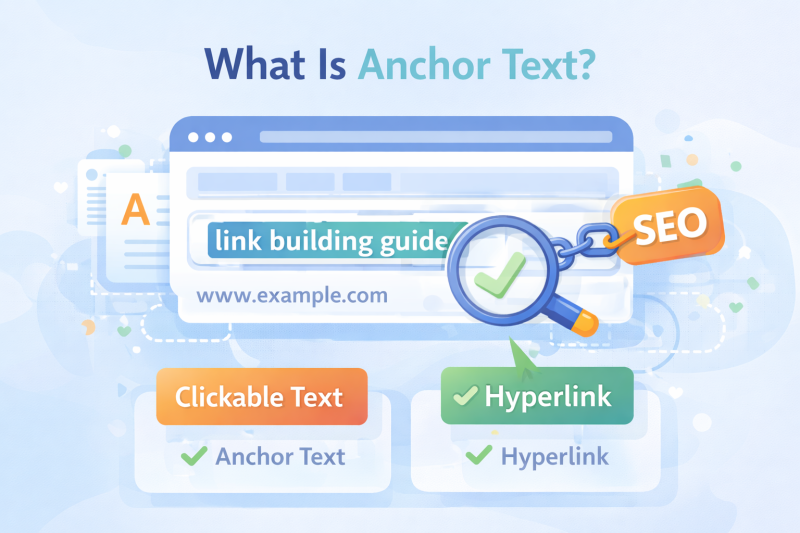
From an SEO perspective, anchor text matters because it adds meaning to the link. It tells readers what kind of page they are about to visit, and it helps search engines understand the relationship between the linking page and the destination page.
That is why what is anchor text in SEO is slightly different from a basic web definition. In SEO, anchor text is not only a usability element. It is also a relevance signal.
Simple anchor text examples
Here are a few simple examples:
- “Learn more about on-page SEO basics”
- “See our backlink quality checklist”
- “Read the full internal linking guide”
In each case, the bolded phrase is the anchor text. It gives context before the click happens.
A weaker example would be:
- “Click here”
- “Read this”
- “Visit page”
These are still anchors, but they do not give much meaning to users or search engines.
Why anchor text matters
Anchor text matters because it improves clarity. Good anchor text helps readers decide whether a link is worth opening. It also makes content easier to scan, especially in longer articles where people want quick answers.
For SEO, anchor text can support:
- Better topical relevance between pages
- Stronger internal linking structure
- Clearer signals about page purpose
- A more natural reading experience
That does not mean every anchor needs a keyword. It means every anchor should have a reason to exist.
How Anchor Text Helps SEO
How anchor text gives context to linked pages
Search engines look at many signals when understanding a page, and anchor text is one of them. When one page links to another using a descriptive phrase, that phrase helps explain what the destination page is about.
For example, linking to a page with the anchor “how to audit backlinks” gives clearer context than linking with “read more.” The first version tells both users and search engines what to expect.
This is especially useful with internal links. If your site has several related articles, anchor text helps connect them in a meaningful way instead of creating random pathways.
How search engines read anchor text
Search engines do not treat anchor text as a magic ranking shortcut. It is one signal among many. Still, it can reinforce topical alignment when used naturally and consistently.
In practice, search engines may use anchor text to better understand:
- The subject of the linked page
- The relationship between linked pages
- Whether the link appears contextually relevant
- Whether the anchor pattern looks natural or manipulative
That last point matters. When anchor text is forced, repeated too aggressively, or stuffed with exact-match keywords across many links, it may stop being helpful and start looking unnatural.
Anchor text for users vs SEO
A good rule is to write anchor text for people first and let SEO follow from that. The best anchors are usually the ones that make sense in the sentence, match the surrounding topic, and preview the linked page accurately.
When people can understand a link without guessing, the anchor is doing its job.
That is why good anchor text sits in the overlap between usability and SEO. It should be descriptive enough to guide the reader, but natural enough to fit the sentence without sounding engineered.
>>> EXPLORE FURTHER: Buy Backlinks, Buy Guest Posts & Backlink Services | SEONetwork
Main Types of Anchor Text
Exact match
Exact match anchor text uses the exact target keyword of the linked page.
Example: linking to a page targeting “anchor text best practices” with the anchor anchor text best practices.
This can be useful in moderation, especially when the phrase fits naturally. The problem starts when the same exact phrase appears too often across multiple links.
Partial match
Partial match anchor text includes a variation or part of the target keyword.
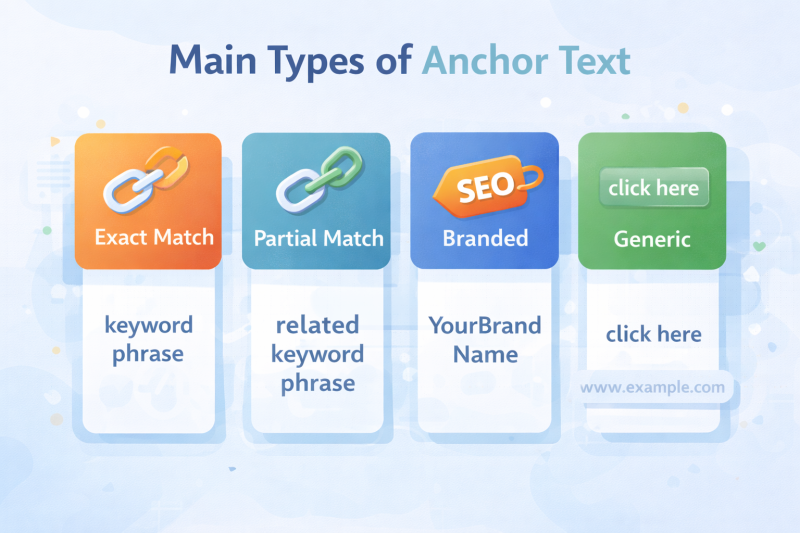
Example: best practices for anchor text or how to optimize anchor text.
This type often feels more natural than exact match because it gives you room to match real sentence flow while still keeping topical relevance.
Branded
Branded anchor text uses a brand name.
Example: SEONetwork or SEONetwork platform.
Branded anchors are common in editorial mentions, citations, and homepage links. They often look more natural than keyword-heavy anchors, especially in external link building.
Generic and naked URL
Generic anchor text includes phrases like:
- click here
- read more
- learn more
Naked URL anchors show the full web address, such as a raw homepage URL.
These types are not automatically bad, but they are usually less informative. Generic anchors may still work in the right context, though they should not dominate your content. Naked URLs can be fine when referencing a brand or source directly, but they are not usually the clearest option inside educational content.
What Makes a Good Anchor Text?
Relevance and clarity
Good anchor text tells the truth about the linked page. It should reflect what the user will actually find after clicking.
If the link goes to a guide about internal linking, the anchor should suggest that. If the page is about backlink evaluation, the anchor should not imply something unrelated.
Clear anchors reduce friction. Misleading ones damage trust.
Natural keyword use
Keywords can appear in anchor text, but they should not feel forced. The goal is not to cram the target phrase into every link. The goal is to use words that fit both the sentence and the linked page.
For example, this feels natural:
- “You can review these anchor text best practices before updating older pages.”
This feels forced:
- “Use what is anchor text in SEO to improve your what is anchor text strategy.”
The second version sounds written for a machine instead of a person. That usually makes the content weaker, not stronger.
Variation and readability
Strong anchor text profiles usually have variation. On a real website, not every internal or external link should use the exact same phrase.
Variation helps because:
- It makes writing more natural
- It avoids repetitive link patterns
- It reflects how people actually reference topics
- It creates a healthier mix of descriptive language
Readable anchor text is usually short to medium in length, direct, and integrated into the sentence without disrupting flow.
>>> EXPLORE FURTHER: How to Do SEO Optimization: A Step-by-Step Guide – SEONetwork
Common Anchor Text Mistakes
Over-optimized exact match anchors
One of the most common mistakes is using the same exact keyword anchor again and again. This often happens when people treat anchor text as a ranking lever instead of part of a useful reading experience.
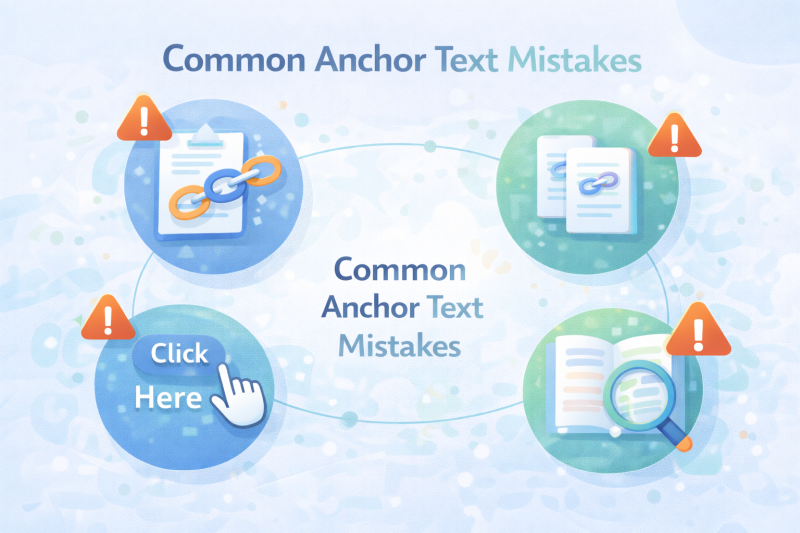
Exact match anchors are not inherently wrong. The issue is overuse. When every link points to a page with the same phrase, it can look manipulative and make the content feel repetitive.
Repeating the same anchor text too often
Even outside of exact match keywords, repetitive anchors can weaken content. If several different pages all use the same link phrase, readers may not know how those pages differ.
Anchor text should help distinguish topics, not blur them together.
For internal links especially, repetition is usually a sign that the site structure or content mapping needs more thought.
Using vague anchors like “click here”
“Click here” is not always harmful, but it usually adds very little value. It tells readers what action to take, not what they will get.
In most cases, descriptive anchor text is a better choice because it improves accessibility, clarity, and topical context.
Compare these two examples:
- “Click here for more details.”
- “Read our guide to internal link optimization.”
The second one is clearer immediately.
Anchor Text Best Practices for Smarter Link Building
Best practices for internal links
For internal linking, anchor text should help users move to the next relevant page naturally. It works best when it connects related ideas, not when it is dropped in just to create another link.
A few practical guidelines:
- Link only when the destination page adds real value
- Use descriptive phrases that fit the paragraph
- Avoid forcing the same keyword every time
- Match anchor wording to search intent where possible
- Keep internal linking consistent across related topics
This is also where content planning helps. A site with clear topic clusters will usually produce better anchor text because each destination page has a defined purpose.
Internal link opportunity: link from this article to a related page such as what are backlinks, internal linking best practices, or how to evaluate link quality.
Best practices for backlinks
For backlinks, anchor text needs even more balance. A backlink profile filled with aggressive exact-match anchors can look unnatural. A healthier mix often includes branded anchors, partial match anchors, topical phrases, and natural editorial wording.
At SEONetwork, we see this matter most when SEO teams are comparing placements. A link is not only about where it appears. It is also about whether the context, page topic, and anchor text make sense together. Stronger link decisions usually come from looking at the full placement environment, not just chasing one keyword anchor.
That is one reason structured link buying tends to work better than guesswork. When you can review page fit, topic relevance, and anchor usage more clearly, it becomes easier to avoid low-quality patterns.
Soft CTA to explore structured link placements on SEONetwork
If your team is trying to build links with more clarity, this is where structure matters. SEONetwork is built to help SEO teams and site owners review placements more clearly, compare relevant opportunities, and make link decisions with better context instead of relying only on manual outreach.
Internal link opportunity: link here to the main advertiser page or a related page about choosing quality backlink placements.
FAQ
Is anchor text still important for SEO?
Yes. Anchor text still matters because it helps users understand links and gives search engines context about linked pages. It is not the only signal that matters, but it is still a useful one.
Can bad anchor text hurt rankings?
Bad anchor text can contribute to weaker SEO outcomes if it becomes misleading, over-optimized, or unnaturally repetitive. More often, it hurts clarity and user experience first, which can also weaken overall content quality.
What is the best anchor text for internal links?
The best anchor text for internal links is usually descriptive, relevant, and natural within the sentence. It should tell readers what the linked page is about without sounding forced.
Conclusion
Anchor text is the clickable text in a link, but in SEO, it does more than make navigation possible. It helps explain page relationships, improves usability, and supports stronger internal and external linking when used with care.
The best anchor text is clear, relevant, and natural. It matches the page being linked to, fits the sentence around it, and avoids the kind of repetition that makes content feel over-optimized. For teams working on SEO at scale, getting anchor text right is less about tricks and more about making better editorial decisions.
If you are reviewing link opportunities and want a more structured way to assess placement context, anchor fit, and page relevance, SEONetwork is one practical place to start.
Check our Link Marketplace for the most balance and safest link building strategies.

I’m Jackson Avery, and I have 5 years of experience in content SEO. At SEONetwork, I share practical SEO knowledge, insights, and content strategies to help readers better understand search intent, content optimization, and sustainable organic growth.