
What Are SEO Citations? They are online mentions of your business details, usually your name, address, and phone number, across directories, maps, and other third-party websites. In local SEO, they help reinforce business accuracy, visibility, and trust across the web.
SEONetwork views citations as a local SEO foundation, not a numbers game. This article explains how they work, why consistency matters, and what businesses should actually focus on when building or cleaning them up.
What Is Citation in SEO?
In local SEO, a citation usually means an online mention of your business’s core details on another website.
That is the most practical answer to both what are seo citations and what a citation in seo. A citation is not some separate technical object hidden inside search algorithms. It is simply your business being represented online in places where people and search engines may encounter it.
Most citations include your business name, address, and phone number. Some also include your website URL, opening hours, business category, service area, or other profile information. The exact format can vary, but the main purpose stays the same: helping your business appear consistently across the web.
Why SEO Citations Matter
Citations matter because local SEO depends on more than one source of truth. Your website may explain who you are, what you do, and where you are located, but local search engines also evaluate how consistently your business appears across the wider web.
That does not mean citations are a magic shortcut. They are not. But they do help reinforce business identity, support discoverability, and strengthen the local SEO foundation around your website and Google Business Profile.
In practical terms, citations help search engines feel more confident that your business is real, active, and represented consistently. They also help users find your business on platforms they already trust, such as maps, directories, industry websites, and local media.
>>> READ MORE: Buy Backlinks for SEO, Buy Guest Posts & Backlink Services | SEONetwork
The Working Definition Most Businesses Should Use
If you need a simple definition you can actually use, this is the one worth keeping:
An SEO citation is an online mention of your business’s key details, usually your name, address, and phone number, and sometimes your website URL, opening hours, category, or other profile data.
That definition matters because it keeps citation work grounded in reality. You are not trying to “build citations” in the abstract. You are trying to make sure important sources online show the right business information in the right places.
Structured and Unstructured Citations
Not all citations look the same, and this is where many businesses start mixing different ideas together.
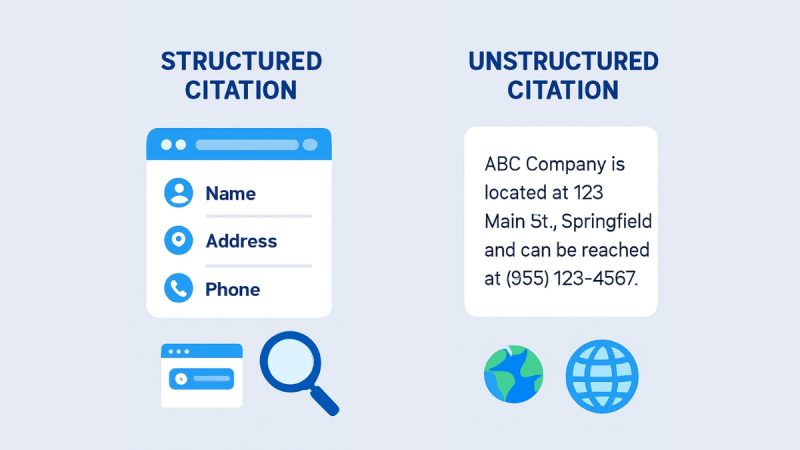
Structured citations
Structured citations are the standard business listings most people think of first. These are the formal profiles and directory entries on platforms such as Google Business Profile, Yelp, Facebook, Apple Maps, Bing Places, and other local or industry listing sites.
These are usually the easiest citations to audit and manage because the format is predictable. You can check whether your business name, address, phone number, website, hours, and categories are correct without guessing where the information lives.
Unstructured citations
Unstructured citations are less formal mentions of your business on websites that are not built specifically as business directories.
This could be a local news story that mentions your business, a neighborhood blog that refers to your store, a city guide that includes your brand in a list of recommendations, or an interview where your business appears in context. These mentions may not follow a clean listing format, but they can still reinforce your presence and credibility.
The key point is that both types can matter. Structured citations are easier to manage. Unstructured citations often feel more natural and can strengthen broader local visibility.
What Information Should a Citation Include?
The core of a citation is usually your business name, address, and phone number, often shortened to NAP.
That said, not every citation needs to include every possible detail to be useful. Some will be full business listings with many fields. Others may be partial mentions that still clearly refer to the same business.
The practical rule is simple: your most important listings should be as complete as possible, and your other mentions should be clear enough that both users and search engines can recognize the same business identity.
For most businesses, the most important citation fields are:
- Business name
- Address
- Phone number
- Website URL
- Business category
- Opening hours
If those details are stable and accurate on your major profiles, you are already in a much better position than a business with dozens of inconsistent listings.
Do SEO Citations Need a Link?
No. A citation does not need a backlink to be useful.
This is one of the most common misunderstandings around citations. Many businesses confuse citations with backlinks and assume a listing only matters if it links directly to the site. In local SEO, that is too narrow.
A citation can still help by reinforcing business identity, consistency, and discoverability even if there is no clickable link attached. Backlinks and citations can overlap, but they are not the same thing. A citation may include a link, but it does not need one in order to serve its local SEO purpose.
Where Should Businesses Build Citations First?
A practical citation strategy works best in layers.
The first layer should always be your Google Business Profile, because it is the most important local business listing and often the foundation of local search visibility.
The second layer is the group of major general platforms and directories that people in your market actually use. Depending on your country and industry, that may include places like Yelp, Facebook, Apple Maps, Bing Places, and a small number of widely recognized business platforms.
The third layer is made up of local and industry-specific sources. This is where citation work becomes more strategic. A law firm, dental clinic, plumber, restaurant, or real estate business should not all pursue the same supporting directories. The best citation sources are often the ones most relevant to your business category and location.
This layered approach is much more useful than chasing volume. The strongest citation strategy usually starts with the biggest and most trusted sources, then expands selectively into the places that are most relevant to your market.
>>> READ MORE: Off Page SEO Checklist: What To Review, Build, And Improve
What Makes a Citation Stronger or Weaker?
Not all citations are equally useful.
A stronger citation is usually accurate, visible, relevant, and tied to a trusted source. It clearly points to the same real business you are trying to rank locally. It appears on a site people recognize, or at least one that makes sense within your industry or location.
A weaker citation is usually one of the following: outdated, duplicated, incomplete, inconsistent, or placed on a low-quality website that few users trust and few businesses in your niche actually care about.
This is why a business with fifty messy listings can still be in a worse position than a business with fifteen strong, clean, and relevant citations. In local SEO, quality and consistency usually matter more than raw count.
Citation Consistency Matters, but Not in a Paranoid Way
Consistency matters because the whole point of citations is to reinforce a stable business identity.
If your business has one phone number on your site, another on an old directory, and a third on a forgotten profile page, that creates confusion. The same is true for old addresses, duplicate locations, or slightly different business names that make it look like several businesses instead of one.
At the same time, it is important not to become too rigid. Minor formatting differences are not usually the real problem. Search engines are generally capable of understanding small variations such as abbreviations or punctuation differences.
The practical rule is this: fix the inconsistencies that change your real business identity, such as the wrong phone number, old address, duplicate listing, or mismatched name. Do not waste time obsessing over every tiny formatting detail if the business is still obviously the same.
A Practical Citation Cleanup Workflow
If your local business has never handled citations properly, the best next step is usually cleanup before expansion.
Start with the official business details on your website and your Google Business Profile. Make sure those are correct first. Then audit the major listings where customers are most likely to find you. Fix outdated information, remove duplicates where possible, and standardize the most important details.
After that, improve or add the local and industry-specific listings that are actually relevant to your business.
This is usually much more effective than building more citations on top of bad existing ones. More listings do not solve messy data. They often just spread the mess further.
Common Citation Mistakes to Avoid
One common mistake is turning citation work into a numbers game. More citations are not automatically better. The quality of the source, the consistency of the data, and the relevance of the listing usually matter more than the raw count.
Another mistake is confusing citations with backlink campaigns. A directory profile can include a link, but the purpose of citation work in local SEO is broader than link equity alone. If your only question is whether a listing gives a followed link, you are usually missing the real value of the citation.
A third mistake is leaving inaccurate information live for too long. Outdated phone numbers, incorrect addresses, duplicate profiles, and incomplete listings weaken trust and create confusion.
A fourth mistake is submitting to directories that are not relevant just because they exist. Not every business needs the same citation sources. Industry fit and local relevance matter far more than random directory volume.
What a Business Should Do Next
If you are a business owner or local marketer, the next step is not to submit your business to every directory you can find. The better next step is to make sure your business information is correct on the sources that matter most.
Start with your Google Business Profile and your official on-site contact information. Then review the main directories and profiles where customers actually look for businesses in your market. Clean up duplicates, fix outdated data, and expand only into relevant local and industry-specific sources.
That is usually the most useful citation workflow for real local SEO. It is cleaner, more realistic, and much easier to maintain than a blind directory submission campaign.
In practice, SEO citations are online mentions of your business details across directories, maps, business profiles, and other third-party websites, especially in local SEO. They matter not because they are a magic ranking trick, but because they help reinforce a consistent business identity, improve discoverability, and support local prominence alongside reviews, links, and complete business information.
The most effective way to work with citations is to focus on the important sources first, keep your core data accurate, avoid duplicate clutter, and separate educational citation content from service-intent pages when planning your site structure.
At SEONetwork, we usually see better local SEO decisions when businesses stop treating citations as either a magic shortcut or a meaningless checkbox. Looking at them through the lens of accuracy, relevance, visibility, and page intent tends to produce a cleaner local SEO foundation and better support for broader growth pages.
Check our Backlink Platform for the most balance and safest link building strategies.
FAQs
What are SEO citations?
In local SEO, citations are online mentions of a business’s core details on third-party websites, usually including name, address, and phone number, and sometimes other profile information.
What is citation in SEO?
It usually means the same thing: a business mention used in local SEO to reinforce identity, consistency, and visibility across the web.
Do citations need a backlink?
No. A citation can still be useful without a backlink because the mention itself helps connect the business to a consistent online identity.
Are citations still important for local SEO?
Yes, but mainly as part of a broader local SEO foundation that includes accurate business information, reviews, prominence signals, and relevant external presence.
What matters more, more citations or better citations?
Better citations. Accurate, relevant, trusted, duplicate-free listings on important sources usually matter more than sheer volume.

I’m Jackson Avery, and I have 5 years of experience in content SEO. At SEONetwork, I share practical SEO knowledge, insights, and content strategies to help readers better understand search intent, content optimization, and sustainable organic growth.