
Finding SEO clients is not a problem most people solve once and move on from. It is an ongoing process that requires the right channels, the right positioning, and enough consistency to build momentum over time.
The challenge is not a shortage of potential clients. Businesses across every industry need SEO, and most of them are not getting it done well. The real challenge is standing out clearly enough that the right prospects find you, trust you, and choose to work with you over everyone else offering the same service.
This guide covers how to get SEO clients through multiple channels, from inbound content to local outreach to LinkedIn, so you can identify what fits your current stage and build from there.
Define Your Positioning Before You Start Looking for Clients
Most agencies and freelancers start prospecting before they have answered a more fundamental question: who exactly are you trying to work with?
Without a clear answer, outreach feels generic, proposals land flat, and even warm leads go cold because the prospect cannot see why you specifically are the right fit for them.

Positioning does not mean turning away work. It means being specific enough that the right clients immediately recognize you as relevant. A few practical ways to define it: choose a vertical (SEO for SaaS companies, SEO for law firms, SEO for e-commerce brands), choose a service type (local SEO, technical SEO, content-led SEO), or choose a company size and budget range you are genuinely set up to serve well.
The more specific your positioning, the shorter your sales cycle tends to be. Prospects who self-identify in your niche come in with less skepticism, ask fewer qualification questions, and convert at a higher rate. It feels counterintuitive to narrow your focus when you are trying to grow, but it almost always produces faster results.
Build Inbound Channels That Attract Clients Consistently
Inbound is slower to build than outbound, but it compounds. A well-ranked page, a strong referral network, or a solid presence on a review platform keeps generating leads without ongoing effort. The goal is to have at least one inbound channel working before you need to rely entirely on active outreach.
Rank your own website for the right terms
If you are an SEO professional and your own site does not rank, that is a credibility problem with prospects before you even start a conversation. Your website is the most visible case study you have.
Target terms like “SEO agency for [industry],” “local SEO services in [city],” or “technical SEO consultant.” These are the searches your ideal clients are running when they are actively looking for help. A single well-ranked page in your niche can generate more qualified leads per month than most outreach campaigns.
Alongside ranking, use your site to publish case studies that show real results. Organic traffic numbers, ranking improvements, revenue impact wherever you can attribute it. Prospects evaluating SEO agencies are naturally skeptical. Concrete, specific outcomes do more to build trust than any amount of positioning copy.
Ask for referrals from existing clients
Referrals convert at a higher rate than almost any other channel and cost almost nothing to generate. The issue is that most people either do not ask or ask at the wrong time.
The right time to ask for a referral is after you have delivered a result the client is genuinely happy about, not at the start of an engagement, not in a general check-in, and not at contract renewal. When a client tells you they are pleased with what you have done, that is the moment to ask directly whether they know anyone else who might benefit from the same kind of help.
Beyond client referrals, build relationships with agencies in complementary disciplines: web design studios, PPC agencies, PR firms, and brand consultancies. They regularly work with clients who need SEO and have no one to refer them to. A handful of strong agency partnerships can generate a consistent stream of warm introductions without any cold outreach on your part.
Get listed on directories and review platforms
Clutch, UpCity, and G2 are where many mid-market businesses go when they are evaluating agencies. A complete profile with verified reviews creates passive lead flow that builds over time.
You do not need to be on every platform. Pick two or three where your target clients actually search, optimize your profile fully, and focus on accumulating genuine reviews from past clients. A profile with fifteen detailed reviews outperforms one with fifty brief ones. The quality of what reviewers say matters more than the quantity.
>>> EXPLORE FURTHER: Buy Backlinks, Buy Guest Posts & Backlink Services | SEONetwork
How to Get Local SEO Clients
Local SEO clients are often the most accessible starting point, particularly for freelancers and smaller agencies. Competition for local business clients is lower than in broader markets, the buying decision is usually made by one person, and the need is concrete and easy to demonstrate.
The best way to find local prospects is to do the research before you make contact. Search Google Maps for businesses in a category you want to target. Look at who ranks poorly for their core local terms compared to their direct competitors. A restaurant that does not appear in the local pack when people search for the cuisine it serves, a law firm that is invisible for the practice area it specializes in, a dental clinic with no Google reviews, these are businesses with an obvious problem you can help solve.
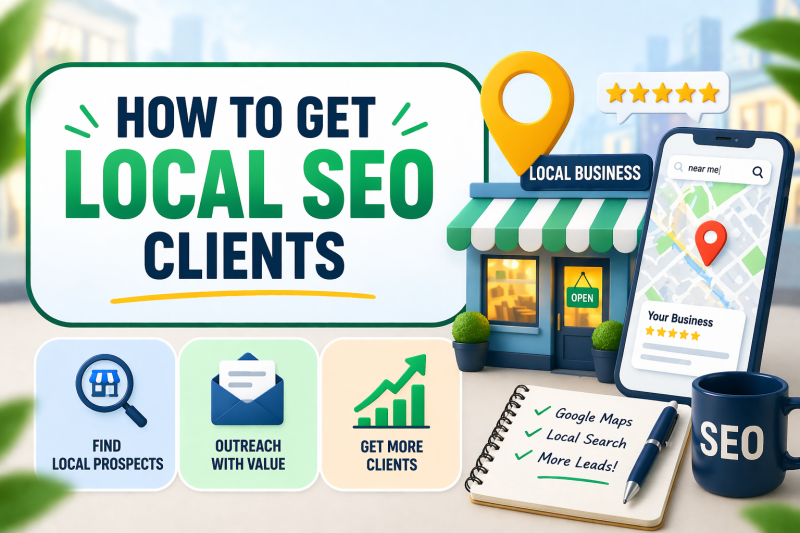
When you reach out, lead with the finding, not the pitch. Send a brief message or email that references something specific about their current situation: “I noticed your business does not appear in Google results when people search for [service] in [city], while your competitors [name them] do.” This approach demonstrates competence immediately and gives the prospect a reason to respond.
Local business networking is also underused. Chamber of commerce events, BNI chapters, and industry-specific local groups regularly bring together business owners who are actively looking for marketing help. Being present in these spaces consistently, rather than attending once or twice, is what makes it pay off.
How to Get SEO Clients on LinkedIn
LinkedIn is one of the most effective channels for reaching the people who actually make agency buying decisions: marketing managers, CMOs, heads of growth, and founders at companies with real SEO budgets. It is less useful for very small local businesses, but for B2B-focused agencies or those targeting mid-market companies, it is worth investing in seriously.
Before you do any outreach, make sure your profile is set up correctly. Your headline should state clearly who you help and with what, not your job title. Your about section should speak to your ideal client’s situation, not summarize your career history. Anyone who lands on your profile as a result of your outreach needs to understand immediately what you do and whether it is relevant to them.
The most effective LinkedIn outreach is not the most common kind. Sending a connection request followed immediately by a pitch is the fastest way to get ignored. Instead, spend time engaging genuinely with content that your target clients and their peers are posting. Leave comments that add something rather than just agreeing. This creates familiarity before you ever send a direct message, and it means when you do reach out, you are not a stranger.
When you do message someone, do not pitch in the first message. Reference something specific, a post they wrote, a challenge their company is publicly working through, a niche you both operate in, and open a conversation. The goal of the first message is to get a reply, not to close a deal.
If you want to scale LinkedIn outreach systematically, LinkedIn Sales Navigator makes it significantly easier to find and filter the right contacts. It is worth the cost once your ICP is clearly defined. Using it before you know exactly who you are targeting is less effective.
Creating content on LinkedIn aimed at your ideal client’s pain points is also a longer-term play worth running in parallel. Posts that address common SEO misconceptions, share results from campaigns, or explain how to evaluate SEO agencies are the kind of content that builds credibility with exactly the people you want to be talking to.
How to Get SEO Clients Without Cold Calling
Cold calling works for some people in some contexts, but it is not the only path, and for many SEO professionals, it is not the most efficient one. If you prefer not to cold call, several approaches can be equally or more effective depending on how you execute them.
Personalized cold email remains one of the most scalable outreach channels when done properly. The keyword is personalized. A cold email that references something specific about the recipient’s website, their ranking situation, a recent piece of content they published, or a competitor they are visibly losing ground to will consistently outperform a templated message. You are demonstrating that you have done work before asking for their time.
Sending an unsolicited SEO audit is a more time-intensive version of this approach but often generates stronger responses. A two-page document that identifies three or four specific issues on a prospect’s site, explains why they matter, and briefly sketches how you would approach fixing them is a much more compelling opening than any email that simply describes your services.
Podcast guesting, speaking at local business events, and contributing to industry publications are all ways to build authority and generate inbound interest without direct outreach of any kind. These take longer to produce results but tend to attract higher-quality prospects because the relationship starts from a position of demonstrated expertise rather than interruption.
Partnering with complementary agencies is the most overlooked non-cold-calling strategy. A web design agency that regularly builds sites for businesses in your target market has clients who need SEO immediately after launch. A PPC agency has clients who would benefit from organic search supporting their paid campaigns. These partnerships generate warm introductions at a fraction of the effort of finding cold prospects.
How to Get More SEO Clients by Scaling What Already Works
Once you have landed your first few clients and identified which channels are actually bringing them in, the priority shifts from experimentation to amplification. Trying to run six acquisition channels simultaneously at an early stage spreads attention too thin. Identifying what is working and doing more of it is almost always the right move before expanding.
If referrals are generating your best clients, build a more deliberate referral process. Create a simple template for asking, set a reminder to ask after every successful delivery, and consider whether a formal referral incentive makes sense for your context.
If content is driving inbound leads, invest in producing more of it at a higher frequency, targeting a wider range of terms in your niche, and distributing it more actively on the channels your prospects use.

Case studies organized by industry are one of the most effective sales assets for scaling client acquisition. A prospect in the legal industry who can read about results you drove for another law firm will convert significantly faster than a prospect reading a generic case study. Where possible, build a library of case studies across the verticals you serve and use them selectively in outreach and proposals.
Lead magnets can also generate consistent pipeline when matched to the right audience. A free site audit tool, an SEO readiness checklist, or a guide to evaluating SEO agencies gives prospects a reason to engage before they are ready to buy, and it gives you a reason to follow up.
How to Get SEO Clients for Your Digital Marketing Agency
Agencies have a structural advantage that freelancers often do not: an existing client base. Clients who are already working with you on PPC, paid social, web development, or content production are the warmest possible SEO prospects. The trust is already established, the relationship is active, and expanding a service relationship is a much shorter conversation than acquiring a new client from scratch.
Start by auditing your current client list for businesses that are paying for traffic through ads but not investing in organic. The pitch is straightforward: paid traffic stops the moment the budget stops. SEO builds an asset that compounds over time. That framing resonates particularly well with founders and CMOs who are cost-conscious about their marketing spend.
Agency clients also have different expectations from freelance clients. They typically want structured reporting, clear deliverables, defined timelines, and a named point of contact who can coordinate across teams. When packaging SEO services for an agency context, make sure these elements are explicit. Vague deliverables are the most common reason agency client relationships break down early.
When scaling SEO delivery across multiple clients simultaneously, the off-page work, particularly link building, is where most agencies hit operational friction. Manual outreach does not scale cleanly above a certain volume. Platforms like SEONetwork make this part more manageable by giving agencies a structured way to find, evaluate, and place backlinks across multiple campaigns, without the overhead of running individual outreach for each client.
>>> READ MORE: How to Do SEO Optimization: A Step-by-Step Guide – SEONetwork
Common Mistakes That Slow Down Client Acquisition
Pitching before building any trust is the most common mistake. Sending a cold message that jumps straight to services and pricing asks the prospect to make a buying decision before they have any reason to trust you. The first interaction should establish relevance and open a conversation, not close a sale.
Not having visible proof of results is the second most common barrier. If a prospect cannot find evidence that you have produced real outcomes for real clients, the sales conversation starts from a position of skepticism that is difficult to recover from. Case studies, client testimonials, and your own site’s ranking performance all serve as proof. At minimum, you need one.
Targeting too broad an audience makes every part of the process harder: messaging is less specific, proposals feel generic, and close rates drop. The narrower your initial focus, the faster your results will compound.
Underpricing to win clients is a trap that compounds over time. Low-priced clients are often more demanding, less patient, and harder to retain than clients who pay market rates. They also crowd out capacity for better opportunities. Pricing that reflects the value of the work you do attracts clients who are invested in the outcome.
FAQ
How long does it take to get the first SEO client?
It depends heavily on which channels you use and how clearly you are positioned. Someone with an existing network who asks for referrals and sends targeted outreach can land a first client within a few weeks. Someone starting entirely from inbound content and cold outreach with no existing relationships should expect the process to take two to three months. The timeline compresses significantly once you have one or two clients and can use their results as proof.
Should I specialize in a niche to get more clients?
Yes, particularly at the early stage. Specializing makes your positioning clearer, your outreach more relevant, and your close rate higher. You do not need to turn away clients outside your niche, but having a primary niche makes it much easier to build a reputation, get referrals within an industry, and create case studies that resonate with new prospects. Generalist positioning is harder to act on for prospects who are trying to evaluate whether you understand their specific situation.
What should I include in an SEO proposal for a new client?
A strong SEO proposal includes a summary of the client’s current situation based on your audit, the specific goals you are working toward and how you will measure them, a clear breakdown of deliverables and what is included in each, a timeline for when they can expect to see movement, your pricing and what it covers, and at least one relevant case study. Keep it focused. A shorter proposal that addresses the prospect’s specific situation directly is more effective than a lengthy document that covers every service you offer.
Is cold email still effective for getting SEO clients?
Yes, when it is genuinely personalized. A cold email that references something specific about the recipient’s site, their ranking situation, or their competitive position gets a meaningfully higher response rate than a templated message. The volume-based spray-and-pray approach does not work well for SEO services because the decision requires trust and the emails are easy to identify as generic. One well-researched email to a targeted prospect consistently outperforms a hundred generic ones.
How much should I charge for SEO services?
Pricing depends on your market, your experience, the scope of work, and the type of client you are targeting. For freelancers starting out, a common range for monthly retainers is $500 to $1,500 for small local businesses and $1,500 to $3,000 for small to mid-sized businesses with broader needs. Established agencies working with mid-market companies typically charge $3,000 to $8,000 per month or more depending on the scope. Avoid pricing by the hour for ongoing SEO work. Retainer-based pricing is more predictable for both sides and better reflects the value of sustained effort over time.
How do I get SEO clients when I have no portfolio?
Start by building one before you approach paying clients. Offer a heavily discounted or free engagement to one or two businesses you have a relationship with, document the process and results thoroughly, and use that as your first case study. You can also work on your own site or a side project to demonstrate ranking ability. A before-and-after showing meaningful organic growth is more persuasive than any credentials or certifications. Most clients care about whether you can produce results, not about how long you have been doing it.
Getting SEO clients is ultimately a compounding process. The first few are the hardest because you are building positioning, proof, and process simultaneously. Once those are in place, referrals become easier to generate, inbound channels start to produce, and outreach converts at a higher rate because you have something concrete to point to.
Start with one or two channels that fit your current situation, build results, and expand from there. A focused approach at the beginning almost always outperforms trying to run every acquisition channel at once.
Check our Link Marketplace for the most balance and safest link building strategies.

I’m Jackson Avery, and I have 5 years of experience in content SEO. At SEONetwork, I share practical SEO knowledge, insights, and content strategies to help readers better understand search intent, content optimization, and sustainable organic growth.