
Domain Authority vs Authority Score (AS) are two third-party metrics used to measure the overall strength of a website’s backlink profile and its likelihood to rank in search results. DA is developed by Moz, while Authority Score is Semrush’s equivalent, and although both use a 0 to 100 scale, they differ in methodology, data sources, and how they should be interpreted in practice. This guide covers what each metric measures, how they compare, what a good score looks like, how to check domain authority for free, and how to increase domain authority over time.
What Is Domain Authority?
Domain Authority, commonly abbreviated as DA, is a metric developed by Moz. It predicts how likely a website is to rank in search engine results pages, based primarily on the quality and quantity of backlinks pointing to that domain.
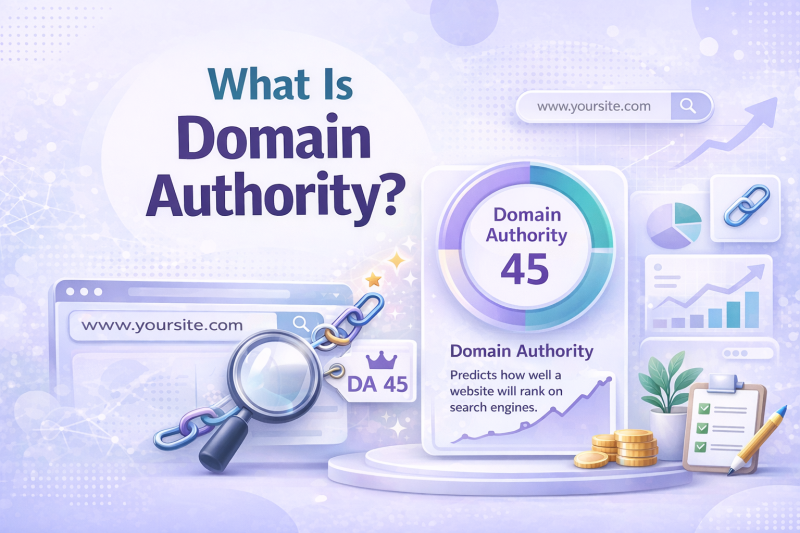
DA is scored on a scale of 0 to 100. The scale is logarithmic, which means moving from 20 to 30 is relatively straightforward, but moving from 70 to 80 requires significantly more effort. New websites typically start with a DA of 1, while established authoritative sites like Wikipedia or Google sit at 90 and above.
The score is calculated using a machine learning model that factors in:
- The number of unique domains linking to your site
- The quality and authority of those linking domains
- The overall link profile of your site compared to all other sites in Moz’s index
One important clarification: DA is not a Google metric. Google does not use Domain Authority in its ranking algorithm. DA is Moz’s own proprietary prediction tool, designed to correlate with rankings but not directly tied to how Google evaluates your site. Treating DA as a Google signal is one of the most common misconceptions in SEO.
What Is Authority Score?
Authority Score, abbreviated as AS, is Semrush’s equivalent metric. Like DA, it measures the overall strength and trustworthiness of a domain on a scale of 0 to 100. But the methodology behind it differs from Moz’s approach.
Semrush calculates Authority Score using three main components:
- Link power: The quality and quantity of backlinks pointing to the domain, including the authority of linking domains and the number of referring domains
- Organic traffic: Estimated organic search traffic to the domain, which Semrush factors in as a signal of real-world relevance
- Spam factors: Detection of unnatural or low-quality link patterns that might indicate manipulative link building
The inclusion of organic traffic data is the most notable difference from DA. Authority Score attempts to reflect not just a site’s link profile but also its actual performance in search, making it a slightly broader measure of domain strength.
Like DA, Authority Score is not a Google metric. It is Semrush’s proprietary scoring system and should be treated as a reference point, not an absolute measure of SEO health.
Domain Authority vs Authority Score: Key Differences
Understanding where these two metrics diverge helps you use them more effectively in your SEO workflow.
Origin and tool. DA comes from Moz. AS comes from Semrush. If your team uses Moz for link research, you will naturally work with DA more often. If Semrush is your primary tool, AS will be the default reference point. Neither is universally superior. The value of each depends largely on the size and quality of the tool’s underlying link index.
Methodology. DA is calculated almost entirely from link data. AS incorporates link data plus organic traffic estimates and spam detection. This means two sites with similar link profiles can have different Authority Scores if one generates significantly more organic traffic than the other.
Volatility. DA can fluctuate noticeably when Moz updates its index or recalibrates its model. Because the score is relative, meaning it is calculated in comparison to all other sites in Moz’s index, changes to other sites can affect your DA even if nothing on your site has changed. Authority Score tends to be somewhat more stable because it incorporates multiple data signals rather than relying primarily on link data.
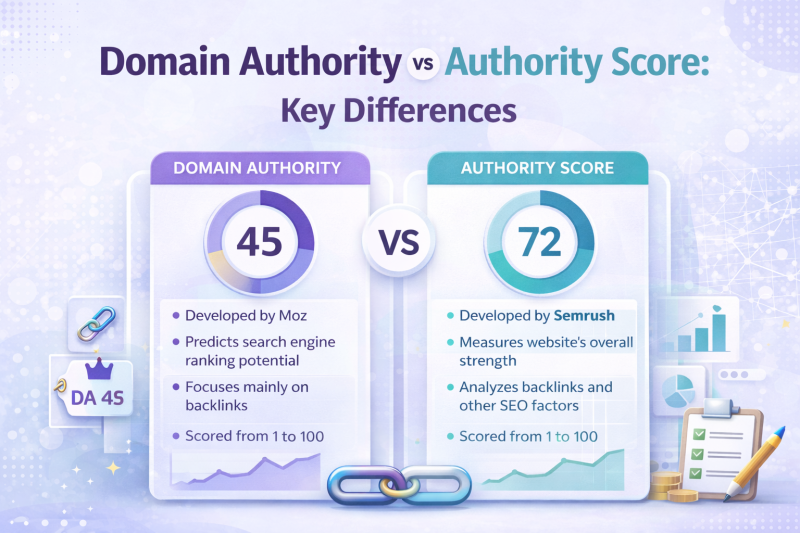
Industry adoption. DA has been around longer and is more widely recognized across the industry. Many publishers and link building marketplaces still use DA as the default reference point when pricing placements or assessing site quality. Authority Score is gaining ground as Semrush’s market share grows, but DA remains the more commonly cited metric in outreach and marketplace contexts.
When to use each. Use DA when working within Moz’s ecosystem or when communicating with partners who reference it as a standard. Use Authority Score when doing competitive research in Semrush or when you want a metric that incorporates traffic data alongside link strength. In practice, most experienced SEOs reference both alongside Ahrefs’ Domain Rating (DR) to get a more complete picture.
What Is a Good Domain Authority Score?
This is one of the most frequently asked questions about DA, and the honest answer is: there is no universal good score. A DA of 30 might be strong in a niche with low-authority competition, and a DA of 60 might be weak if your competitors are all sitting at 70 and above.
That said, a general reference framework looks like this:
DA 1 to 20: New or relatively unknown sites with limited backlink profiles. Normal for sites under a year old or sites that have not invested in link building.
DA 21 to 40: Sites with a developing backlink profile. Starting to gain traction but still building authority. Most small to medium blogs and local business sites fall in this range.
DA 41 to 60: Established sites with a solid backlink profile. Competitive in many niches. Sites in this range can rank for moderately competitive terms with good on-page SEO and content quality.
DA 61 to 80: Strong, well-established sites. Typically major industry publications, large e-commerce sites, or well-funded brands with consistent content and link building programs.
DA 81 to 100: Reserved for the most authoritative domains on the web. Major news outlets, government sites, universities, and platforms like Wikipedia and YouTube sit in this range.
The more useful question is not “what is a good DA?” but “what is my DA relative to the sites I am competing against?” If your competitors for a target keyword have an average DA of 45 and you are at 40, the gap is manageable. If they average 70 and you are at 25, link authority is likely one of several factors holding you back.
A common mistake is treating DA as the primary success metric for an SEO campaign. DA should be a diagnostic tool and a competitive reference point, not the end goal.
How to Check Domain Authority
There are several ways to check DA and Authority Score depending on which tools you have access to.
Checking DA with Moz. The most direct way is through Moz’s Link Explorer at moz.com/link-explorer. Enter any domain and you will see its DA alongside other link metrics like linking domains and inbound links. Moz also offers a browser extension called MozBar that displays DA directly in search results and on any page you visit.
Checking Authority Score with Semrush. In Semrush, enter a domain into the Domain Overview tool. The Authority Score appears at the top of the report alongside organic traffic estimates, backlink totals, and keyword rankings. You can also use the Backlink Analytics tool for a more detailed breakdown of the link profile behind the score.
Checking Domain Rating with Ahrefs. While not DA or AS, Ahrefs’ Domain Rating (DR) is widely used alongside both metrics. Enter a domain in Ahrefs’ Site Explorer to see DR, referring domains, and backlink data. Many SEOs cross-reference DA, AS, and DR together for a more complete view of domain strength.
How to Check Domain Authority Free
If you do not have a paid subscription to Moz or Semrush, there are still several ways to check domain authority at no cost.
MozBar (free Chrome extension). MozBar is Moz’s free browser extension. It displays DA and Page Authority (PA) for any site you visit and overlays these metrics directly in Google search results. It is one of the most practical free tools for quick DA checks during research or prospecting.
Moz Link Explorer (free tier). Moz offers limited free access to Link Explorer without a paid subscription. You can run a small number of queries per month to check DA, see top linking domains, and review basic link data. The free tier is sufficient for occasional checks but becomes limiting quickly if you are doing regular link prospecting.
Semrush free account. Semrush offers a free account with limited daily queries. You can check Authority Score for a domain through the Domain Overview tool, though the data available is more restricted than a paid plan.
Other free tools. Several third-party tools aggregate DA data and allow free checks, including Ubersuggest (which displays Moz DA), Small SEO Tools, and Website SEO Checker. These tools pull from Moz’s API, so the DA data is the same as checking directly through Moz, though the surrounding features vary.
The main limitation of free checks is volume. If you are prospecting a large list of sites for link building or running a site audit, free tier limits will slow you down. For one-off checks or small-scale research, the free options are entirely adequate.
How to Increase Domain Authority
Increasing DA is a byproduct of building a stronger, more trustworthy website overall. There is no shortcut, but the inputs are well understood.
Build backlinks from high-authority domains. The single biggest driver of DA growth is acquiring backlinks from sites that already have strong link profiles. A link from a DA 70 site carries significantly more weight than ten links from DA 10 sites. Focus on quality over quantity. Guest posting, digital PR, original research, and creating genuinely linkable content are the most sustainable ways to earn high-quality backlinks at scale.
For teams looking to streamline this process, SEONetwork provides a structured way to find and compare placement options across publishers with verified authority metrics, which removes much of the manual back-and-forth involved in traditional outreach.
Diversify your referring domain profile. Moz’s algorithm rewards a wide range of unique domains linking to your site. Fifty links from fifty different domains is more valuable than fifty links from the same five domains. When building links, prioritize reaching new domains rather than repeatedly acquiring links from the same sources.
Remove or disavow toxic backlinks. Low-quality, spammy, or irrelevant backlinks can drag down your DA and trigger spam signals in tools like Semrush. Conduct periodic backlink audits to identify and remove links that could be hurting your profile. Use Google’s Disavow Tool for links you cannot remove manually.
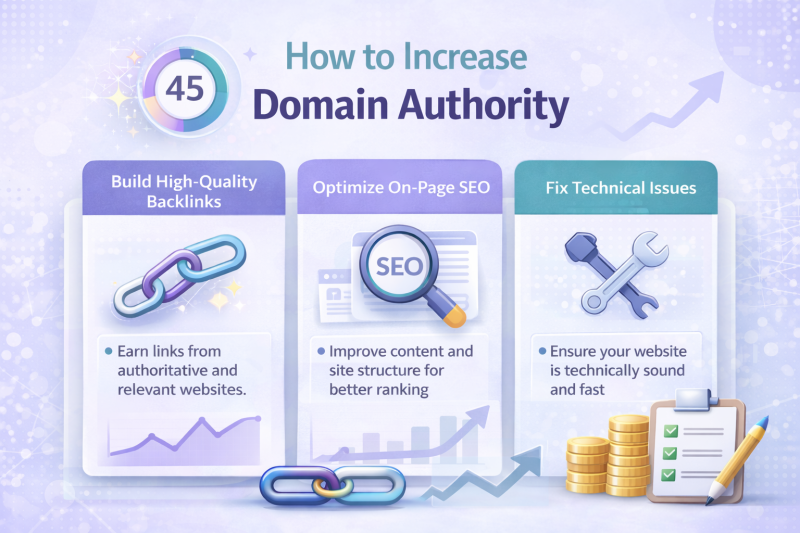
Strengthen your internal linking structure. A well-structured internal link network helps distribute authority across your site more effectively and signals to search engines that your content is organized and coherent. Cornerstone pages that receive consistent internal links from supporting articles accumulate authority more efficiently.
Create content that earns links naturally. Original research, comprehensive guides, data-driven studies, and tools tend to attract backlinks without active outreach. This kind of content works as a long-term asset, continuing to generate links and improve your DA over time with minimal ongoing effort.
Be patient. DA does not move quickly. Meaningful improvements typically take months, not weeks. Sites with very low DA can see faster movement early on, but as you climb higher on the scale, progress slows because the metric is logarithmic and relative to the entire web. Consistency over time matters more than short-term bursts of link activity.
Should You Obsess Over Domain Authority?
The short answer is no. The longer answer requires some context.
DA and Authority Score are useful reference points. They give you a quick, rough sense of how a site compares to others in terms of link strength. They are practical for competitive analysis, for evaluating potential link partners, and for tracking your own site’s progress over time at a high level.
But they are third-party metrics, not Google signals. Your DA can drop overnight when Moz updates its index, even if your actual SEO health has improved. Your Authority Score can differ significantly from your DA. And neither metric tells you anything definitive about whether you will rank for a specific keyword.
The SEOs who get the most value from these metrics are the ones who use them as one input among many. They cross-reference DA with DR and AS, they look at actual ranking performance, they assess content quality and search intent alignment, and they use domain authority metrics primarily for competitive benchmarking and link prospecting rather than as a campaign success metric.
Focus on building a site that deserves a high DA: strong content, a clean technical foundation, a diverse backlink profile from relevant sources, and a clear topic structure. The score follows the work, not the other way around.
Final Thoughts
Domain Authority and Authority Score measure similar things in different ways. DA is Moz’s link-focused prediction metric. Authority Score is Semrush’s broader measure that incorporates traffic and spam signals alongside link data. Neither is a Google ranking factor, and neither should be treated as the ultimate measure of SEO success.
What matters is understanding what each metric tells you, where it falls short, and how to use it practically. Check your DA and Authority Score regularly, benchmark them against your competitors, and use them to guide your link building priorities. But keep the focus on the fundamentals: quality content, strong backlinks, and a well-structured site.
Check our Link Building Marketplace for the most balance and safest link building strategies.
Frequently Asked Questions
Is Domain Authority the same as Authority Score?
No. Domain Authority is a metric created by Moz, while Authority Score is created by Semrush. Both use a 0 to 100 scale and measure domain strength, but they use different methodologies. DA focuses primarily on link data, while Authority Score incorporates link data, organic traffic estimates, and spam detection.
Does Google use Domain Authority as a ranking factor?
No. Domain Authority is a proprietary metric created by Moz and is not used by Google in its ranking algorithm. It is a third-party prediction tool designed to correlate with search performance, but it does not directly influence how Google ranks your pages.
How often does Domain Authority update?
Moz updates its index and recalculates DA periodically, typically every few weeks. Because DA is a relative metric, your score can change even if nothing on your site has changed, simply because other sites in Moz’s index have gained or lost links.
What is the difference between Domain Authority and Page Authority?
Domain Authority measures the strength of an entire domain. Page Authority (also from Moz) measures the strength of a specific page. Both use the same 0 to 100 scale and similar methodology, but DA reflects your site’s overall link profile while PA reflects the link equity pointing to a single URL.
Can I increase Domain Authority quickly?
Not sustainably. DA growth is driven by acquiring high-quality backlinks from diverse, authoritative domains over time. There are no shortcuts that produce lasting results. Tactics like buying large volumes of low-quality links may cause a temporary fluctuation but typically do more harm than good to your overall SEO health.
How is Domain Rating different from Domain Authority?
Domain Rating (DR) is Ahrefs’ equivalent metric. Like DA, it measures domain strength based on backlink data, but Ahrefs uses its own index and methodology. DR, DA, and Authority Score often produce different scores for the same domain because each tool has a different link index and calculation approach. Most SEOs use all three as reference points rather than relying on any single metric.
>>> YOU MAY ALSO LIKE:
- Buy Backlinks, Buy Guest Posts & Backlink Services | SEONetwork
- Off Page SEO Checklist: What To Review, Build, And Improve – SEONetwork

I’m Jackson Avery, and I have 5 years of experience in content SEO. At SEONetwork, I share practical SEO knowledge, insights, and content strategies to help readers better understand search intent, content optimization, and sustainable organic growth.