Manual outreach link building is the process of finding relevant websites, evaluating whether they are actually worth contacting, and reaching out directly to secure backlinks or content opportunities. It still works when relevance, editorial fit, and relationship-sensitive outreach matter more than raw speed, but it becomes inefficient quickly when prospect qualification is weak. This article explains how manual outreach works, where it still makes sense, and what teams need to get right before treating it as a serious acquisition strategy.
What Is Manual Outreach Link Building?
Manual outreach link building is a hands-on way of acquiring backlinks by identifying relevant websites and contacting them directly instead of relying only on automated outreach, passive link attraction, or pre-listed publisher inventory.
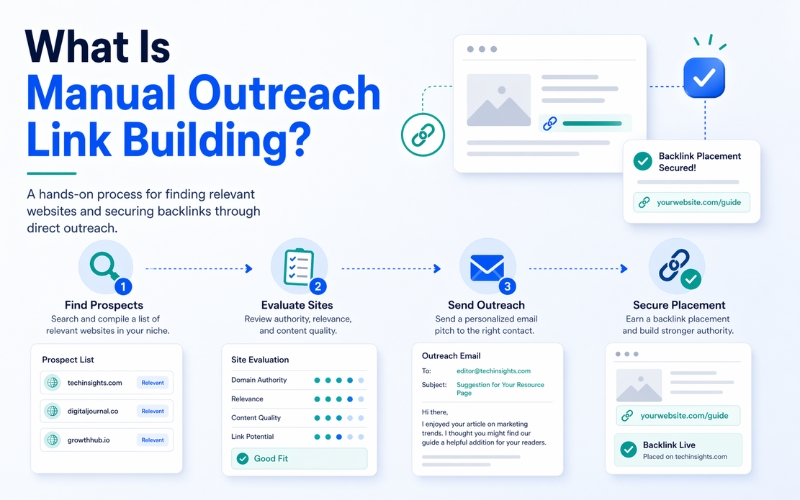
In practice, that can lead to different outcomes. Sometimes the goal is a guest contribution. In other cases, it may be a resource mention, expert quote, partnership reference, interview feature, or another content placement that results in a link. That distinction matters because manual outreach is not one fixed tactic. It is a method of finding and creating opportunities through direct contact.
The process usually includes:
- finding relevant websites or publishers
- reviewing whether those sites are worth contacting
- identifying the right editor, owner, or content manager
- sending a relevant pitch
- following up and tracking responses
That sounds straightforward, but the real difficulty is not sending emails. It is deciding whether the prospect is good enough, the asset is strong enough, and the opportunity is worth the effort in the first place.
This is why manual outreach often gets misjudged. Some teams treat it as premium just because it requires more labor. Others dismiss it as outdated because it is harder to scale. A more useful view is that manual outreach works when the extra effort leads to better-fit placements and better decisions.
>>> READ MORE: Buy Backlinks, Buy Guest Posts & Backlink Services | SEONetwork
Why Manual Outreach Still Has A Place In Modern Link Building
Manual outreach still matters because not every worthwhile link opportunity sits inside a clean, structured acquisition workflow.
It Gives Teams More Control Over Relevance
One of the clearest advantages of manual outreach is control. Instead of working from a fixed list of available websites, teams can actively search for publishers, blogs, resource pages, and niche sites that actually fit the page they are trying to support.
That matters because relevance often creates more long-term value than convenience. A smaller list of better-fit outreach targets can produce stronger opportunities than a much larger list built around what is simply easiest to access.
It Can Improve Editorial Fit
Manual outreach also makes sense when the goal is not just to place a link somewhere, but to secure a placement that feels natural inside a real editorial environment.
That might mean a guest contribution, a resource inclusion, an expert commentary angle, or a targeted pitch around a useful asset. In those cases, the value comes less from the fact that outreach happened and more from the fact that the outreach led to a more believable and contextually strong placement.
It Still Works In Relationship-Sensitive Niches
Some industries still respond better to direct communication than to broad-scale automation.
B2B markets, specialist communities, trade publications, local industries, and expert-led niches often care more about relevance, credibility, and relationship quality than about throughput alone. In those spaces, manual outreach can still outperform more mechanical workflows because the communication itself becomes part of the qualification process.
Where Manual Outreach Works Best
Manual outreach is not the right answer for every campaign, but there are situations where it still makes clear sense.
For High-Relevance Placements
If the goal is to secure links from sites that are tightly aligned with your niche, manual outreach usually gives you more control. That is especially useful when the destination page needs strong topical reinforcement rather than just broader exposure.
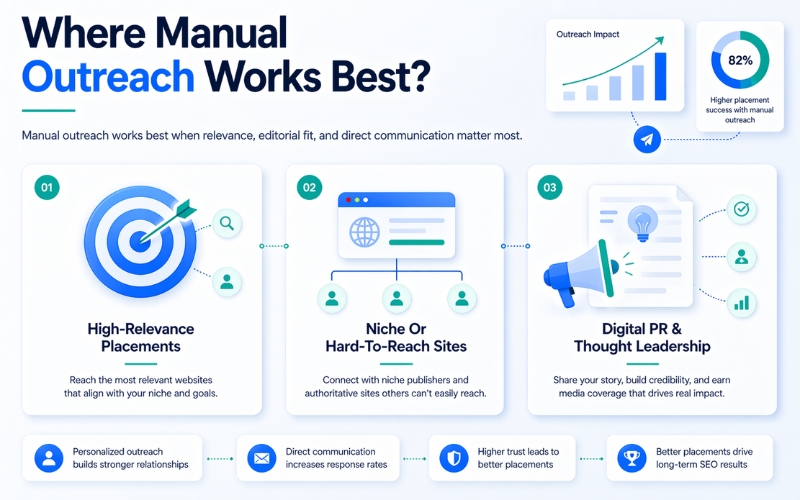
For Hard-To-Reach Or Non-Public Opportunities
Some valuable websites do not publish obvious submission pages, rate cards, or contributor guidelines. They may still be open to partnerships, interviews, expert input, or content collaboration, but only through direct contact.
In those cases, manual outreach is often the only realistic path to the opportunity.
For Digital PR And Thought Leadership Angles
When the opportunity depends on an insight, founder viewpoint, original asset, or story angle, manual outreach often works better than a purely placement-based workflow. The outcome depends on whether the pitch is interesting and relevant, not just whether a publisher happens to have inventory available.
Why Manual Outreach Often Becomes Inefficient
Manual outreach has real strengths, but the weaknesses show up quickly when the process behind it is weak.
It Slows Down Fast When Teams Need Scale
Manual outreach is naturally slower than more structured acquisition models. Prospecting, site review, contact research, tailored pitching, and follow-up all take time. If the campaign depends on fast throughput, outreach-heavy execution can become a bottleneck quickly.
It Breaks Down When Prospect Review Is Inconsistent
A common problem in manual link building is uneven judgment.
One person sees a site as a strong prospect. Another sees the same site as weak. Without clear standards for relevance, quality, and placement fit, the list becomes noisy and the campaign becomes harder to manage.
It Creates Friction When The Workflow Is Fragmented
Manual outreach often gets split into disconnected parts:
- one person builds the list
- another reviews the sites
- another writes the emails
- another negotiates scope or pricing
- another tracks responses in spreadsheets
That fragmentation is where a lot of inefficiency comes from. The more scattered the process becomes, the harder it is to keep quality consistent and decisions clear.
The Core Process Behind Manual Outreach Link Building
A good manual outreach campaign usually follows a sequence. The order matters because weak decisions early in the process make every later step less efficient.
Step 1: Find Relevant Prospects
Start with websites that actually fit the niche, topic, and audience of the page you want to support.
That can come from search operators, competitor backlink reviews, niche publication research, resource page discovery, or content gap analysis. The goal is not just to find sites that accept outreach. It is to find sites worth the effort of outreach.
Step 2: Evaluate Website Quality
Before sending a single pitch, review the site itself.
Look at topical consistency, content quality, article depth, outbound link behavior, editorial standards, and whether the site appears to serve a real audience. A site can show decent metrics and still be a weak outreach target if the content environment is poor.
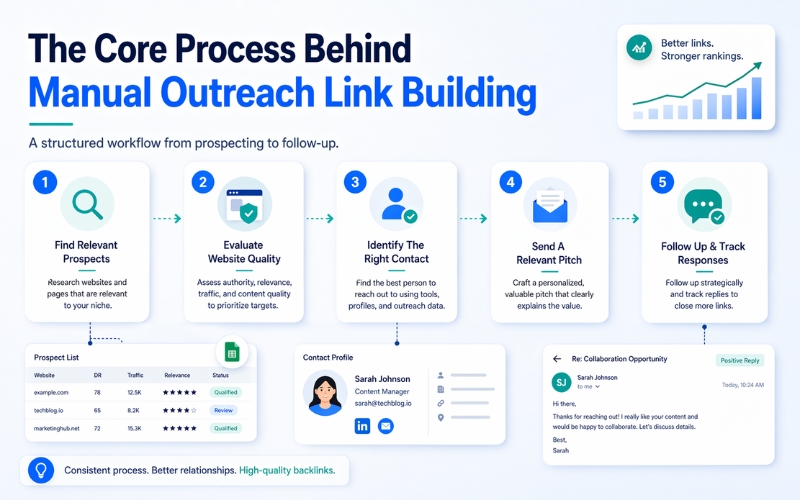
Step 3: Identify The Right Contact
Generic inboxes and contact forms are not always useless, but they are usually less effective than reaching the actual editor or decision-maker.
The closer the contact is to the person who can make the content decision, the stronger the chance of getting a meaningful response.
Step 4: Send A Relevant Pitch
This is where many teams overfocus on wording and underfocus on fit.
A good outreach email is not just personalized. It is relevant. It gives the recipient a clear reason to care, a clear idea of what is being proposed, and a clear signal that the pitch was not sent to dozens of unrelated sites.
Step 5: Follow Up And Track Responses
A lot of outreach value comes from disciplined follow-up rather than the first email alone.
But follow-up only helps when the target was qualified properly to begin with. Repeated follow-ups to weak prospects do not improve a weak campaign. They just make the inefficiency more obvious.
>>> READ MORE: Off Page SEO Checklist: What To Review, Build, And Improve
What Usually Determines Whether Outreach Converts
Manual outreach becomes more effective when the team improves decision quality, not just email volume.
Better Prospect Qualification
The biggest gains often happen before any email is sent.
A well-qualified list almost always beats a large list. If the sites are relevant, credible, and realistic targets, everything downstream becomes easier.
Stronger Asset Or Placement Fit
The pitch has to lead somewhere useful.
If the page you want linked is weak, generic, or not worth referencing, even a strong outreach email will struggle. Outreach is easier when the destination asset actually deserves attention.
Real Personalization
Real personalization is not dropping a site name into a template.
It means understanding why the website is relevant, why the idea fits, and why the person receiving the message might care. That does not require a long email. It requires sharper judgment.
Good Follow-Up Discipline
Some teams stop too early. Others follow up too aggressively and damage the interaction.
The best follow-up usually feels professional and purposeful. It should not sound desperate, nor should it feel like automated persistence disguised as relationship building.
A Simple Practical Example
Imagine a B2B SaaS company trying to build links to a strong product-comparison page.
One option is mass outreach to hundreds of general marketing blogs with a vague guest-post pitch. That may create scale, but the response quality is likely to be mixed and the editorial fit may be weak.
Another option is a smaller manual outreach list built around niche SaaS publications, specialist consultants, and operators who already cover the problem the page addresses. The number of targets is lower, but the topical fit is much stronger and the pitch has a clearer reason to land.
In many real campaigns, the second option is where manual outreach still makes sense. It is slower, but the added effort is buying relevance and context rather than just more email volume.
Common Mistakes In Manual Outreach Link Building
A lot of failed outreach campaigns are not failing because outreach itself no longer works. They fail because the process is weak.
Sending Generic Emails
This is the most obvious mistake. If the pitch sounds templated, vague, or barely relevant, response quality drops quickly.
Prioritizing Volume Over Fit
Some teams treat outreach like a pure numbers game. That usually leads to big lists, weak conversion, and low-value placements. The problem is not the email count itself. It is the absence of real qualification.
Reaching Out Before The Asset Is Worth Linking To
This happens more often than teams admit. They build the list and start pitching before the destination page is actually strong enough to deserve attention.
That creates a structural problem. The outreach may be competent, but the asset itself is weak.
Ignoring Site-Level Quality Signals
A site can look fine on paper and still be a poor target if the content is thin, the editorial quality is weak, or the outbound link footprint looks obviously commercial.
Measuring Success Only By Response Rate
A reply is not the same thing as a worthwhile link opportunity.
Some campaigns get acceptable response rates but still produce poor placements because the real evaluation standard was never clear.
Manual Outreach Vs Structured Workflows: How To Choose
This is where teams need to be honest about trade-offs.
Choose Manual Outreach When Relevance Matters More Than Speed
If the campaign depends on selective placements, niche publishers, expert-led content, or relationship-sensitive opportunities, manual outreach can still be worth the effort.
Choose A Structured Workflow When Clarity And Scale Matter More
If the main problem is not finding contacts but comparing sites, qualifying publishers, keeping standards consistent, or moving faster across many opportunities, then the workflow itself may need to improve more than the outreach copy.
Use A Hybrid Model When The Campaign Needs Both
For many teams, the best answer is hybrid.
Use manual outreach for top-tier, niche, or relationship-sensitive placements. Use more structured acquisition workflows when comparison, transparency, and scalable execution matter more than individualized outreach.
How SEONetwork Helps Teams Reduce Outreach Friction
One reason manual outreach becomes inefficient is that the hardest part is rarely just sending the email. The real friction usually comes from qualifying publishers, comparing placements, keeping standards consistent, and moving from prospecting to execution without turning the process into spreadsheet chaos.
As a backlink marketplace, SEONetwork helps advertisers and publishers find, compare, and manage placements in a more structured and transparent way. For teams that still use manual outreach selectively but need more clarity across the broader acquisition process, that kind of structure reduces friction without forcing every opportunity into the same outreach-heavy model.
Conclusion
Manual outreach link building still works when the added effort leads to better-fit placements, stronger editorial context, and smarter decisions.
It makes the most sense when the campaign depends on selective targets, niche relevance, or relationship-sensitive opportunities that cannot be replicated easily through a broader structured workflow. It becomes much less efficient when qualification is weak, the process is fragmented, or the team is trying to scale through labor alone.
If manual outreach feels harder than it should, the problem is often not the pitch itself. It is the lack of a clear system for qualifying, comparing, and acting on the right opportunities.
Check our Link Building Marketplace for the most balance and safest link building strategies.
FAQ
What Is Manual Outreach Link Building?
Manual outreach link building is the process of finding relevant websites and contacting them directly to secure backlinks or content placements through tailored outreach.
Does Manual Outreach Still Work For Link Building?
Yes. It still works when relevance, editorial fit, and relationship-sensitive communication matter more than speed. It is often most useful in selective or niche campaigns.
Why Does Manual Outreach Fail So Often?
It usually fails because the prospect list is weak, the asset is not worth linking to, the outreach is generic, or the site-review process is inconsistent.
Is Manual Outreach Better Than Automated Link Building?
Not always. Manual outreach offers more control, but it is slower and harder to scale. Whether it is better depends on the campaign and how much value comes from fit versus efficiency.
When Should Teams Use A More Structured Workflow Instead?
Teams should consider a more structured workflow when they need faster comparison, clearer qualification, better transparency, and more scalable execution than manual outreach alone can provide.
>>> YOU MAY ALSO LIKE:
- Best Link Building Quality vs Quantity: What Matters More for SEO? – SEONetwork
- Link Building Prices: What You Should Expect To Pay And Why Costs Vary

I’m Jackson Avery, and I have 5 years of experience in content SEO. At SEONetwork, I share practical SEO knowledge, insights, and content strategies to help readers better understand search intent, content optimization, and sustainable organic growth.