
What makes a quality backlink? A quality backlink is not defined by a single metric. It comes from the combination of topical relevance, placement context, website quality, anchor fit, target-page alignment, and overall editorial credibility. A high-DR link can still be weak if it comes from the wrong site or appears in poor content, while a lower-metric link can be highly valuable when the context is strong. In this guide, we break down the signals that matter most, the shortcuts that often mislead teams, and how to evaluate backlink opportunities more realistically.
What Makes A Quality Backlink?
A quality backlink is a link from a relevant website that appears in a credible editorial context and points to a page that genuinely fits the surrounding discussion. In simple terms, it is a link that feels justified to both users and search engines.
This is where many link evaluations go wrong. People often treat quality as a shortcut metric, usually DR, DA, traffic, or publisher size. Those signals can be useful, but none of them defines link quality on its own. A backlink becomes stronger when multiple signals align rather than when one number looks impressive in a spreadsheet.
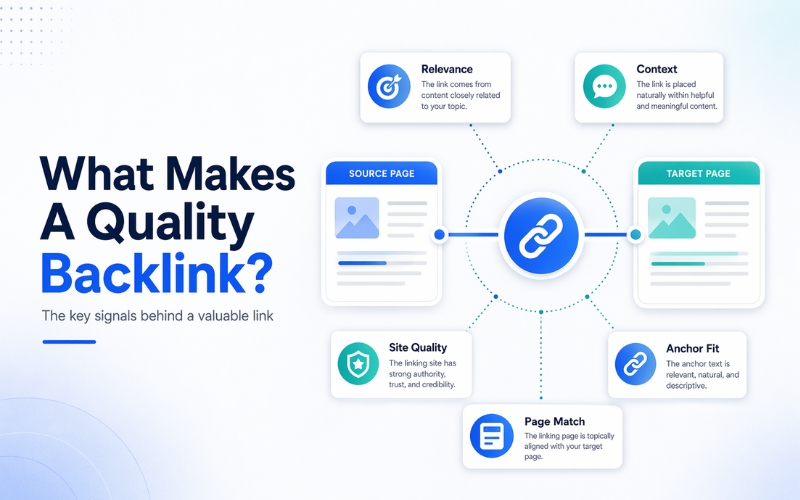
In practice, backlink quality usually comes down to six core elements:
- Topical Relevance
- Placement Context
- Website Quality
- Anchor Text Fit
- Target Page Alignment
- Editorial Credibility
A link does not need to be perfect in every area to be worthwhile. But when several of these elements are weak at the same time, the placement usually becomes much less attractive.
Why Backlink Quality Matters More Than Raw Volume
For most SEO work, stronger links tend to outperform larger batches of weaker ones.
A relevant backlink from a site that genuinely covers your topic often does more than multiple links from unrelated or low-value websites. That is because backlinks are not just counted. They are interpreted through context. The clearer the relationship between the source site, the linking page, and the destination page, the easier it is for the backlink to support rankings in a meaningful way.
Weak links often create noise instead of strength. A site can build a large backlink profile and still end up with a pattern that looks messy, inconsistent, or only loosely connected to its actual topic. That kind of volume may look impressive on paper, but it often contributes less than expected once you review the placements closely.
Link quality also depends on the destination page being worth supporting. Even a strong backlink has limited value if it points to a page with weak search intent alignment, thin content, or poor internal support. In practice, better backlinks work best when they support pages that are already structurally positioned to benefit from them.
>>> READ MORE: Buy Backlinks, Buy Guest Posts & Backlink Services | SEONetwork
The Core Factors That Make A Backlink High Quality
When people ask what makes a quality backlink, the most useful answer is to break quality into signals you can actually review.
Topical Relevance
Relevance is usually the first filter.
A backlink is stronger when the source website and the linking page have a clear connection to the topic of the destination page. That does not mean every link has to come from the exact same niche, but the relationship should be easy to justify. A digital marketing site linking to an SEO resource usually makes sense. A broad entertainment site linking to that same page with no clear topical bridge usually does not.
The stronger the topical connection, the more credible the placement tends to look.
Placement Context
Where the link appears matters almost as much as the site it appears on.
A backlink placed inside a useful paragraph is usually stronger than one dropped into a weak article, an author bio, or a page that seems built mainly to host outbound links. Good placement context means the link supports the point being made. It feels integrated into the content rather than attached for SEO purposes.
A useful test is simple: if the article still reads naturally without the link, but the link clearly adds value, that is often a positive sign.
Website Quality
A strong backlink usually comes from a site that looks real, active, and built for an audience.
The site does not need to be huge, but it should show signs of editorial care. Its content should be reasonably well written, its topic focus should make sense, and its publishing pattern should not look chaotic or purely commercial. Sites that exist mainly to sell placements often reveal themselves through thin articles, inconsistent themes, weak structure, or excessive outbound linking.
A backlink from a smaller but credible site can easily be more useful than a link from a larger site with poor content standards.
Anchor Text Fit
Anchor text matters because it shapes the connection between the source content and the destination page.
A strong anchor usually feels natural in the sentence and fits the topic of the linked page. It helps the reader understand why the link is there. Overly aggressive exact-match anchors often do the opposite. They make the placement feel engineered rather than editorially justified.
This does not mean exact-match anchors are always wrong. It means they should not dominate the pattern when softer and more natural phrasing would serve the same purpose more convincingly.
Target Page Alignment
The destination page has to make sense in context.
A backlink can look strong on the source side but still underperform if it points to the wrong page. The best placements connect the linking page to a destination that matches the topic, user intent, and level of specificity being discussed. If the source article is about technical SEO and the link points to a generic homepage, the fit is usually weaker than linking to a focused technical SEO resource.
This is one reason page-level judgment matters so much in link building.
Editorial Credibility
A quality backlink usually feels like it belongs there.
If the placement looks like it exists because the writer or editor had a reason to include it, that is a strong signal. If it looks mechanically inserted into weak or irrelevant text, it becomes much less convincing. Editorial credibility is often the difference between a link that adds real contextual value and one that only exists to satisfy a campaign target.
What Does Not Automatically Make A Backlink High Quality?
Some signals are useful. Many are over-trusted.
A High DR Or DA Score
Third-party metrics can help with screening, but they are not a definition of quality. A high-metric site can still have weak topical fit, poor placement context, or thin content standards. Metrics should support judgment, not replace it.
A Large Traffic Number
Traffic can be a positive signal, but it does not automatically make a placement relevant or valuable. A high-traffic site in the wrong topic area may still be a weak backlink opportunity if the editorial fit is poor.
A Guest Post Label
Some teams assume a guest post link is automatically lower quality. Others assume any accepted guest post opportunity is worth taking. Neither view is reliable. A guest post can be strong or weak depending on the site, the content, the context, and the editorial standard behind it.
Exact-Match Anchor Text
An exact-match anchor can sometimes fit naturally, but it is not inherently higher quality. In many cases, a more natural anchor is the stronger choice because it fits the sentence better and creates a more believable link pattern.
>>> DIVE DEEPER: Off Page SEO Checklist: What To Review, Build, And Improve
How To Evaluate Backlink Opportunities More Realistically
The best link reviews usually come from a repeatable process rather than instinct alone.
Start With Relevance
Begin with the simplest question first: Does this website make sense for the page you want to support?
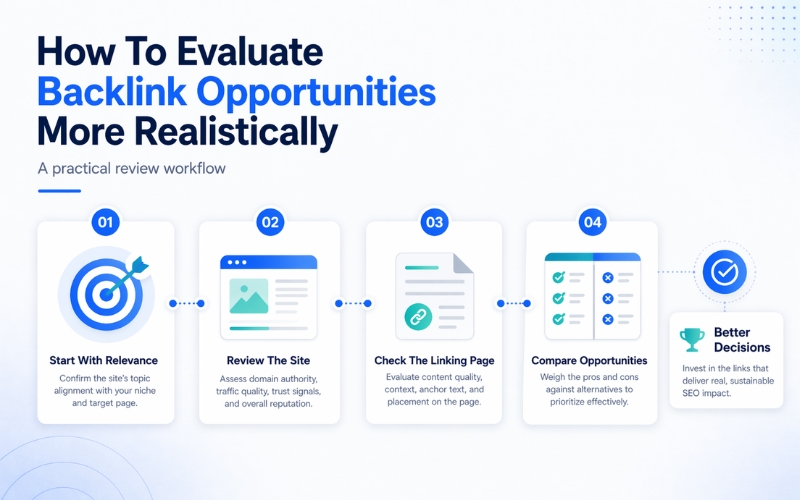
If the answer is weak, that usually saves time quickly. Relevance is often the fastest way to eliminate placements that look attractive on the surface but do not fit well enough to justify the effort.
Review The Site And The Linking Page Separately
After relevance, look at the site itself and then the page where the backlink would actually live.
Review recent content quality, niche focus, audience fit, and how the site handles outbound links. Then review the specific linking page. Is it well written? Is it genuinely useful? Would the article still deserve to exist if the link were removed?
A backlink lives on a page, not just a domain. That distinction matters more than many teams realize.
Compare Opportunities Side By Side
Link decisions get clearer when you compare options directly instead of judging each placement in isolation.
Ask questions like:
- Which site has the better topical fit?
- Which page has cleaner editorial context?
- Which placement feels more natural?
- Which target-page match is stronger?
This usually leads to better decisions than asking whether a single placement looks “good enough” in abstract terms.
Strong Vs Weak Backlinks In Practice
The difference between a strong backlink and a weak one often becomes clearer when two opportunities are compared directly.
Imagine two possible placements for a page about technical SEO.
Option A comes from a broad business site with a stronger DR score and higher traffic, but the article topic is only loosely connected to SEO. The content is average, the anchor feels slightly forced, and the target page match is not especially tight.
Option B comes from a smaller but focused search marketing blog. The site covers SEO consistently, the article is clearly about technical SEO, the anchor fits naturally, and the destination page directly supports the discussion.
In many real SEO decisions, Option B is the stronger backlink even if Option A looks more impressive at first glance. That is the practical difference between evaluating links by context and evaluating them by surface metrics alone.
Common Mistakes When Judging Backlink Quality
One of the biggest mistakes is over-relying on third-party metrics. Metrics are useful shortcuts, but they are not substitutes for actual review.
Another common problem is stopping at the domain level. Teams see a solid site and assume the link will be good, even though the actual page may be weak, off-topic, or built mainly to host placements. That leads to decisions based on surface indicators rather than the page environment where the backlink actually lives.
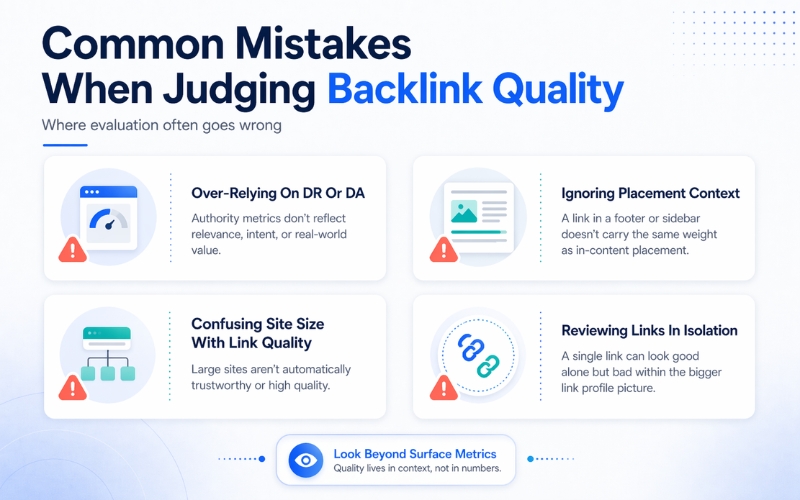
A third mistake is confusing site size with link quality. Bigger sites can offer strong opportunities, but scale alone does not make a backlink more relevant, more natural, or more contextually useful.
Finally, many teams review backlinks one variable at a time. They look at the site, then the metric, then the anchor, then the target page, but do not evaluate how well those parts work together. That disconnect is one reason weak placements slip through.
A Simple Review Framework For Backlink Decisions
If you want a cleaner process, use this five-point review framework:
- Is The Site Topically Relevant?
- Does The Site Look Credible And Useful?
- Is The Linking Page Strong On Its Own?
- Does The Anchor Text Fit Naturally?
- Does The Target Page Match The Context Well?
The goal is not perfection. The goal is a placement that makes editorial sense and supports the destination page in a believable way.
This is usually what makes a quality backlink in real SEO work. Not one standout metric, but the alignment of several useful signals.
How SEONetwork Helps Teams Evaluate Backlinks More Clearly
One of the hardest parts of link building is not finding more websites. It is applying the same quality standards consistently once the list starts growing.
That is where structure becomes useful. As a backlink marketplace, SEONetwork helps advertisers and publishers compare placement opportunities more clearly and manage backlink decisions in a more organized way than scattered manual outreach alone. That does not replace judgment, but it does make it easier to evaluate options consistently when backlink review starts getting messy.
Conclusion
A quality backlink is usually the result of alignment, not one standout metric. When relevance, page context, website quality, anchor fit, target-page match, and editorial credibility all work together, the placement becomes much more likely to matter.
If your team wants better link building decisions, the next improvement is rarely building more links faster. It is using a clearer review standard before deciding which opportunities deserve the effort.
Check our Link Building Marketplace for the most balance and safest link building strategies.
FAQ
What Makes A Quality Backlink?
A quality backlink is a link from a relevant website that appears in strong content, fits naturally within the page, and points to a destination that matches the surrounding topic.
Are High-DR Backlinks Always Better?
No. High-DR backlinks can still be weak if the site is irrelevant, the page quality is low, or the placement context is poor.
How Important Is Relevance In Backlink Quality?
Relevance is one of the most important signals. A backlink usually becomes more valuable when the source site and linking page clearly relate to the target page.
Can A Lower-Metric Backlink Still Be Valuable?
Yes. A lower-metric backlink can be highly valuable when the topical fit, editorial context, and target-page alignment are strong.
How Do You Review Backlinks More Consistently?
Use a repeatable framework that covers relevance, site quality, page quality, anchor fit, and target-page fit. Comparing opportunities side by side usually leads to better decisions than reviewing each one in isolation.
>>> YOU MAY ALSO LIKE:
- Best Link Building Quality vs Quantity: What Matters More for SEO?
- Should You Outsource Backlink Building? When It Makes Sense And How To Do It Well – SEONetwork