
How to learn SEO? SEO is learnable. You can start at home, without a formal course, and without a big budget. The real obstacle is not access to information; it is learning in the wrong order.
Most beginners try to learn everything at once, or jump straight into tactics before understanding the fundamentals. This roadmap is structured to help you avoid that. It takes you from the basics through to real-world practice, in the order that actually makes sense.
Understand how SEO actually works
Before you touch a keyword tool or write a single line of content, you need a working mental model of what SEO is doing underneath. It comes down to three stages:
- Crawling: search engine bots discover pages by following links across the web.
- Indexing: discovered pages are analysed, categorised, and stored in a database.
- Ranking: When someone searches, the engine picks the most relevant, authoritative results from that index.
Your job as an SEO is to make sure the right pages get crawled and indexed, and that Google sees them as the best answer for the searches that matter to your site.
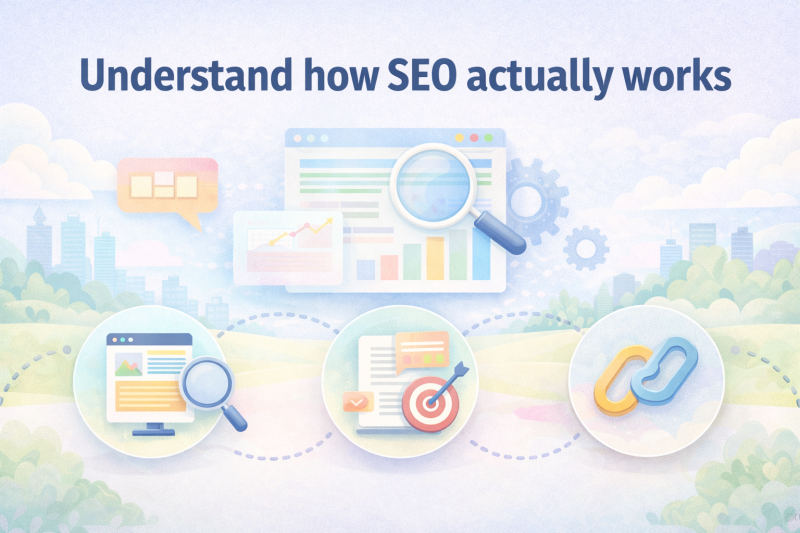
SEO operates across three areas:
- On-page SEO: content quality, keyword usage, heading structure, internal linking.
- Technical SEO: crawlability, site speed, indexing, structured data.
- Off-page SEO: backlinks, domain authority, brand signals.
It is also worth understanding early that SEO sits inside a broader marketing context. It is a long-term acquisition channel, not a quick fix. That framing helps you prioritise what to learn when, and how to connect SEO decisions to actual business outcomes.
>>> DIVE DEEPER: How to Do SEO Optimization: A Step-by-Step Guide
Start with keyword research: it shapes everything else
Keyword research is the best first practical skill to develop, because it informs your content strategy, your site structure, and your on-page decisions. Get this wrong and everything built on top of it is misaligned.
The most important concept here is search intent: what the person is actually trying to accomplish when they type a query. A keyword can have high volume and still be the wrong target if the intent does not match what your page delivers.
There are four main intent types:
- Informational: the user wants to learn something. Example: “how to learn SEO”.
- Navigational: the user wants to find a specific website or brand.
- Commercial: the user is comparing options. Example: “best SEO tools 2025”.
- Transactional: the user is ready to act or buy.
To get started without spending money, these tools are sufficient:
- Google Search Console (free): shows what queries your site is already getting impressions for.
- Google Keyword Planner (free): broad volume data, useful for early-stage research.
- Ahrefs Webmaster Tools (free): keyword and backlink data for your own site.
- Google Search itself: autocomplete, People Also Ask, and related searches are underrated research sources.
Learn SEO writing: how to create content that ranks
SEO writing is not about inserting keywords at a certain density. It is about structuring content so it serves the reader’s intent clearly, and signals relevance to search engines through that clarity.
The technical elements to get right:
- Title tag: concise, includes the primary keyword, written for clicks as well as rankings.
- Meta description: not a direct ranking factor, but influences CTR. Write it for the user.
- Heading hierarchy (H1/H2/H3): use headings to create a logical structure, not just to insert keywords.
- Internal linking: link to related pages naturally within the content to help both users and crawlers navigate your site.
The content itself needs to answer the query fully. That means covering the topic with enough depth that someone searching that keyword does not need to go back and look elsewhere. It does not mean writing the longest article possible.
The best way to build SEO writing skill is to publish real content, track how it performs in Search Console, and iterate. There is no substitute for that feedback loop.
Practice on a real website from day one
You cannot develop SEO skills by reading alone. You need a site to observe, test, and iterate on. Without that, knowledge stays theoretical and does not translate into judgment.
If you do not have a site, start a small one on a topic you know well. A basic WordPress or similar setup is enough. The goal is not to build something perfect, it is to have a real environment where you can implement what you learn and see what happens.
Start with the basics as soon as the site is live:
- Set up Google Search Console and connect your site.
- Submit a sitemap.
- Optimise the title tags and meta descriptions on key pages.
- Check that important pages are being indexed.
- Review your URL structure and make sure it is clean and logical.
Learning SEO at home is entirely realistic. You do not need office infrastructure, agency access, or expensive tools at this stage. A laptop, a live site, and Search Console are enough to get meaningful feedback from.
Get familiar with technical SEO: the essentials
You do not need to be a developer to understand technical SEO. But you do need to know enough to identify problems and either fix them yourself or communicate them clearly to someone who can.
The areas worth prioritising early:
- Page speed and Core Web Vitals: Google uses these as ranking signals. Slow pages hurt both rankings and user experience.
- Crawlability: make sure important pages are not accidentally blocked by robots.txt or noindex tags.
- Structured data: helps Google understand your content type and can unlock rich results.
- Mobile-friendliness: Google indexes the mobile version of your site first.
Useful free tools at this stage:
- Google Search Console: coverage report, Core Web Vitals report, mobile usability.
- PageSpeed Insights: page-level speed and CWV diagnostics.
- Screaming Frog SEO Spider (free tier): crawl up to 500 URLs to find broken links, redirect chains, missing tags, and other on-site issues.
Add link building to your skillset when you are ready
Link building is off-page SEO and it is an advanced skill, not a starting point. Build your on-page and content foundations first. Once those are solid and you have pages worth linking to, then it makes sense to focus here.
What matters when evaluating a backlink:
- Relevance: a link from a topically related site carries more weight than a generic one.
- Authority: links from established, trusted sites pass more value.
- Context: a link placed naturally within relevant content is more valuable than a footer or sidebar link.
Common approaches include guest posting, niche placements, digital PR, and building content that earns links naturally over time.
For teams managing link building at scale, manual outreach can get time-consuming and inconsistent. Platforms like SEONetwork help structure the process by connecting advertisers with publishers in a more transparent, organised way compared to traditional outreach.
>>> READ MORE: Become a Publisher and Sell Backlinks With SEONetwork
Where to learn SEO: resources worth your time
There is no shortage of SEO content online. The challenge is filtering for quality. These are reliable starting points:
- Google Search Central Documentation: the primary source for how Google’s systems work. Dense but authoritative.
- Ahrefs Blog: well-structured, practical, and backed by real data. Good for both beginners and intermediate learners.
- Moz Beginner’s Guide to SEO: a comprehensive free resource that covers all the major areas.
- Reddit r/SEO: community discussions are useful for understanding real-world problems, edge cases, and current debate.
- Case studies: reading how others solved specific ranking problems teaches you more than most theoretical guides.
One point worth repeating: you can learn SEO for free. The best tools for early-stage learning are either free or have free tiers. Paid tools become valuable later when you need scale, speed, or competitive data, but they are not a prerequisite.
How long does it take to learn SEO?
There is no standard answer, but here is a realistic framing:
- 1 to 3 months: enough time to understand the fundamentals and start producing optimised content, if you have a site to practice on.
- 6 to 12 months: enough time to see meaningful organic growth and develop real judgment about what works in your niche.
- Ongoing: SEO changes. Algorithm updates, new search features, and shifting user behaviour mean you are always learning.
The gap between knowing SEO and being good at SEO is mostly time spent working on real problems. No course shortens that gap as effectively as sustained practice on a live site.
Where to start
If you take one thing from this guide, it is this: learn in order. The sequence matters more than the pace.
Start with how SEO works. Move into keyword research. Practice SEO writing on a real site. Build technical knowledge as you go. Add link building when your foundation is solid.
Most of this is achievable at home, with free tools, on your own schedule. What it requires is consistency and a willingness to measure what is happening.
When you reach the link building stage and want a more structured approach to managing placements, SEONetwork is worth exploring as a platform built specifically for that part of the process.
Check our Link Marketplace for the most balance and safest link building strategies.
>>> YOU MAY ALSO LIKE:
- How Long Does It Take for SEO to Work? A Realistic Timeline

I’m Jackson Avery, and I have 5 years of experience in content SEO. At SEONetwork, I share practical SEO knowledge, insights, and content strategies to help readers better understand search intent, content optimization, and sustainable organic growth.