
A content pillar is a main piece of content built around one broad topic and connected to related subtopics through internal links. If you are asking what is a content pillar, the practical answer is simple: it helps search engines understand your site structure and helps readers explore a topic more clearly. At SEONetwork, this question often comes up when teams publish many articles but still struggle to build topical relevance, internal linking strength, and a clearer SEO content system.
What Is a Content Pillar?
To understand pillar content, it helps to start with its role within a larger content structure. A content pillar is not just a long article. It is a central page or post that introduces a broad topic and connects readers to more focused supporting content.
A Simple Content Pillar Definition
A content pillar is a core piece of content that covers a broad subject in a structured way. It gives readers a strong overview of the topic while also linking to related articles that go deeper into specific subtopics.

In SEO, this usually means one main page sits at the center of a topic cluster. Around it, several supporting pages explore narrower questions, terms, or use cases connected to that main subject.
Why Content Pillars Matter In SEO
Search engines try to understand not only individual pages, but also how those pages connect across a website. A strong content pillar makes that relationship easier to interpret.
When a website has one central page supported by relevant subtopics, it sends clearer signals about expertise, relevance, and topical depth. That can make the overall content system more useful for both users and search engines.
How A Content Pillar Supports Topic Coverage
A pillar helps organize content around a single, clear theme rather than scattering similar ideas across disconnected posts. This reduces confusion and makes it easier to cover a topic with more purpose.
For readers, that means fewer dead ends and a better path through the subject. For SEO, it means stronger context around related terms, better internal links, and a more coherent site structure.
What Does SEO Pillar Content Look Like?
Many websites hear the term, but are still not sure what it looks like in practice. SEO pillar content usually has a clear structure, broad topical coverage, and meaningful links to related pages.
Pillar Pages Vs Regular Blog Posts
A regular blog post often answers one narrow question. A pillar page usually covers a broader topic and acts as a central hub for connected content.
For example, a blog post might explain one specific SEO metric. A pillar page would explain the broader topic, define the key ideas, and direct readers to deeper content on each related area.
Pillar Content Post Or Page SEO Explained
The phrase pillar content post or page SEO usually refers to content designed to support search visibility through topic structure, internal linking, and broader relevance. In practice, a pillar can be either a page or a post, depending on how the website is built.
The more important distinction is not page versus post. It is whether the content serves as a central resource for a topic and connects clearly to supporting content.
Core Topic, Subtopics, And Internal Links
A pillar usually starts with one broad topic, such as content strategy, internal linking, technical SEO, or keyword research. From there, it connects to narrower articles that answer related questions.
That structure matters because internal links do more than move traffic. They help define relationships between pages. This is also a natural place to add internal links to related resources such as a guide on topic clusters, internal linking, or content planning.
>>> EXPLORE FURTHER: Buy Quality Backlinks, Buy Guest Posts & Backlink Services | SEONetwork
How Content Pillars Help Your Website Grow
A content pillar is useful because it improves more than one part of a site at the same time. It can shape structure, strengthen relevance, and make content planning more sustainable over time.
Better Site Structure
Many websites grow by adding content one article at a time without a clear map. Over time, that can lead to overlap, weak internal linking, and scattered topic signals.
A pillar gives structure to that growth. Instead of publishing around a topic in random directions, the site builds around a defined center.
Clearer Topical Relevance
Topical relevance becomes easier to build when content is grouped with intention. A pillar tells search engines what the main topic is, while supporting articles reinforce related angles.

This does not guarantee rankings on its own, but it creates a stronger foundation for relevance. It also makes the content easier for users to navigate and understand.
Stronger Internal Linking Signals
Internal links are more useful when they follow a logical pattern. A pillar model helps create that pattern by placing one main page at the center and connecting it to supporting pieces in both directions.
This can help distribute context more effectively across related pages. It also reduces the chance of important content being buried too deeply.
Easier Content Planning Over Time
One of the biggest benefits of a pillar structure is that it turns content planning into a clearer system. Instead of asking what to write next in isolation, teams can identify which subtopics are missing around a core subject.
That often leads to better coverage, fewer repetitive articles, and a stronger long-term content roadmap.
How To Create A Content Pillar Step By Step
Building a pillar is less about writing one very long article and more about making smart structural choices. The goal is to choose the right topic, connect the right subtopics, and build content that works together.
Choose One Broad Topic
Start with a topic broad enough to support multiple related articles, but not so broad that the pillar becomes unfocused. A good pillar topic usually sits above several connected search questions.
For example, “internal linking” can work as a pillar topic because it supports related content on link architecture, anchor text, orphan pages, and crawl paths. A topic like “marketing” is usually too broad.
Map Supporting Cluster Content
Once the core topic is clear, the next step is to identify the subtopics that support it. These should not be random keywords. They should represent useful, connected questions that readers naturally explore.
This is where seo pillar content becomes more strategic. The supporting pieces should expand the topic in ways that add real depth, not just repeat what the pillar already says.
Build The Pillar Page Structure
The pillar itself should introduce the topic clearly, explain the main concepts, and create a strong overview. It does not need to answer every small question in full detail.
Instead, it should cover the subject well enough to orient the reader and then guide them toward supporting content where appropriate. That creates a better reading experience and a cleaner content hierarchy.
Add Internal Links To Related Pages
Internal linking is what turns a strong standalone article into a pillar system. The pillar should link to related subtopic pages, and those pages should link back where relevant.
This helps reinforce the relationship between pages and gives readers a clearer journey. It also creates obvious places for internal links to related site content on SEO basics, content planning, or on-page optimization.
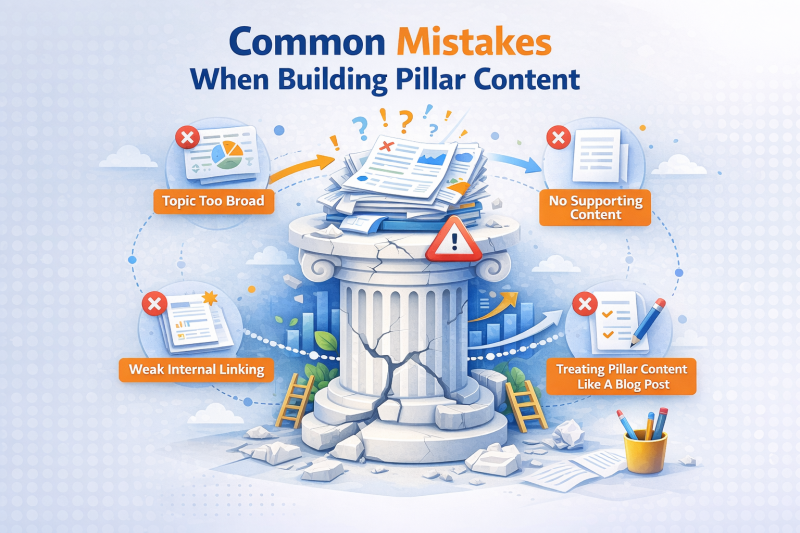
Common Mistakes When Building Pillar Content
Many websites understand the concept of pillar content but miss the structure that makes it valuable. The result is often a long page that looks important but does not function like a real pillar.
Choosing A Topic That Is Too Broad
A pillar works best when the topic is broad enough to support depth but narrow enough to stay focused. If the topic is too large, the content can become vague and difficult to organize.
That often leads to generic coverage instead of useful structure. A focused pillar usually performs better than a giant page trying to cover everything.
Writing A Pillar Without Supporting Content
A pillar without supporting content is incomplete. It may still be useful as a standalone resource, but it will not fully work as a topic hub.
The real strength of a pillar comes from the relationship between the main page and the surrounding content. Without that, the structure stays flat.
Weak Internal Linking Between Pages
Some websites publish pillars and clusters but do not connect them well. If the linking is inconsistent or too limited, the structure becomes harder for users and search engines to follow.
A pillar model depends on those connections. The content should feel intentionally linked, not loosely grouped.
Treating Pillar Content Like A Normal Blog Post
A pillar should not read like a narrow blog post stretched to a longer word count. It should have broader scope, clearer structure, and stronger pathways to related pages.
That difference matters because the purpose is different. A blog post may answer one question. A pillar should help define an entire topic area.
>>> EXPLORE FURTHER: How to Do SEO Optimization: A Step-by-Step Guide
Content Pillar Examples By Topic Type
The format of a pillar can change depending on the site and subject. What stays consistent is the role it plays as a central resource within a broader topic cluster.
Blog Content Example
A marketing blog might create a pillar called “What Is Email Marketing” and support it with articles on email subject lines, welcome sequences, deliverability, and list segmentation.
The pillar gives the main overview, while the supporting articles handle the detailed questions readers may ask next.
Service Website Example
A service website may build a pillar around a broader service category like local SEO. Supporting pages could then cover Google Business Profile optimization, local citations, review signals, and location pages.
This helps the site explain the topic clearly while creating stronger internal relationships between commercial and informational content.
SEO Education Example
An SEO learning site could create a pillar around technical SEO, then connect it to pages about crawlability, indexation, canonicals, structured data, and site speed.
This works well because the main pillar creates context, while the supporting content builds depth around the same subject area.
FAQs About Content Pillars
This topic often creates follow-up questions because the terminology can overlap with other SEO concepts. The answers below help clarify the most common points of confusion.
Is A Content Pillar The Same As A Pillar Page?
They are closely related, and many people use the terms almost interchangeably. In most cases, a content pillar refers to the broader concept, while a pillar page refers to the actual page or post that serves as the central resource.
How Long Should A Pillar Page Be?
There is no fixed word count that makes a page a pillar. It should be long enough to cover the topic clearly and create useful pathways to related subtopics.
A pillar should feel comprehensive, but it should not become unnecessarily long. Structure and usefulness matter more than raw length.
Can A Small Website Use Pillar Content?
Yes, and in many cases it should. A smaller website can benefit from clear topic structure even more because it helps make limited content feel more organized and intentional.
A small site does not need dozens of supporting pages at the start. It can begin with one strong pillar and a few focused related articles.
How Many Cluster Articles Should Support One Pillar?
There is no perfect number. What matters is whether the supporting content reflects real subtopics connected to the main subject.
Some pillars work well with four or five strong supporting pieces. Others may grow into much larger clusters over time as the site expands.
Final Thoughts On What Is A Content Pillar?
A content pillar is one of the clearest ways to turn scattered articles into a more useful SEO structure. It helps define a topic, improve internal linking, and make content easier to navigate for both readers and search engines.
If you are building content around a core subject, starting with a pillar can make future planning much easier. And if you are refining your broader SEO strategy, it is worth exploring how topic structure, internal linking, and content depth work together across your site.
>>> YOU MAY ALSO LIKE:
- What Is a Content Hub? A Simple Guide to Content Hubs for SEO
- What Is Cornerstone Content? Definition, SEO Role, and How to Use It

I’m Jackson Avery, and I have 5 years of experience in content SEO. At SEONetwork, I share practical SEO knowledge, insights, and content strategies to help readers better understand search intent, content optimization, and sustainable organic growth.