
SEO visibility is a measure of how visible your website is in organic search based on the keywords you rank for and where those rankings appear. If you are asking what is SEO visibility, the practical answer is simple: it shows how likely your pages are to be seen in search, which is why many SEO teams use it to spot growth or decline before traffic fully reflects it.
At SEONetwork, we see SEO visibility as a directional metric, not a standalone success metric. This guide explains what it means, how it is measured, what affects a seo visibility score, and how to improve visibility with clearer content, stronger structure, and better SEO decisions.
What Is SEO Visibility?
SEO visibility is one of those metrics people often see in SEO tools before they fully understand what it actually represents. It sounds simple, but it is often confused with rankings, traffic, and impressions.
SEO visibility meaning
SEO visibility refers to how prominently a website or page appears in unpaid search results across a set of keywords. In practical terms, it tries to answer a simple question: how likely is it that searchers will see your site in search results?
That is why visibility is usually expressed as a percentage, score, or trend line rather than a raw visit count. The metric is designed to estimate presence in search, not actual sessions.
A page ranking in position 2 for a high-volume keyword usually contributes more to visibility than a page ranking in position 18 for a low-volume term. The idea is not just whether you rank, but how much your rankings are likely to be seen.
SEO visibility vs traffic
SEO visibility and organic traffic are related, but they are not the same thing.
Visibility is about potential exposure in search results. Traffic is about actual visits that reached your site. A page may improve in visibility because it moved from page two to the top five, even if the traffic gain has not fully shown up yet. On the other hand, a page may get traffic from branded searches or seasonal demand even when overall visibility is flat.
This is why teams that look only at traffic can miss early SEO movement. Visibility can show whether your search presence is strengthening before clicks fully catch up.
Why SEO visibility matters
SEO visibility matters because it helps you see whether your content is becoming more competitive in search. It is especially useful when you want to track:
- Overall search presence over time
- The impact of content updates
- The effect of internal linking or technical fixes
- Keyword coverage across topic clusters
- Whether your domain is gaining or losing ground in organic search
For site owners and SEO teams, visibility is often more useful as a trend metric than as a standalone KPI. It helps explain whether your SEO direction is improving, even before business outcomes fully reflect it.
>>> EXPLORE FURTHER: Best Place to Buy Backlinks, Buy Guest Posts & Backlink Services | SEONetwork
How SEO Visibility Is Measured
Most people see a visibility number inside a tool and assume it is a fixed truth. It is not. It is a model built from ranking data, keyword sets, estimated click behavior, and tool-specific methodology.
What a visibility score means
A seo visibility score is usually a modeled estimate of how much organic search exposure your site has across tracked keywords. Different tools may calculate it differently, but the principle is similar: higher rankings for more valuable keywords tend to produce a higher visibility score.
In most cases, the score is influenced by:
- The keywords being tracked
- Each keyword’s search volume
- Your ranking positions
- Estimated click-through behavior by position
- Whether SERP features reduce traditional organic clicks
So when someone asks what a “good” score is, the better question is often: good compared to what? Your previous baseline, your competitors, and your keyword set matter more than the raw number alone.
Rankings, impressions, and keyword positions
Several seo visibility search metrics help shape visibility analysis, even if the tool combines them into one score.
Rankings show where your pages appear. Impressions show how often they are shown. Keyword position distribution helps reveal whether you are clustered in the top 3, top 10, or much lower. Together, these signals help explain whether your site is becoming easier to discover.
For example:
- Rising impressions with stable rankings may suggest broader keyword coverage
- Rising rankings with limited impressions may mean you are improving on lower-volume terms
- Stronger top-3 distribution often has a larger visibility effect than small gains from position 27 to 19
This is why SEO visibility should be read as a layered metric, not a single isolated number.
Why do different tools show different numbers?
Different SEO tools track different keyword databases, geographies, devices, update frequencies, and calculation models. That means your visibility score in one tool will not always match another.
This is especially important when reviewing seo domain visibility. One platform may emphasize a broader keyword universe, while another may focus more heavily on a custom tracked set. Neither is automatically wrong. They are just measuring visibility through different lenses.
The better approach is to stay consistent with the same tool or benchmark set over time. Visibility becomes more useful when you compare trends within one system rather than jumping between unrelated numbers.
What Affects SEO Visibility?
SEO visibility does not move for one reason alone. It is shaped by how well your site covers useful topics, how strong your rankings are, how clearly your pages match intent, and how competitive the search results are.
Keyword coverage and ranking distribution
A site with strong visibility usually ranks for more than just a handful of head terms. It has meaningful keyword coverage across related queries, subtopics, and long-tail variations.
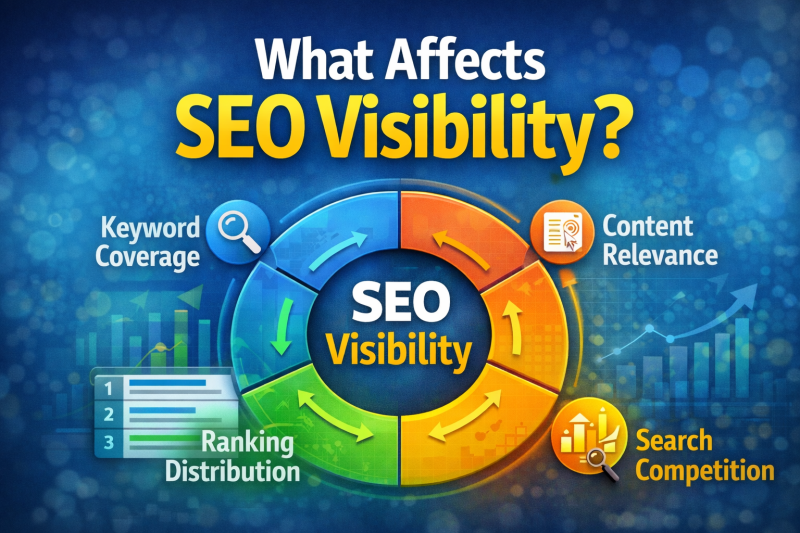
Ranking distribution matters too. Ten keywords in positions 3 to 8 usually contribute more to visibility than fifty keywords stuck in positions 40 to 60. What improves visibility is not just more keywords, but better placement across the search results.
This is where topic structure becomes important. If your content is scattered, duplicate, or thin, your keyword footprint may remain shallow even if you publish often.
Search intent and content relevance
Pages gain visibility when they match what people are actually looking for. A page can be technically optimized and still struggle if it does not answer the dominant intent behind the query.
For example, a keyword with clear informational intent often needs a straightforward definition, explanation, examples, and next-step guidance. A page that turns that intent into a vague sales pitch may not hold strong rankings even if the topic is relevant.
Search visibility improves when content is not only optimized, but clearly aligned with the real purpose of the query.
CTR, SERP features, and competition
Search results are not a flat list anymore. Visibility is also shaped by featured snippets, ads, AI-generated summaries, image packs, video blocks, local results, and other SERP features that compete for attention.
That means a page ranking in position 3 may not get the same real-world exposure it once did. CTR changes by query type, SERP layout, and competition level. In some spaces, even strong rankings can feel less visible because the page is pushed down by other elements.
This is also why modern SEO teams increasingly look beyond classic rankings and think about visibility in a more realistic SERP context.
How to Improve SEO Visibility
Improving visibility is not about chasing one metric. It usually comes from making the site easier to understand, easier to crawl, more aligned with search intent, and more competitive across related topics.
Build pages around clear search intent
Start with search intent, not just keywords. If the query is asking for a definition, explain the concept early. If it signals comparison, show distinctions. If it implies action, provide steps.
This is one reason many SEO pages underperform: they mention the keyword, but delay the real answer. Strong visibility often goes to pages that resolve the main question quickly, then expand with useful depth.
For informational topics, a good structure often includes:
- direct answer near the top
- Explanation in plain language
- examples or comparisons
- practical next steps
- FAQs that extend intent naturally
Strengthen internal linking and topic coverage
Internal linking helps search engines and users understand how your pages connect. It also helps distribute relevance across related content instead of leaving strong pages isolated.
If you want to improve visibility around a topic, build a tighter content system around it. That may include:
- a core guide targeting the main query
- supporting pages for related questions
- internal links that clarify topic relationships
- refreshed anchors that match user understanding
- fewer overlapping pages competing for the same intent
Improve titles, content quality, and on-page clarity
Visibility often improves when pages become easier to interpret at both the search-result level and the page level.
That means reviewing:
- title tags that are too vague or too broad
- headings that do not reflect search intent clearly
- intros that delay the answer
- content sections that overlap or ramble
- weak formatting that makes answers hard to scan
Better visibility often comes from better clarity. Not more words, just better structure and sharper communication.
>>> DIVE DEEPER: How to Do SEO Optimization: A Step-by-Step Guide
Common Mistakes When Reading SEO Visibility
SEO visibility is helpful, but it is also easy to misuse. Many teams overreact to small score changes or treat visibility as if it explains everything by itself.
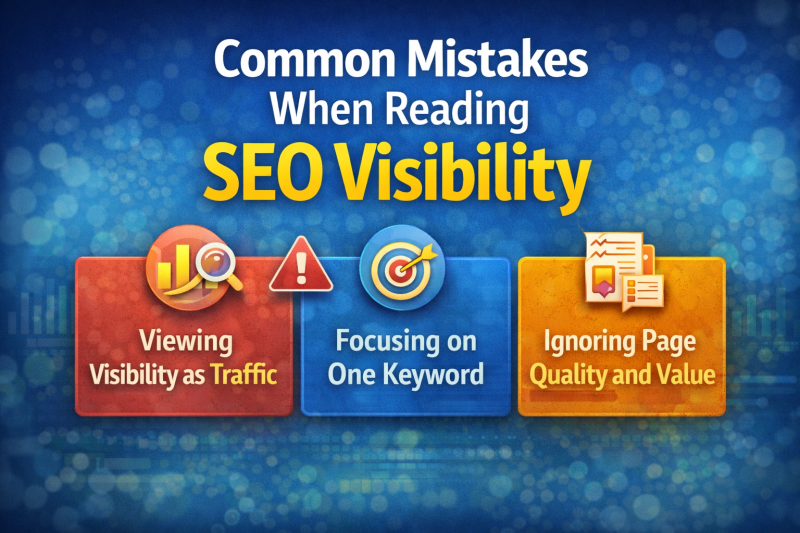
Treating visibility as traffic
Visibility is not traffic, and it is not revenue. It is a directional metric about search presence. If you treat it as a direct performance outcome, you may make the wrong decisions.
A site can gain visibility without gaining qualified traffic right away. It can also gain visibility for low-value queries that do not convert. The metric is useful, but only when read in context.
Focusing only on one keyword
One keyword rarely tells the full story. Search visibility is broader than a single ranking win or loss.
If your analysis centers only on one target term, you may miss whether your site is building stronger topic authority across related searches. A healthier view looks at clusters, page groups, intent coverage, and ranking patterns.
This is especially important for growing seo domain visibility, where the broader footprint matters as much as individual keyword trophies.
Ignoring page quality and conversion value
Not all visibility gains are equally valuable. Ranking more often is good, but ranking for the wrong topics or attracting the wrong visitors is not the same as meaningful SEO progress.
That is why visibility should be reviewed alongside:
- page relevance
- business fit
- conversion potential
- user experience
- content depth and trust signals
The best SEO work improves visibility in ways that also support better outcomes after the click.
>>> DIVE DEEPER: How to Learn SEO: A Practical Roadmap for Beginners
FAQ
Is SEO visibility the same as organic traffic?
No. SEO visibility measures how visible your site is likely to be in search results, while organic traffic measures actual visits from search. Visibility is about potential exposure. Traffic is about realized clicks.
What is a good SEO visibility score?
There is no universal “good” score that applies to every site. A strong score depends on your industry, keyword set, competitors, and current baseline. In most cases, trend direction and competitor comparison matter more than the raw number itself.
How long does it take to improve SEO visibility?
It depends on the topic, competition, site quality, and the type of changes you make. Some pages show visibility movement within weeks after content and internal-linking improvements, while more competitive queries may take much longer.
Do AI SEO tools change how visibility should be tracked?
Some teams now use ai seo tools visibility dashboards or AI-supported SEO platforms to identify patterns faster, but the core principle stays the same: visibility is still a directional measure of search presence. AI may help summarize changes, surface anomalies, or prioritize pages, but it does not replace the need to interpret rankings, intent match, and page quality carefully.
Conclusion
SEO visibility is a measure of how visible your site is in organic search across the keywords that matter to your business. It is not the same as traffic, and it is not a perfect score, but it is a useful way to understand whether your search presence is strengthening or weakening over time.
The most valuable way to use visibility is in context. Look at how it connects to rankings, impressions, page quality, keyword coverage, and business relevance. When you do that, visibility stops being just another number in a tool and becomes a clearer signal for better SEO decisions.
If you are working on search growth and want a more structured way to support strong pages with relevant placements, SEONetwork can be part of that process.
Check our Link Marketplace for the most balance and safest link building strategies.
>>> YOU MAY ALSO LIKE:
- What Makes a Good Landing Page in 2026?

I’m Jackson Avery, and I have 5 years of experience in content SEO. At SEONetwork, I share practical SEO knowledge, insights, and content strategies to help readers better understand search intent, content optimization, and sustainable organic growth.