
If you are asking how many backlinks do I need to rank, the honest answer is that no fixed number works for every page. If you are planning to buy backlinks, the harder question is not just how many you need, but which placements are actually worth paying for. One page may move with a handful of relevant links, while another may need much more support because the keyword, the SERP, and the strength of competing pages are completely different.
This article explains what actually determines backlink needs, how advertisers can estimate them before spending, and what to look at before turning backlink volume into a budget decision.
Why does no fixed number of backlinks guarantee rankings?
A lot of advertisers want a clean benchmark before they start planning a campaign. That is understandable. If you are investing in SEO, you want to know whether you need five backlinks, fifty, or something in between. The problem is that rankings do not respond to link count alone. They respond to context.
Rankings depend on the keyword and competition
The number of backlinks needed for a low-competition keyword is not the same as the number needed for a competitive commercial query. If the top results are backed by strong domains, solid content, and years of accumulated authority, the threshold is naturally higher.
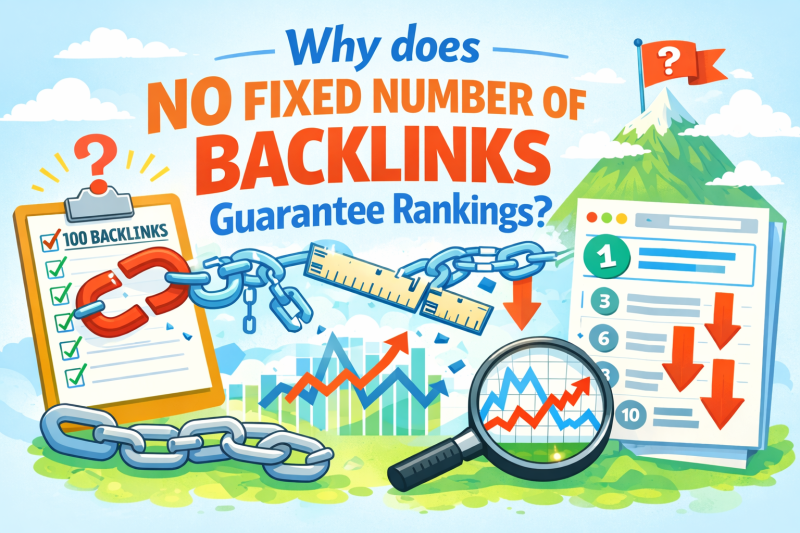
This is why the question is never just “how many backlinks do I need to rank?” It is really “how many backlinks do I need to compete for this keyword against these pages?” That distinction matters because it shifts the focus from generic benchmarks to real search conditions.
Different pages need different levels of backlink support
Not every page on a website has the same job. A product page, a category page, a local service page, and a blog article can all need different types and levels of support.
Some pages rank with very little backlink help because the query is specific and the page matches intent well. Other pages struggle even with decent links because they are trying to compete in a much tougher part of the SERP. That is why advertisers often miscalculate backlink needs when they assume one link strategy should work across every page.
Relevance and page strength matter as much as link count
Two websites can each have ten backlinks pointing to a page and still perform very differently. The difference often comes down to relevance, quality, and page strength.
A smaller number of contextually strong backlinks can outperform a larger number of weak or mismatched placements. At the same time, a page with thin content or poor intent alignment may not rank well even if you keep adding links. Backlinks help, but they work best when they support a page that already deserves visibility.
>>> READ MORE: Off Page SEO Checklist: What To Review, Build, And Improve
What actually determines how many backlinks you may need
Once you move past the idea of a universal number, the next step is understanding what actually shapes backlink demand. In practice, several factors work together. That is why estimating backlink needs is less about finding a magic number and more about reading the competitive landscape accurately.
Keyword difficulty and SERP competition
The keyword itself is the first thing to evaluate. A query with low competition may not need much link support if the current top-ranking pages are not especially strong. A high-intent keyword with clear commercial value usually attracts better-optimized competitors, which changes the link requirement immediately.
The more valuable the keyword, the more likely it is that other advertisers are actively investing in content, authority, and backlinks around it. That is why the number you need for one query can look completely unreasonable for another.
The authority of the pages already ranking
Many people look only at domains when reviewing competition, but the actual ranking pages matter just as much. Sometimes, a very strong domain is ranking with a page that is only loosely optimized. In other cases, the page itself is highly focused, deeply linked internally, and backed by strong referring domains.
What matters is not just who owns the ranking result, but how strong that individual URL is. If the pages above you already have relevant backlinks, established authority, and solid topical support, your page will likely need more than a token effort to catch up.
Your content quality, intent match, and internal linking
Backlinks do not operate in isolation. A page that matches search intent well, answers the query clearly, and sits within a strong internal linking structure often needs fewer external links than a weaker alternative.
This is one of the most important points for advertisers. If a page is underperforming because the content is shallow, the structure is weak, or the intent is slightly off, backlinks may help less than expected. The more aligned and useful the page already is, the more efficiently backlinks can support it.
The overall trust level of your website
A new or weaker site usually needs to work harder than an established one. That does not always mean more backlinks dramatically, but it does mean the broader trust level of the website influences how easily individual pages can move.
A site with stronger topical coverage, better internal architecture, and more established authority often gets more out of each backlink. A site without that foundation may need additional support across multiple pages before rankings become more stable.
How to estimate backlink needs before you start building
This is the part advertisers usually need most. Even if there is no exact number, you still need a practical way to estimate the scope before you start buying placements or planning campaigns. Before you create backlinks or invest in placements, you need to understand what the current SERP is actually demanding.
The goal is not to produce a perfect prediction. The goal is to make a more informed decision than simply guessing or copying someone else’s link count.
Review the top-ranking pages for your target keyword
Start by looking closely at the pages currently ranking for the exact keyword you care about. Not just the domains, and not just the first result. Review several top pages and pay attention to what kind of content is winning.
You are looking for patterns. Are the ranking pages highly detailed? Are they clearly commercial, informational, or mixed? Do they appear to belong to well-established sites? This tells you what type of page you are actually competing against before you turn backlink planning into a numbers exercise.
Compare referring domains, relevance, and content strength
The next step is to look at referring domains, but with more judgment than people usually apply. A page with many weak referring domains is not necessarily stronger than a page with fewer but more relevant ones.
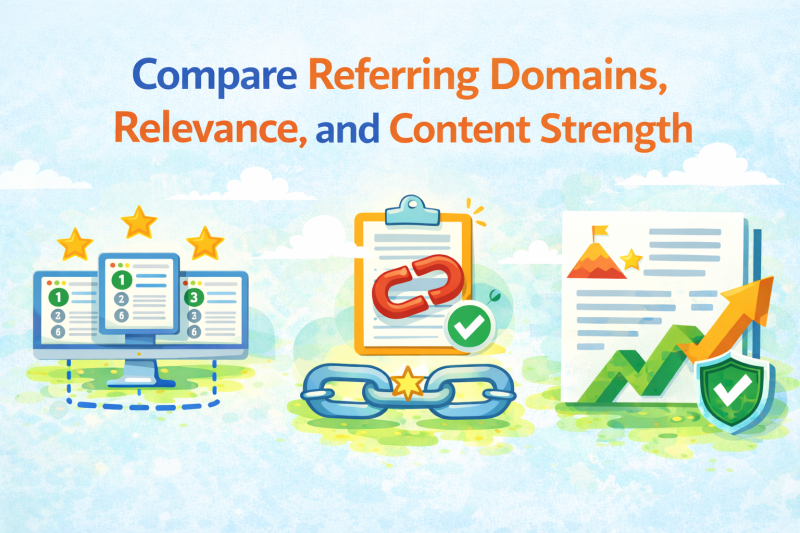
As you compare top-ranking pages, focus on the combination of factors. Look at how many referring domains they have, whether those links appear contextually relevant, and how strong the page itself feels. If the page is well written, clearly aligned with intent, and supported by a healthy backlink profile, that gives you a more realistic baseline.
Look for the gap you need to close, not just a random benchmark
This is where better backlink planning usually happens. You do not need a mythical perfect number. You need to understand the gap between your page and the pages already winning.
Sometimes that gap is large, and a few backlinks will not be enough. Sometimes the gap is much smaller than expected, and a more selective campaign can make sense. Either way, the right question is not “what number do people usually recommend?” but “what does this SERP suggest my page is missing?”
That is a much more useful way to estimate backlink needs before you spend money or time.
>>> READ MORE: Buy Backlinks, Buy Guest Posts & Backlink Services | SEONetwork
Mistakes advertisers make when they focus only on backlink numbers
When advertisers think about backlinks mainly as a quantity target, planning gets distorted quickly. The result is often overspending, weak placements, or unrealistic expectations about what links can fix.
Chasing quantity without relevance
This is one of the most common mistakes in backlink planning. A campaign may look productive because the number of acquired links is growing, but if those links are poorly matched to the page or the niche, the impact can be limited.
Relevance is what turns a backlink into something more meaningful than just another URL mention. Without relevance, volume often becomes an expensive distraction.
Expecting backlinks to fix weak pages
Backlinks can support strong pages. They do not reliably rescue weak ones.
If a page is thin, unfocused, or poorly aligned with search intent, adding more backlinks may not create the result you want. This is where advertisers sometimes overestimate the power of link acquisition and underestimate the importance of page quality. In many cases, improving the page and improving the backlink profile should happen together.
Using the same link strategy for every keyword
A page targeting a narrow informational query may not need the same level of support as a page targeting a competitive bottom-funnel keyword. Yet many campaigns use one repeatable link formula for everything.
That approach can create waste in both directions. Some pages receive more support than they need, while others remain underpowered because the strategy was not adapted to the actual competition.
Buying placements without a clear ranking goal
Not every backlink campaign starts with a clearly defined target. Sometimes advertisers buy placements because they know backlinks matter, but they have not decided which page they are supporting, what keyword movement they are aiming for, or what gap they are trying to close.
That usually leads to scattered execution. The more clearly you define the ranking goal before placing links, the easier it becomes to judge whether a placement fits the campaign.
>>> READ MORE: Does Google Reviews Help SEO?
How SEONetwork helps advertisers assess placements more clearly
By the time advertisers start evaluating backlink opportunities, the real issue is often not whether links matter. It is whether the process of finding and comparing placements is clear enough to support good decisions.
That is the problem we aim to make easier at SEONetwork.
A lot of link buying becomes inefficient because the research process is fragmented. Opportunities come from different conversations, pricing is inconsistent, quality standards vary, and comparison becomes harder than it should be. For advertisers, that makes a simple question like how many backlinks do I need even harder to answer, because the supply side is not easy to assess clearly.
SEONetwork is built to make that evaluation process more structured. Instead of treating every placement as an isolated negotiation, advertisers can review options in a clearer environment, compare relevance and fit more easily, and make decisions with better context. That does not mean every opportunity is automatically right. It means the process of judging placements becomes less messy.
This matters because backlink planning is not only about how many links you need. It is also about whether the links you choose are worth buying in the first place. If the evaluation process is unclear, even a good budget can end up producing weak decisions.
For advertisers who want to support rankings without relying entirely on manual outreach, a more structured marketplace approach can make backlink planning more practical. It gives you a better shot at matching placements to page goals instead of buying links in a scattered way.
If you are trying to estimate backlink needs and also want a clearer way to assess placements, SEONetwork is designed to help make that process more manageable, more comparable, and less guess-driven.
Check our Link Building Marketplace for the most balance and safest link building strategies.
FAQ
The most useful way to close this topic is to answer the questions advertisers usually ask once they realize there is no universal backlink number.
How many backlinks do I need to rank?
No fixed number guarantees rankings. The real answer depends on the keyword, the strength of the pages currently ranking, the quality of your page, and the overall authority of your website. In some cases, a few relevant backlinks can be enough to move a page. In others, the competitive gap is much larger.
How many high-quality backlinks do I need?
The phrase “high quality” matters more than the number itself. A small number of highly relevant, credible backlinks can do more than a larger set of weak placements. The right estimate depends on how strong those backlinks are, how competitive the SERP is, and whether your page is already well optimized.
Is quality more important than quantity in backlinks?
In most cases, yes. Quantity still matters at some level because competition is real, but quality changes the value of every backlink you acquire. A campaign built around relevant, well-placed links is usually stronger than one built around volume alone.
Can I rank with only a few backlinks?
Yes, that is possible for some keywords and some pages. If the competition is moderate, the page is strong, and the backlinks are relevant, only a few may be enough to help. But that should not be treated as a general rule. Competitive queries often require much more support.
How do I know whether my page needs more backlinks?
Start by reviewing the SERP and comparing your page against the pages already ranking. If they have stronger referring domains, better topical authority, and more complete content support, your page may need more link equity or stronger overall optimization. The answer usually becomes clearer once you look at the gap instead of the raw number alone.
In the end, the best answer to how many backlinks do I need is not a number pulled from a generic checklist. It is a competitive estimate based on the keyword, the page, and the quality of the support you are building around it. That is the mindset that helps advertisers plan more intelligently and buy placements with a clearer purpose.
>>> YOU MAY ALSO LIKE:
- How Long Does It Take For Backlinks To Work? A Realistic SEO Timeline

I’m Jackson Avery, and I have 5 years of experience in content SEO. At SEONetwork, I share practical SEO knowledge, insights, and content strategies to help readers better understand search intent, content optimization, and sustainable organic growth.