
How to buy backlinks is not just about finding websites that sell placements. The harder part is comparing relevant publishers, understanding pricing clearly, and choosing pages that are actually worth supporting.
SEONetwork is built to simplify that process for advertisers. Instead of relying on scattered outreach and inconsistent offers, brands can evaluate publishers, compare placements, and move forward with more clarity.
Why Buying Backlinks Feels Harder Than It Should?
Most advertisers do not struggle because there are too few websites selling placements. They struggle because the process is fragmented.
One publisher replies by email with a brief offer. Another sends pricing without enough useful site context. A third gives a number that looks acceptable until you realize the page is a poor fit, the audience is irrelevant, or the content environment is weak. By the time an advertiser compares ten options this way, the real problem becomes obvious: buying backlinks is often less about access and more about clarity.
That is why the usual advice around buying backlinks often feels incomplete. It talks about relevance, authority-style metrics, anchor text, and page fit, but it rarely solves the workflow problem. Advertisers still need a practical way to compare publishers, review placements, and make decisions without chasing disconnected offers one by one.
SEONetwork exists to make that process easier. For advertisers, the value is not only in finding available placements. It is in seeing the buying decision more clearly from the start.
What Advertisers Should Actually Look For Before Buying a Backlink
A good backlink opportunity should make sense even before you ask whether it is worth paying for.
The first thing to check is relevance. If the publisher’s content has little to do with the page you want to promote, the link will always be weaker in practice, no matter how attractive the numbers look on paper. A backlink works best when the content environment and the destination page naturally belong in the same conversation.
The second thing is page quality. Many advertisers focus heavily on the publisher, but the destination page matters just as much. If you are sending a placement to a thin landing page, a weak service page, or a blog article that does not really answer anything well, the backlink is doing more work than the page deserves. That is rarely a good use of the budget.
The third thing is placement context. A link placed inside content that feels natural, readable, and relevant will usually be stronger than one dropped into a page simply because there was space to insert it. Context affects trust. It affects how readers interpret the placement. It also affects whether the link feels like a real part of the page or just an obvious transaction.
The fourth thing is pricing clarity. One of the easiest ways to waste budget is to compare placements without enough context to understand what you are actually buying. A lower price does not automatically mean better value. A higher price does not automatically mean better quality. What matters is whether the publisher, the page, and the placement fit the goal you are trying to support.
This is exactly where SEONetwork becomes more practical than fragmented outreach. Instead of collecting disconnected offers and trying to piece together the decision manually, advertisers get a clearer workflow for comparing relevant publishers and judging placements with more consistency.
Why Random Outreach Creates So Much Friction
Random outreach makes backlink buying harder than it needs to be because it turns every decision into a separate negotiation.
That may sound flexible, but in practice it often creates more confusion than control. Advertisers end up working across email threads, inconsistent publisher responses, incomplete information, and offers that are difficult to compare fairly. Even when strong opportunities exist, the process of finding and evaluating them takes more time than it should.
This is especially frustrating when an advertiser already knows what kind of page they want to support. The issue is no longer strategy. The issue is execution. They need a clearer way to move from page goal to publisher selection without getting trapped in manual back-and-forth.
A backlink marketplace helps solve that problem because it reduces the mess. It brings publisher discovery, comparison, and transaction flow into one place. That is not just a convenience improvement. It is a decision-quality improvement.
SEONetwork is valuable here because it helps advertisers stop buying in the dark. The process becomes more structured, which means fewer low-context decisions and better control over where the budget goes.
Why a Marketplace Makes More Sense for Advertisers?
Backlink buying becomes much easier when the process is built around comparison rather than guesswork.
Advertisers usually need to answer the same practical questions every time they buy a placement. Is this publisher relevant? Does the content environment make sense for the page I want to support? Is the pricing reasonable? Will this placement actually help me move the right page forward, or am I simply buying another disconnected mention?

When those questions are answered across separate publishers in separate formats, the work becomes slower and more error-prone. When they are answered in one place, the decision becomes clearer.
That is why a marketplace model fits advertiser needs so well. It is not just about speed. It is about giving advertisers a more consistent way to review options, compare placements, and avoid weak buys.
SEONetwork makes that process more manageable by creating a cleaner path from search to evaluation to purchase. Instead of relying on scattered outreach, advertisers can approach backlink buying as a structured publisher-comparison process.
How SEONetwork Helps Advertisers Buy Backlinks More Clearly
SEONetwork helps advertisers move from messy buying to informed buying.
The biggest difference is visibility. Advertisers can review publisher opportunities with more context instead of trying to reconstruct that context from separate conversations. That makes it easier to compare like for like, spot stronger fits faster, and avoid spending time on placements that were never a good match in the first place.
The second difference is workflow. Buying backlinks manually often means repeating the same research and communication steps across too many separate channels. SEONetwork reduces that fragmentation by creating a more centralized process. For advertisers, that means less time spent chasing answers and more time spent making actual page-level decisions.
The third difference is decision quality. A clearer marketplace environment makes it easier to focus on the things that matter most: relevance, fit, page quality, and buying intent. That is ultimately what advertisers need if they want backlink buying to support real growth rather than just fill a spreadsheet.
This is why the SEONetwork angle should not be understood as “another place that sells links.” The stronger positioning is that SEONetwork gives advertisers a better way to buy placements because the workflow is built around comparison, relevance, and clarity.
>>> EXPLORE FURTHER: Buy Backlinks, Buy Guest Posts & Backlink Services | SEONetwork
What Type of Pages Should Advertisers Support First
Not every page deserves paid placement support equally. This is one of the most important decisions in the whole process.
A blog article is often the easiest page type to support first because it gives publishers and readers something useful to connect with. If the article answers a real question, explains a topic clearly, or offers something worth reading, it usually fits more naturally inside off-site content. Informational assets often give advertisers more flexibility when choosing relevant publisher environments.
A service page can also be worth promoting, but the quality bar should be higher. The page needs to be clear, useful, and commercially ready. If it feels too thin, too generic, or too sales-heavy without enough substance, even a strong placement may struggle to create real value.
A category page or commercial hub can work when it already has strong internal structure and clear positioning. These pages usually need more careful publisher matching because the commercial intent is stronger and the context has to work harder.
The key point is that advertisers should not buy placements to rescue weak pages. They should buy placements to support strong pages more effectively. Once the destination page is clear, SEONetwork makes it easier to find publishers that match the topic, audience, and intent of that page.
Buying Backlinks the Right Way Means Buying More Selectively
A smarter buying strategy usually starts smaller and more selectively than people expect.
Instead of trying to place links everywhere at once, many advertisers get better results by starting with one clear page goal, one small group of suitable publishers, and one defined campaign angle. That creates a stronger feedback loop. It becomes easier to see what kinds of placements fit best, which content environments support the page naturally, and where future spend should go.
This is a more useful way to think about how to buy backlinks than chasing scale too early. Buying more does not automatically produce better outcomes. Buying more selectively often does.
That is another reason SEONetwork fits the advertiser workflow so well. It supports selective buying better than scattered outreach does. When the process is clearer, selectivity becomes easier. And when selectivity becomes easier, the quality of decisions usually improves.
Why Advertisers Should Buy Placements Responsibly
There is one part of this topic that should be handled clearly.
Google’s spam policies say buying or selling links for ranking purposes is considered link spam, including exchanging money for links or posts that contain links. Google also recommends qualifying paid links with rel="sponsored" and notes that nofollow is still acceptable if needed.
That is why responsible advertisers should think in terms of buying placements, not treating paid links like hidden ranking shortcuts. If money changes hands, the placement should be handled transparently. The practical value then comes from relevance, visibility, audience fit, and page support, not from pretending the transaction is something it is not.
SEONetwork fits that approach much better than informal outreach because it gives advertisers a more structured way to review publishers, compare opportunities, and make cleaner commercial decisions from the start.
>>> READ MORE: Off Page SEO Checklist: What To Review, Build, And Improve – SEONetwork
Common Backlink Buying Mistakes SEONetwork Helps Reduce
A lot of poor backlink buying decisions happen because advertisers are forced to decide with too little context.
One common mistake is buying on price alone. Cheap placements often look appealing in isolation, but if the publisher is weak, the page is irrelevant, or the content environment does not fit, the budget is still being wasted.
Another mistake is choosing sites based only on surface metrics. Metrics can help with filtering, but they do not replace contextual judgment. A site can look strong in a tool and still be a poor place for your brand or your page.
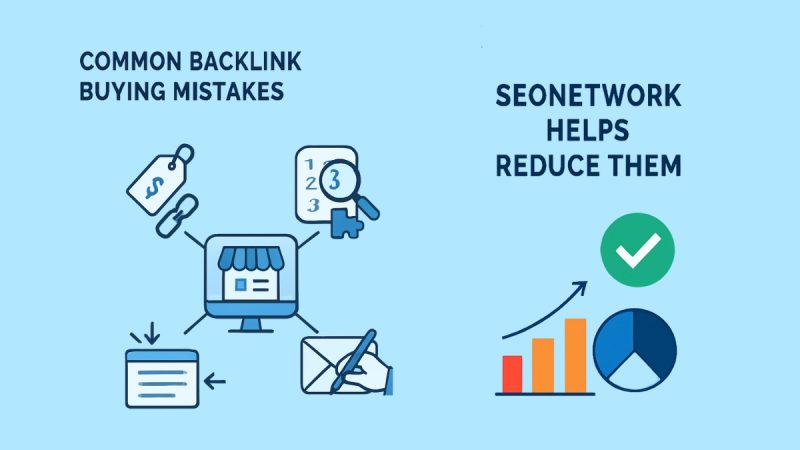
A third mistake is pushing all placements to the same destination page without asking whether that page is truly the right target. Good campaigns usually work better when support is distributed intentionally across pages that are actually worth amplifying.
A fourth mistake is relying too heavily on manual outreach and one-off negotiations. That usually leads to inconsistent publisher comparison, slower decision-making, and weaker control over quality.
SEONetwork helps reduce these mistakes because it gives advertisers a more structured way to compare options before buying. The platform does not eliminate judgment, but it improves the conditions in which that judgment happens.
Why More Advertisers Are Choosing SEONetwork
Advertisers do not just need more backlink opportunities. They need a more practical way to evaluate them.
That is why more brands are drawn to a marketplace model instead of relying entirely on manual publisher discovery. The value is not just access. The value is a buying process that feels easier to understand and easier to control.
SEONetwork helps advertisers compare publishers faster, judge placements more clearly, and reduce the friction that usually comes with fragmented outreach. For brands that want to support the right pages without wasting time on disconnected offers, that structure matters.
The result is not just convenience. It is a better path to making stronger backlink-buying decisions.
Buying backlinks becomes much easier when the process is built around relevance, comparison, and page-level decision-making. The real challenge is usually not finding websites that sell placements, but finding the right publishers, understanding the offer clearly, and supporting pages that are actually worth promoting.
Google’s guidance makes the boundaries clear: buying links for ranking purposes falls under link spam, and paid links should be qualified appropriately.
That is why the better question is not simply how to buy backlinks. The better question is how to buy them in a way that gives advertisers more clarity, more control, and fewer weak decisions.
SEONetwork is built to make that process easier for advertisers. For brands that want a clearer way to compare publishers, review placements, and buy backlinks with less friction, SEONetwork offers a more structured path forward.
Check our Link Building Marketplace for the most balance and safest link building strategies.
FAQs
Is buying backlinks against Google’s rules?
Google’s spam policies say buying or selling links for ranking purposes is considered link spam. It also recommends qualifying paid links appropriately, with rel="sponsored" preferred.
Should advertisers only buy followed links?
Not necessarily. The more useful first question is whether the placement is relevant, visible, and worth buying as a real commercial placement. Paid links should be handled in line with Google’s guidance.
What kind of page should I promote first?
Usually the page that is already strong enough to deserve support: a useful guide, a clear service page, or a well-structured category page. Backlink buying works better when the destination page is already worth amplifying.
Why is random outreach such a weak buying workflow?
Because it creates fragmented comparisons. Advertisers end up judging different publishers through different emails, different formats, and incomplete information, which makes good decisions slower and harder.
Why buy through SEONetwork instead of doing everything manually?
SEONetwork gives advertisers a more structured way to compare publishers, review placements, and reduce the friction that comes with disconnected outreach. That usually leads to clearer decisions and better page support over time.
>>> YOU MAY ALSO LIKE:
- How to Create Backlinks That Actually Move The Needle in 2026

I’m Jackson Avery, and I have 5 years of experience in content SEO. At SEONetwork, I share practical SEO knowledge, insights, and content strategies to help readers better understand search intent, content optimization, and sustainable organic growth.