
Link building prices can range from relatively low-cost placement packages to much higher-budget outreach and digital PR campaigns, depending on what is actually included and how selective the quality standard is. In current market guides and surveys, common pricing ranges run from roughly $150 to $1,500+ per link, while monthly retainers often land somewhere between $3,000 and $15,000+, with higher budgets in more competitive or labor-intensive campaigns.
The problem is that two quotes at very different price points are often not buying the same thing. One may cover little more than access to a weak site, while another may include selective prospecting, editorial review, content coordination, and more credible placement quality. This article explains what link building prices usually include, what rough cost patterns buyers should expect by service type, what drives quotes up or down, and how to judge whether a price is actually worth paying.
The Short Answer: What Link Building Usually Costs
There is no single standard price for link building, but there are useful budget patterns.
At the broadest level, current market references place outsourced link building anywhere from about $100 to $1,500+ per link, with more typical quality-focused manual or selective placements often clustering higher than bargain packages. Monthly campaign budgets commonly start around $3,000 and can rise well past $15,000, especially when the work includes selective outreach, competitive niches, or stronger process overhead.
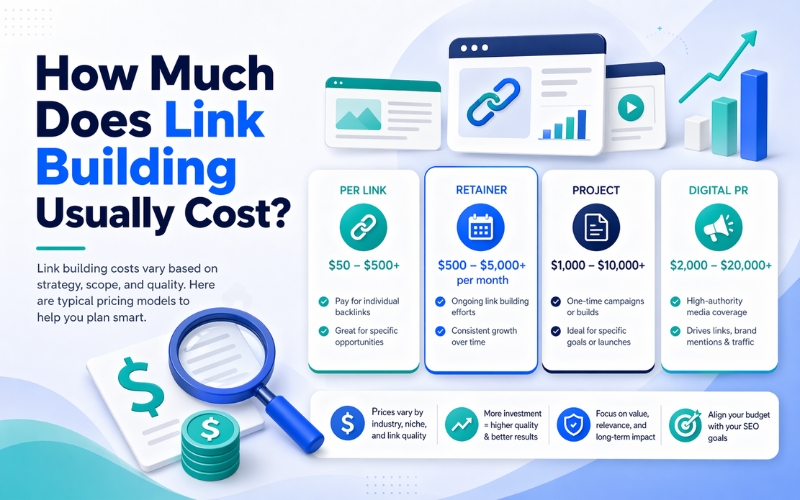
That range is wide because “link building” is not one product. A low-cost niche edit on a weak page, a guest post that includes content writing, a manual outreach placement, and a digital PR campaign are not interchangeable offers with different packaging. They involve different labor, different access, different quality standards, and very different levels of editorial credibility.
So the more useful answer is not one fixed number. It is important that pricing should be read in context. A quote only makes sense when you know what process, site quality, placement logic, and campaign type sit behind it.
What You Are Actually Paying For
One reason pricing feels inconsistent is that buyers are often not paying for the same work.
A meaningful part of link building cost usually sits in prospecting and qualification. That includes finding sites, checking whether they are topically relevant, reviewing the editorial environment, and filtering out weak opportunities before any placement discussion even starts. If that filtering is real, it is part of the price.
Another cost layer sits in outreach and communication. Manual outreach, contact research, follow-up, negotiation, and publisher coordination all add labor. That is one reason selective outreach-driven campaigns often look expensive when compared only by cost per finished link. You are paying for the work required to get to the placement, not just the final URL.
In many cases, pricing also includes content and placement coordination. A full guest post usually involves more than placement access alone. It may include article writing, revisions, formatting, anchor fit, and destination-page alignment. In contrast, a simple link insertion may skip some of that work but still vary greatly in value depending on the strength of the existing page.
Finally, stronger providers usually build in reporting and quality control. That means checking whether the final placement matches the agreed standard, whether the page context is acceptable, and whether the live result is actually worth counting. That kind of discipline is part of what makes one quote more defensible than another.
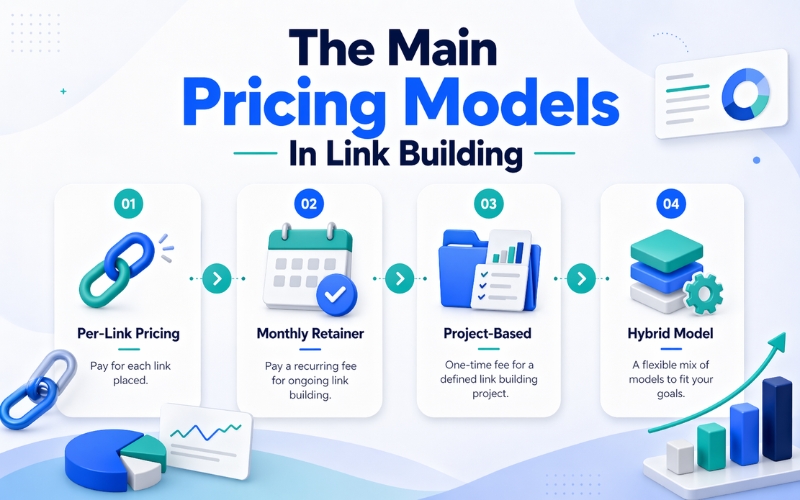
The Main Pricing Models In Link Building
Not all link building services charge in the same way, and the pricing model often shapes the incentives behind the work.
Per-Link Pricing
Per-link pricing is the easiest model to understand. You pay for a specified number of finished links or placements. This can be useful for simple budgeting, but it also creates risk when links are compared only by count, DR, or traffic. A per-link model can look efficient while hiding big differences in relevance, page quality, and editorial fit.
Monthly Retainer Pricing
Monthly retainers are common when the provider is handling ongoing prospecting, outreach, coordination, content support, and reporting. Current industry references often place retainers somewhere around $3,000 to $15,000+ per month, though some campaigns go higher. This model can work well for ongoing support, but it becomes vague quickly if deliverables and review standards are not defined clearly.
Project-Based Pricing
Project pricing tends to fit campaigns with a defined scope, such as a launch, category push, or asset-led outreach effort. This model can be cleaner when the goals are stable, but it is less useful when priorities keep shifting.
Hybrid Or Performance-Oriented Pricing
Some providers combine a base fee with per-link pricing or milestone logic. That can align incentives better, but only if success is judged on fit and placement quality rather than raw link count. Otherwise, the model can still drift toward easy volume.
Rough Price Expectations By Service Type
This is the section many buyers actually need. These ranges are directional market references, not guarantees, and the overlap is real. Still, they give you a more honest starting point than pretending every link service should cost the same.
Guest Post Placements
BuzzStream’s 2025 pricing analysis put the average guest post link at $365, while higher-quality guest posts averaged about $930 when filtered through stronger traffic and DA/DR thresholds. Reporter Outreach’s 2026 pricing guide also places quality link building broadly in the $150 to $1,500+ per link range depending on method and site tier.
That means a guest post quote may be reasonable at very different levels depending on what is included. A low-cost post on a weak site is not the same product as a stronger placement with real editorial standards and content coordination.
Niche Edits And Link Insertions
BuzzStream’s 2025 analysis reported average link insertion pricing around $141, but also noted that these lower-cost insertions are rarely offered on the stronger, higher-traffic sites buyers usually imagine they are getting.
This is where pricing gets deceptive fast. Cheap insertions can look efficient, but if the host page is weak, irrelevant, or obviously commercial, the lower number often reflects lower value rather than a better deal.
Manual Outreach And Selective Placements
Siege Media’s 2026 cost guide says manual link vendors typically charge around $500 to $1,250 per link for most businesses, with harder verticals pushing quality manual links into roughly the $800 to $1,000+ range and competitive niches even higher.
That fits the broader pattern: labor-heavy, relevance-driven campaigns usually cost more because the work includes qualification, outreach, follow-up, and stronger editorial screening.
Digital PR Campaigns
Digital PR is harder to compress into a simple per-link model. BuzzStream’s 2025 digital PR survey reported an average monthly contract of $5,458, with many retainers under $10,000 and about half below $5,000. The same survey found an average cost per link of $597, though the range varied significantly by service type and campaign structure.
That is why digital PR should not be judged the same way as a simple placement-buying model. The value is tied more to campaign outcomes, coverage potential, and creative or editorial lift than to one predictable cost per link.
What Usually Makes Prices Go Up Or Down
Prices do not vary only because of DR or traffic. They vary because the actual work and standards behind the link vary.
A campaign with stronger relevance and quality filters usually costs more than one that accepts almost any site with decent-looking metrics. A harder industry or niche can also raise the price because there are fewer accessible publishers, stricter editorial barriers, or stronger competition for attention.
Outreach complexity matters too. Selective, relationship-based outreach usually costs more than a more standardized campaign because the labor is heavier and the opportunities are harder to secure. Content requirements can raise the price further when the provider is also handling original articles, revisions, expert input, or publisher-specific formatting. Finally, provider structure affects the quote. Agencies, freelancers, and marketplace-led workflows often price differently because they solve different parts of the problem.
This is why a quote should never be judged in isolation. The number only means something when you know which of these cost drivers are actually present.
Cheap Vs Expensive: What The Price Usually Signals
Pricing alone does not tell you enough, but it often signals where shortcuts may be happening.
Very cheap packages often reduce cost by lowering standards somewhere in the chain. That may mean weak site qualification, generic outreach, thin pages, low-value editorial environments, or placements that exist largely to sell links. BuzzStream’s 2025 analysis noted that only 7.6% of guest post opportunities in its study met stronger quality standards, which helps explain why low-cost volume offers often break down once you inspect the actual placements.
At the same time, expensive pricing does not automatically mean quality. Some providers charge premium rates while still hiding weak decision-making behind polished reports or metric-heavy positioning. A higher quote is justified only when the process, placements, and quality controls are visibly stronger.
A reasonable price usually reflects a believable mix of relevance, placement fit, process quality, and execution clarity. That is what makes a quote easier to trust.
How To Compare Link Building Quotes More Realistically
The best way to judge pricing is to compare it against decision quality rather than raw output.
Look Beyond DR And Traffic
Metrics can help with screening, but they do not define whether the price is fair. A strongly relevant placement on a clean page may be worth more than a higher-metric placement on a broad site with weak editorial fit.
Review Real Placements
Ask to see actual links, not just case studies or brand logos. Look at the site, the page, the anchor usage, the surrounding content, and the destination-page fit. This is usually where underpricing and overpricing both become easier to spot.
Understand The Process Behind The Quote
A quote makes more sense when you know what sits behind it. Ask how prospects are found, who reviews them, what standards are used, how approvals work, and how weak opportunities are filtered out. A weak process often hides behind attractive output numbers.
Compare Value, Not Just Link Count
A lower per-link cost is not always more efficient. If the links are weakly relevant, poorly placed, or hard to defend editorially, the cheaper campaign may be worse value overall.
>>> EXPLORE FURTHER: Manual Outreach Link Building: How It Works And When It Still Makes Sense
A Simple Practical Comparison
Imagine two vendors quote you for 10 links.
Vendor A offers 10 links for $1,500 total. The pitch is built around DR tiers and speed, but the process is vague, placement examples are weak, and site approval is limited.
Vendor B offers 10 links for $6,000 total. The price is higher, but the provider shows how sites are qualified, how pages are reviewed, what kinds of placements are avoided, and how the campaign ties links to specific destination pages.
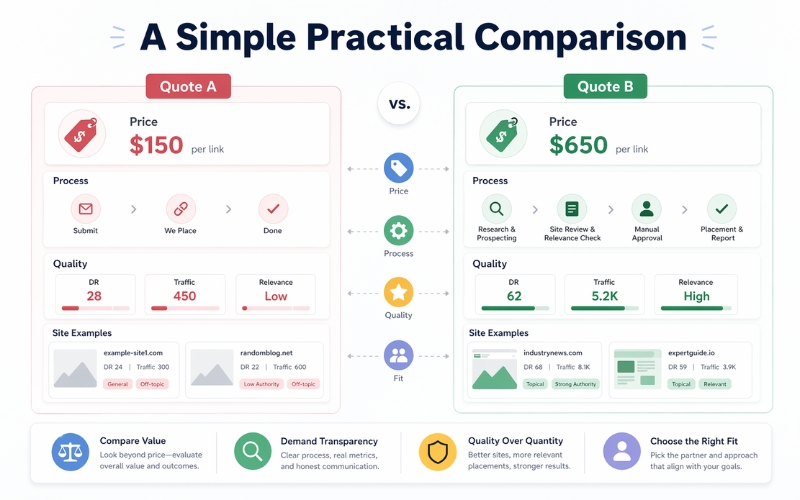
Vendor A is not automatically a bad deal, and Vendor B is not automatically a good one. But the second quote is easier to evaluate because the logic behind the price is visible. That is the real lesson with link building prices: the better quote is usually the one you can audit, not the one that sounds cheaper or more premium on its own.
Agency, Freelancer, Or Marketplace: Which Delivery Model Fits Best?
Different provider models solve different problems.
Agencies
Agencies often provide more structure, deeper reporting, and broader operational support. They tend to fit ongoing campaigns where the team wants consistency and managed execution. That is one reason agency-led campaigns often sit in the higher retainer range.
Freelancers
Freelancers can be more flexible and sometimes more affordable. They may fit smaller campaigns or teams that want closer collaboration. The trade-off is that process depth, review consistency, and reporting can vary more from one freelancer to another.
Marketplace-Led Workflows
A marketplace-led model can make sense when the team wants more transparency in how opportunities are browsed, compared, and approved. This is especially useful when pricing decisions become messy because the real problem is inconsistent site comparison rather than a lack of link options.
>>> EXPLORE FURTHER: Should You Outsource Backlink Building? When It Makes Sense And How To Do It Well
How SEONetwork Helps Teams Compare Link Building Prices More Clearly
One reason link building prices are hard to compare is that the real differences are not always visible in the quote itself. Two offers may look similar at the top line while hiding very different standards around site quality, editorial context, process discipline, and placement fit.
As a backlink marketplace, SEONetwork helps advertisers and publishers compare placement opportunities through a more structured workflow. For teams trying to judge pricing more realistically, that kind of transparency makes it easier to compare options by relevance, approval clarity, and execution quality rather than looking at the number alone.
Conclusion
Link building prices vary because the work behind the links varies. In today’s market, rough benchmarks may run from around $150 to $1,500+ per link or $3,000 to $15,000+ per month, but those numbers only become useful when you understand the service type and standards behind them.
The cheapest quote is rarely the most useful benchmark, and the highest quote is not automatically the safest choice. What matters is whether the price matches the relevance, process clarity, and placement quality your campaign actually needs. If your team keeps getting stuck between low-cost volume offers and expensive but vague promises, the next upgrade is not just a better vendor. It is a better framework for comparing link opportunities in the first place.
Check our Link Building Marketplace for the most balance and safest link building strategies.
FAQ
How Much Do Link Building Services Usually Cost?
There is no universal price, but current market references commonly place link building somewhere between $150 and $1,500+ per link, while monthly retainers often range from $3,000 to $15,000+ depending on service type, niche difficulty, and process depth.
Why Are Some Backlinks So Expensive?
Some backlinks cost more because they require harder outreach, better publisher access, stronger editorial standards, higher niche difficulty, or more selective quality control.
Are Cheap Link Building Packages Worth It?
Sometimes, but often not. Very low-cost offers frequently reflect shortcuts in site qualification, relevance, or editorial quality rather than genuine efficiency. BuzzStream’s 2025 analysis found that only a small share of guest post opportunities passed stronger quality filters.
Is Paying Per Link Better Than A Monthly Retainer?
Not always. Per-link pricing is easier to compare, but retainers can make more sense for ongoing campaigns that need coordinated support across prospecting, outreach, content, and reporting.
How Do You Know If A Link Building Price Is Fair?
A fair price becomes much easier to judge when you review real placements, understand the process behind the quote, and compare cost against fit and quality rather than link count alone.
>>> YOU MAY ALSO LIKE:
- Buy Backlinks, Buy Guest Posts & Backlink Services | SEONetwork
- Off Page SEO Checklist: What To Review, Build, And Improve – SEONetwork

I’m Jackson Avery, and I have 5 years of experience in content SEO. At SEONetwork, I share practical SEO knowledge, insights, and content strategies to help readers better understand search intent, content optimization, and sustainable organic growth.