
Are press releases still relevant? Press releases are still relevant, but mostly when there is real news and a clear communication goal behind them. They are much less useful as a passive SEO tactic built around syndication volume alone. This article explains where press releases still create value, where they underperform, and how they fit more realistically into a modern SEO and digital PR workflow.
The Short Answer: Yes, But Their Job Has Changed
Press releases are still relevant because brands still need a clear, public way to announce news, create a source document, and support media discovery. What has changed is the role they play.
A lot of teams still evaluate press releases through an outdated SEO lens. They look at distribution volume, syndicated copies, or the possibility of getting many links from one announcement. That is usually the wrong frame. Press releases are no longer especially compelling when the goal is to generate direct link equity through mass pickup. They are much more useful when the goal is to support real communication and make it easier for journalists, industry publishers, partners, and interested audiences to find and understand the story.
That distinction matters because it changes how success should be measured. A press release can still be a strong asset even if it does not create meaningful SEO value from syndicated copies. If it helps a brand communicate a credible update, supports journalist outreach, and contributes to mentions or earned coverage, it is still doing useful work.
In other words, press releases are not dead. They are just more context-dependent than many teams expect.
Do Press Releases Still Help SEO?
Yes, but mostly in indirect ways.
The strongest SEO value from press releases today usually comes from what happens around them, not from the release copy being syndicated across many sites. A strong announcement can support earned coverage, brand mentions, referral traffic, entity reinforcement, and greater search visibility around a topic or event. Those outcomes can still matter a great deal.
What press releases do not reliably do is function as a simple direct-link tactic at scale. If a team is still evaluating them mainly by the number of syndicated links created, the model is probably outdated.
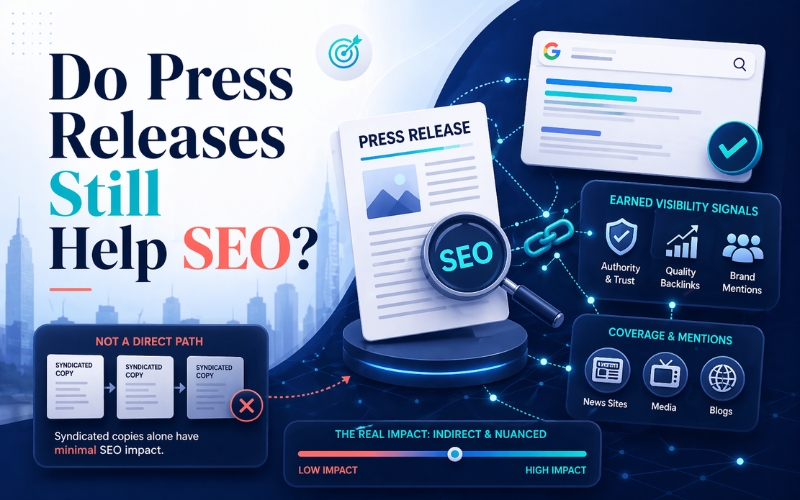
A more useful way to think about it is this:
- Direct value is often limited when the outcome is wide duplication across low-context pages.
- Indirect value can still be meaningful when the announcement supports real media pickup, branded discovery, or strong topical references.
- Strategic value increases when the release points to a destination asset that deserves attention, such as a launch page, research study, media page, or detailed product resource.
The real SEO question is not whether press releases still “build links” in the old sense. It is whether they still help create the conditions for stronger visibility and better coverage. In the right situations, they do.
>>> READ MORE: Best Link Building Quality vs Quantity: What Matters More for SEO?
Where Press Releases Still Create Real Value
Press releases still work when they are used for the jobs they are actually good at.
Official Brand Communication
One of their clearest strengths is formal communication. When a company launches a product, announces funding, enters a partnership, expands into a market, publishes original research, or addresses a sensitive issue, a press release still provides a clean and structured format for putting that information in public view.
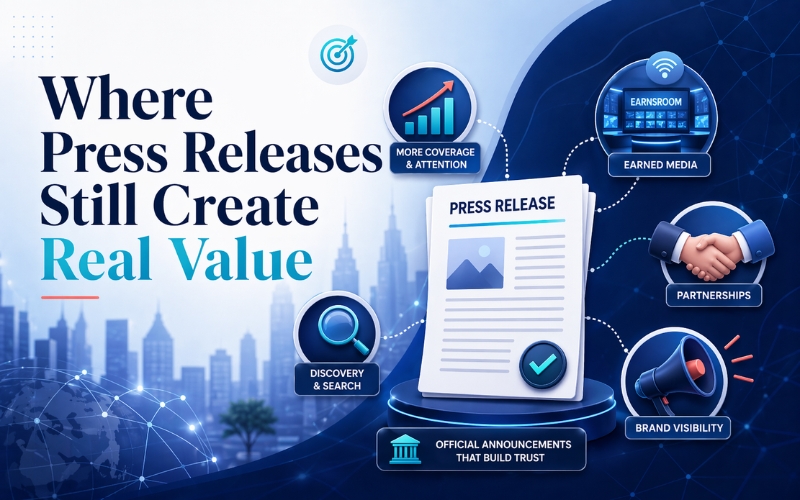
This matters because brands often need a canonical version of an announcement. A blog post can work for some updates, but a press release offers a more direct statement of facts, quotes, dates, and context. That can make it easier for outside publications, stakeholders, and searchers to understand the news quickly.
Earned Media Support
Press releases can also work as support material for media outreach. They are rarely the full strategy on their own, but they can give journalists and editors a source they can reference while deciding whether the story is worth covering.
That is where many teams misjudge the format. A release is often better seen as part of an earned-media process than as the final output. If the story has real news value and the outreach is targeted, the press release can help strengthen the pitch by making the announcement easier to verify and quote.
Brand Visibility And Discovery
Even when press releases do not generate strong direct SEO value, they can still help with discoverability. They can support brand mentions, help surface announcements in branded searches, and create more clarity around key business events.
This is especially useful for brands that are trying to build trust around launches, product changes, executive moves, data reports, or partnership news. For example, a funding announcement, a product launch, or an original research release may not create strong value from syndicated copies alone, but it can still help the right audiences find and reference the story.
Where Press Releases No Longer Do Much On Their Own
The easiest way to overvalue press releases is to assign them jobs they no longer do particularly well.
Syndication Alone Is Not A Strong SEO Strategy
A press release distributed through wire services may still create broad visibility, but that does not mean the syndicated copies are doing much for SEO on their own. Many of those placements are low-context copies of the same text, often with limited editorial value and little reason to expect meaningful ranking impact from the links involved.
That does not make distribution useless. It just means the SEO case should not be built around the assumption that more syndicated copies automatically mean stronger backlink value.
Routine Updates Rarely Earn Attention
Another common mistake is publishing releases for updates that are technically new but not actually interesting. Small company changes, vague product improvements, generic milestone claims, or heavily promotional announcements usually do not attract serious attention just because they were turned into a press release.
The issue is not the format. The issue is the absence of a real news angle. If the update would not matter to a publisher, journalist, partner, or industry audience, the release will usually underperform no matter how professionally it is written.
Publishing Without Outreach Usually Underperforms
Many teams still treat press releases as a passive tactic. They publish the announcement, distribute it, and wait for value to appear. That approach usually disappoints because visibility today depends much more on amplification, fit, and follow-up than on the act of publishing alone.
A release becomes more useful when it sits inside a broader workflow. Without that, it often turns into a well-formatted page that exists publicly but does very little beyond that.
What Makes A Press Release Worth Publishing Today
The best press releases usually have three things: a real angle, a clear audience, and a useful destination.
A Real News Angle
Not every update deserves a release. The format works best when the announcement has a genuine reason to exist publicly. Product launches, funding news, acquisitions, partnerships, major hires, original research, market expansion, and significant customer milestones are often better candidates than routine business activity.
The question is simple: would someone outside the company have a reason to care? If the answer is weak, the release usually becomes filler.
A Clear Audience And Outlet Fit
A press release should not be written as if everyone will care equally. Some announcements are more relevant to industry publishers. Others matter more to investors, customers, partners, or niche trade sites. That affects how the angle should be framed and who should see it after publication.
This is why a release often works better when it is created with outlet fit in mind rather than treated as generic corporate copy.
A Strong Destination Asset
If the release includes a link, the target matters. A thin page, vague homepage, or weak product page limits the practical value of the announcement. A more useful destination might be a launch page, a research report, a well-built product page, or a dedicated media resource that supports the story clearly.
That is one reason press releases often perform better when they are paired with strong content assets instead of being expected to carry the full burden themselves.
A Better Modern Workflow For Press Releases
A press release usually works better when it is part of a sequence rather than a one-step tactic.
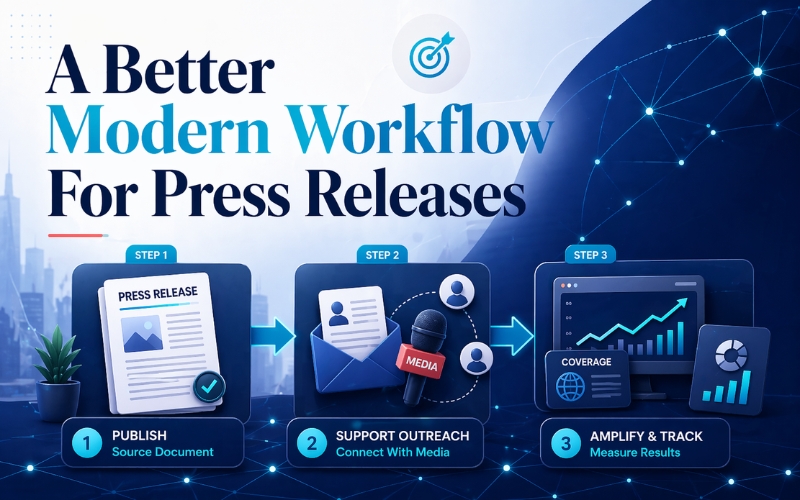
Step 1: Publish It As A Source Document
The release should function as a clean public record of the announcement. That means clear facts, useful quotes, concise context, and a structure that makes it easy to reference. It should be written for clarity first, not inflated to sound more important than the story really is.
Step 2: Use It To Support Outreach
Once it is live, the release can support targeted outreach to journalists, publishers, partners, or relevant industry contacts. In that context, it becomes supporting material rather than the whole plan. It gives the outreach more credibility because the announcement exists in a stable and citable form.
Step 3: Amplify And Track What Happens Next
A release should also be supported through the brand’s own channels when appropriate. That may include social distribution, founder amplification, partner sharing, newsroom visibility, or references from related company content. After that, the team should track what actually happened: pickup, mentions, referral traffic, branded search lift, or coverage from relevant sources.
When A Press Release Is The Wrong Format
A press release can be useful, but it is not always the right container.
If the content is primarily educational, a blog post is often better. If the goal is to earn links through novel insights or proprietary information, a data study or research asset may be stronger. If the brand has a targeted story for a narrow set of journalists but not enough public news value for a broad announcement, direct outreach without a release may be the smarter move.
This matters because teams often force content into a press release format when another format would do the job better. That creates weak releases and then leads to the conclusion that press releases no longer work.
Often, the more accurate conclusion is that the wrong format was chosen.
When Press Releases Still Make Sense For Brands
Press releases are still relevant for visibility, credibility, structured communication, and earned-media support. They are still useful when there is actual news, a real audience, and a clear reason to make the update public in a formal way.
They are much less relevant when treated as a scalable SEO shortcut. If the plan depends mainly on syndication volume, passive distribution, or the assumption that duplicated release copies will create strong backlink value on their own, the likely outcome is disappointment.
For most brands, the question is not whether press releases still work in absolute terms. The better question is whether they are being used for the right job. When they support a real announcement and a broader communication process, they can still be highly relevant. When they are expected to do the work of digital PR, link building, and content strategy all by themselves, they usually fall short.
How SEONetwork Fits Into A More Structured Workflow
For most teams, press releases are only one part of a broader visibility workflow. They work best when teams can separate announcement value, outreach potential, and placement quality instead of treating every release as an SEO asset.
SEONetwork supports that kind of structured evaluation by helping advertisers and publishers compare broader placement opportunities more clearly when digital PR, outreach, and link strategy begin to overlap. That matters most when teams are no longer deciding whether to publish one release, but how that release fits into a larger system of visibility, outreach, and placement decisions.
Conclusion
Press releases are still relevant, but their value now depends much more on fit than on format alone. They still work well as official announcements, media support assets, and visibility tools when the story is genuinely worth publishing. They work much less well when treated as a direct SEO tactic built around syndication and volume.
The real shift is not that press releases disappeared. It is that the standards for using them well became higher. If your team is still asking whether press releases are dead, the more useful question is whether you are using them in the right part of the workflow.
Check our Link Building Marketplace for the most balance and safest link building strategies.
FAQ
Are Press Releases Still Relevant For SEO?
Yes, but mostly in indirect ways. They can still support SEO through earned media, mentions, referral traffic, and greater discoverability around a real announcement. They are less useful when judged mainly by the volume of syndicated links they create.
Do Press Releases Still Build Backlinks?
Sometimes, but usually not in the old “distribute and collect links” sense. The stronger link opportunities tend to come from real editorial pickup or coverage, not from duplicated wire copies alone.
Are Syndicated Press Release Links Valuable?
They can have some visibility value, but they are usually not the strongest part of the SEO outcome. The more meaningful value often comes from earned references, publisher coverage, and contextually strong mentions.
When Should A Brand Publish A Press Release?
A brand should publish a press release when there is real news to communicate publicly, such as a launch, funding round, partnership, executive move, original data release, or another announcement with clear outside relevance.
What Works Better Than A Press Release For Link Building?
In many cases, a strong content asset, research study, digital PR pitch, or targeted outreach campaign works better when the main goal is to earn links rather than formally announce news.
>>> YOU MAY ALSO LIKE:
- Become a Publisher With SEONetwork
- Guest Post Search Operators: How To Find Better Link Opportunities – SEONetwork

I’m Jackson Avery, and I have 5 years of experience in content SEO. At SEONetwork, I share practical SEO knowledge, insights, and content strategies to help readers better understand search intent, content optimization, and sustainable organic growth.