
Guest post search operators are Google query patterns that help SEO teams find websites likely to accept contributed content. They are useful for early-stage prospecting, but they do not qualify a site on their own because a footprint is not the same as topical fit, editorial quality, or placement value. In this guide, we break down which search patterns still work, how to refine them without adding noise, and how to turn raw results into a shortlist that is actually worth pitching.
What Guest Post Search Operators Actually Are?
Guest post search operators are search queries that combine topical keywords, search footprints, and Google operators to surface sites that may accept contributed content. In practice, people often use the term loosely, but it helps to separate the parts.
A phrase like “write for us” is a footprint. It signals that a site may have a contributor page or an editorial process for outside submissions. An operator like intitle: or inurl: is different. It tells Google where to look for that footprint. When you combine the two with a niche or topic modifier, the search becomes much more useful.
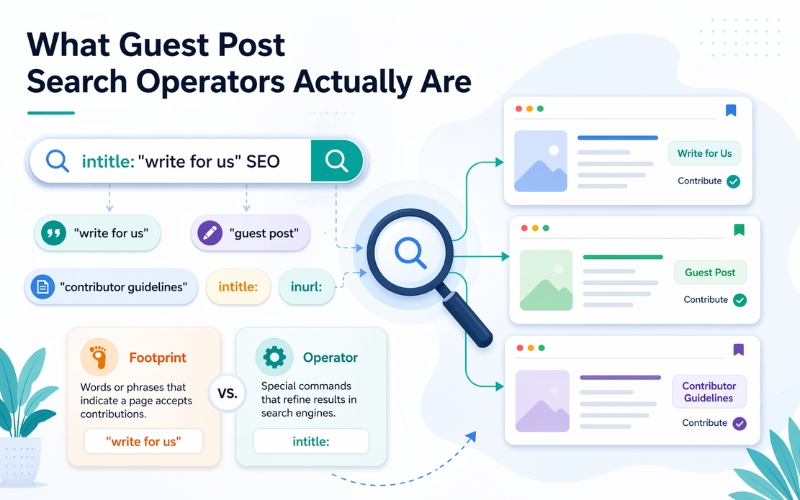
That distinction matters because not every result means the same thing. A site may mention guest posting somewhere on the page without actively accepting contributions. Another site may have a clean contributor page but still be a poor fit for your topic or link goals. Search operators help with discovery. They do not replace evaluation.
In practical terms, these queries are most useful for three things:
- Finding sites that publicly signal contributor acceptance
- Narrowing results to a specific niche or content theme
- Building a first-pass list faster than manual browsing alone
That is the real role of guest post search operators. They help you find candidates efficiently, not qualified opportunities automatically.
Which Query Patterns Tend To Surface Better Prospects
There is no single best query for every niche. Strong prospecting usually comes from testing several patterns, comparing what they return, and keeping the versions that consistently surface relevant sites.
Common Footprints That Still Work
Most outreach teams still start with recognizable contribution footprints such as:
[niche keyword] "write for us"[niche keyword] "guest post"[niche keyword] "submit an article"[niche keyword] "become a contributor"[niche keyword] "contributor guidelines"[niche keyword] "guest author"
These phrases work because they map to real editorial language used by blogs, niche publications, software companies, agency sites, and media-style websites. That said, they do not all behave the same way.
“Write for us” usually produces the widest pool, but it also brings more obvious SEO pages, generic contributor pages, and low-quality sites. “Guest post” can work well, though in some niches it skews toward pages designed mainly for link sellers and aggressive outreach. “Contributor guidelines” and “become a contributor” often surface cleaner editorial environments, especially in B2B and specialist industries.
The useful takeaway is not that one footprint always wins. It is that different footprints reveal different layers of the market. Broad phrases help with scale. Narrower editorial phrases often help with quality.
Search Operators That Improve Precision
Once the basic footprints are producing results, actual operators help clean up the search.
Useful patterns include:
intitle:"write for us" [niche]inurl:"write-for-us" [niche]intitle:"guest post" [topic]site:.com [niche] "contributor guidelines"[keyword] ("write for us" OR "guest post")[keyword] "write for us" -jobs -careers -forum
Each one changes the output in a slightly different way. intitle: is helpful when you want pages where the contribution footprint is central enough to appear in the title. inurl: often reveals dedicated submission or guidelines pages. OR broadens coverage without forcing you to run every variation separately. Exclusions such as -jobs or -forum help remove obvious clutter before you start reviewing prospects.
This is where many teams improve efficiency quickly. They stop treating a footprint as a full query and start treating it as one component in a more controlled search pattern.
Example Queries By Niche
The best-performing queries are usually specific enough to reflect the kind of placement you actually want.
For SEO and marketing topics, examples include:
"SEO" "write for us""content marketing" "guest post""link building" "contributor guidelines"intitle:"write for us" SEO("digital marketing" OR "content strategy") "become a contributor"
For SaaS and B2B, more precise modifiers usually improve the result set:
"SaaS" "write for us""B2B marketing" "guest post""CRM" "contribute"intitle:"contributor guidelines" SaaS"sales enablement" ("write for us" OR "guest post")
For local or vertical-specific campaigns, keep the query tied to the actual subject area instead of using broad guest post language:
"family law" "write for us""HVAC" "guest post""dental practice" "contributor guidelines""real estate investing" "submit an article"
In most niches, relevance improves when the subject modifier is precise. A broad query may give you more results, but a narrower one usually gives you a better starting point.
>>> READ MORE: Sell Backlink by Become a Publisher With SEONetwork
How To Refine Results Without Adding Noise?
The difference between a weak query and a useful one is often small. A few simple adjustments can make the output much easier to work with.
Add Topical Modifiers Early
The niche keyword should shape the entire search, not sit at the end as an afterthought.
A search for "write for us" on its own is too loose for serious prospecting. A search like "cybersecurity" "write for us" already forces a better level of topical alignment. Going narrower still can help even more. Instead of searching a broad topic like marketing, you may get cleaner results from terms such as technical SEO, content operations, demand generation, or attribution.
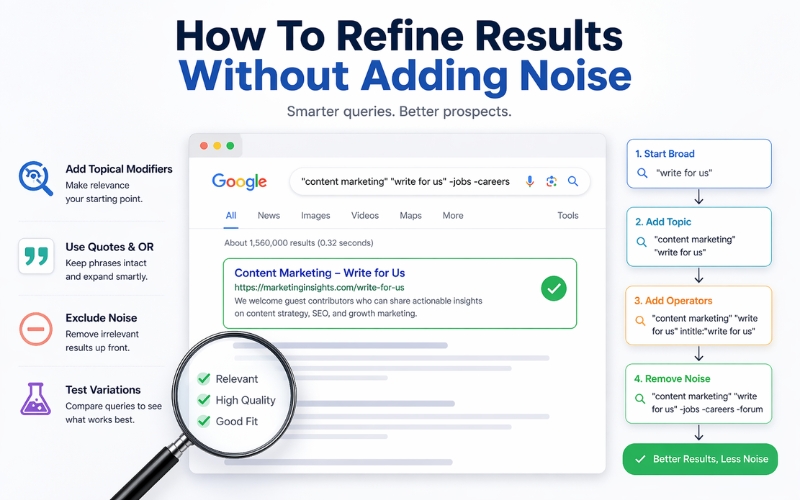
This matters because the quality of a prospect list often reflects the specificity of the search that built it.
Use Quotes, OR Logic, And Exclusions Carefully
Quotation marks help keep a footprint intact. Without quotes, Google may split the phrase and return pages where the words appear separately in a way that is far less useful. That is why "write for us" or "contributor guidelines" usually performs better than an unquoted version.
OR logic is useful when you want to compare related footprints in one pass, especially during early research. A query such as ("write for us" OR "contributor guidelines") SaaS broadens discovery without turning the search into total noise.
Exclusions help reduce obvious junk. A few examples:
"write for us" SEO -jobs -careers"guest post" finance -reddit -quora"contributor guidelines" SaaS -press -newswire
Exclusions do not fix quality on their own, but they make manual review less wasteful by cutting out result types you already know you do not want.
Test Variations Instead Of Trusting One Query
One of the most common prospecting mistakes is relying on a single search pattern and assuming the results represent the market. They usually do not.
A better approach is to build a small query set around the same topic and compare what each version surfaces. In one niche, "guest post" may return over-optimized SEO pages. In another, it may surface real multi-author sites. "Contributor guidelines" may produce fewer results, but the average quality may be much higher. You only see that difference when queries are tested side by side.
Good prospecting rarely comes from finding one perfect search operator. It comes from building a repeatable query set that consistently surfaces usable prospects.
How To Review Guest Post Prospects Before Outreach
This is the stage that separates a long list from a good one. Search can help you discover sites, but it cannot tell you whether a placement is worth your time.
Check Topical Fit Before Metrics
The first question is simple: Does the site make sense for the page you want to support?
If the audience, content focus, and editorial style are only loosely related to your topic, the opportunity is already weaker than it looks. Even a site with decent surface metrics may be a poor fit if the placement will feel forced or disconnected from the site’s core content.
Topical fit should come before DR, DA, traffic estimates, or any third-party score. Metrics can help screen a list. They should not override relevance.
Review Editorial Quality And Site Standards
A strong guest post prospect should look like a real publication or a credible multi-author site, not just a domain that happens to publish paid content.
Look at recent articles, content consistency, depth of topic coverage, writing quality, and whether the site appears to serve a clear audience. A clean editorial environment usually shows itself quickly. So does a weak one.
Useful questions to ask include:
- Does the site publish coherent content within a recognizable niche?
- Do recent articles look useful on their own?
- Are contributed posts clearly integrated into the site, or do they look dropped in?
- Does the site feel built for readers, or mainly for selling placements?
Those signals often matter more than surface numbers.
Watch For Link Farm Signals
Weak guest post targets tend to leave the same clues behind.
Common warning signs include:
- Unrelated topics mixed across the same domain
- Thin articles with weak structure or obvious filler
- Aggressive exact-match anchor patterns
- Heavy sponsored footprints across large parts of the site
- No clear audience, brand identity, or editorial direction
A single issue does not always disqualify a site. Several of them together usually do. When that happens, the safest move is to drop the prospect and move on.
A Practical Workflow For Building A Better Shortlist
A cleaner guest posting process usually follows a structured sequence. The goal is not just to collect domains. It is to narrow them into believable opportunities that are worth an outreach effort.
Start With Query Sets, Not Single Searches
Begin with the topic you want to support, then create several query variations around it using different footprints and operators.
If the campaign is about content marketing, for example, you might test:
"content marketing" "write for us"intitle:"guest post" "content marketing""content strategy" "contributor guidelines"
Running them side by side gives you a more realistic picture of the available opportunity set than depending on one pattern alone.
Capture A Broad First Pass
In the first pass, collect possibilities without pretending they are already approved prospects. Save the domain, the relevant contribution page if it exists, the apparent niche, and a short note on what the site appears to cover.
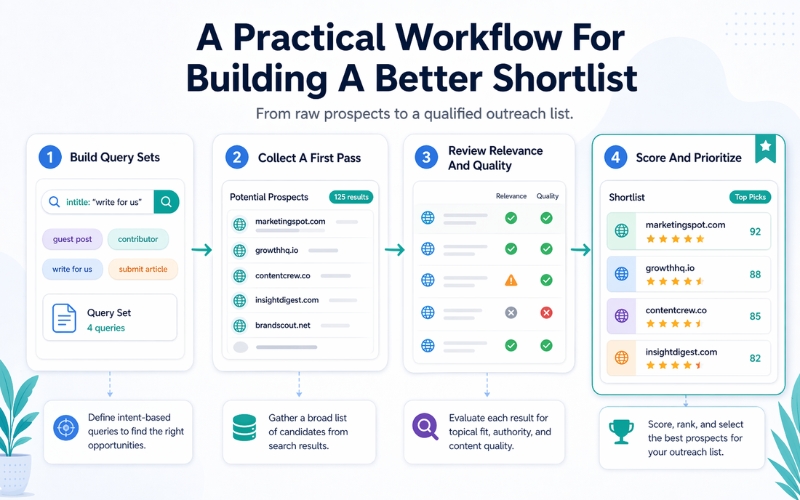
That keeps the process fast while still giving you enough context to review intelligently later.
This is also a natural place to add an internal link to a related resource on guest posting strategy if you have one, since many readers at this stage are also trying to understand the larger outreach process.
Score And Prioritize Before Outreach
Once you have a list, narrow it by the factors that actually affect placement value:
- Topical relevance
- Editorial quality
- Overall site credibility
- Placement fit for the page you want to support
- Likelihood that outreach is worth the effort
This is where many teams improve outcomes quickly. They stop treating discovery as success and start treating prioritization as the real quality filter.
A useful internal link here could point to a related guide on what makes a quality backlink, since that question naturally follows prospect evaluation.
Managing Prospect Lists More Clearly At Scale
The real difficulty in guest post prospecting is usually not finding websites. It is comparing them consistently once the list starts growing.
That is where structure matters more than another query tweak. Once a team is dealing with dozens or hundreds of possible placements, scattered spreadsheets and loose manual notes often create more confusion than clarity. Strong prospecting depends on having a repeatable way to compare relevance, quality, and likely fit.
At SEONetwork, we think about this as a prospect management problem as much as a discovery problem. As a backlink marketplace, SEONetwork helps SEO teams evaluate and compare placement opportunities in a more structured way than manual outreach alone. That does not replace judgment, but it does make it easier to move from raw discovery to clearer decisions when the list starts getting messy.
A natural internal link in this section could point to a broader piece on link building quality vs quantity, especially for readers deciding how selective their outreach process should be.
Conclusion
Guest post search operators still have real value because they help SEO teams find relevant prospects faster and with more direction. Their value drops quickly, though, when they are treated as a quality signal instead of a discovery tool.
The teams that usually get better results are not the ones running the most queries. They are the ones that pair useful search patterns with clear review standards for relevance, editorial quality, and placement fit. If your current process produces long prospect lists but weak decisions, the next improvement is probably not another search footprint. It is a cleaner way to compare opportunities before outreach starts.
Check our Link Building Marketplace for the most balance and safest link building strategies.
FAQ
What Are Guest Post Search Operators?
Guest post search operators are Google query patterns used to find websites that may accept contributed content. They usually combine a topical keyword with footprints such as “write for us” or operators such as intitle: and inurl:.
Which Guest Post Search Operators Work Best?
There is no single best query for every niche. In most cases, a mix of "write for us", "guest post", "contributor guidelines", intitle:, inurl:, and exclusion filters works better than relying on one footprint alone.
Are Guest Post Search Operators Enough To Find Good Sites?
No. They help with discovery, but they do not tell you whether a site is relevant, credible, or worth pitching. That part still requires manual review.
How Do You Filter Low-Quality Guest Post Prospects?
Start with topical fit, then review editorial quality, content consistency, outbound link patterns, and overall site credibility. Avoid sites that look built mainly to sell placements rather than serve a real audience.
Do Guest Post Search Operators Still Work Today?
Yes. They still work well for early-stage prospecting, especially when paired with better filtering and prioritization after the search.
>>> YOU MAY ALSO LIKE:
- Are Press Releases Still Relevant? Where They Still Work And Where They Do Not