
Keyword research is one of those tasks that looks straightforward until you are sitting in front of a tool with thousands of results and no clear idea what to actually target. The problem is rarely a lack of data. It is usually a lack of criteria.
This guide walks through a practical framework for how to find the best keywords for SEO, from defining what “best” actually means in context, to running the research, to prioritizing a final list you can act on. Whether you are building a new content strategy from scratch or auditing what you already have, the process is the same.
What Makes a Keyword the Best Fit for Your SEO Strategy
There is no universally best keyword. A term that drives strong results for one site may be a complete waste of resources for another. What matters is fit across four dimensions.
Search intent is clear and aligned. The keyword should map to one intent type: informational, commercial, or transactional. If the intent is ambiguous or contested in the SERP, ranking for it is harder and converting from it is harder still.
Search volume is proportionate to the niche. A keyword with 200 monthly searches can be excellent in a narrow B2B vertical and irrelevant in a mass-market one. Do not chase volume for its own sake. Evaluate it relative to your audience size and conversion value.
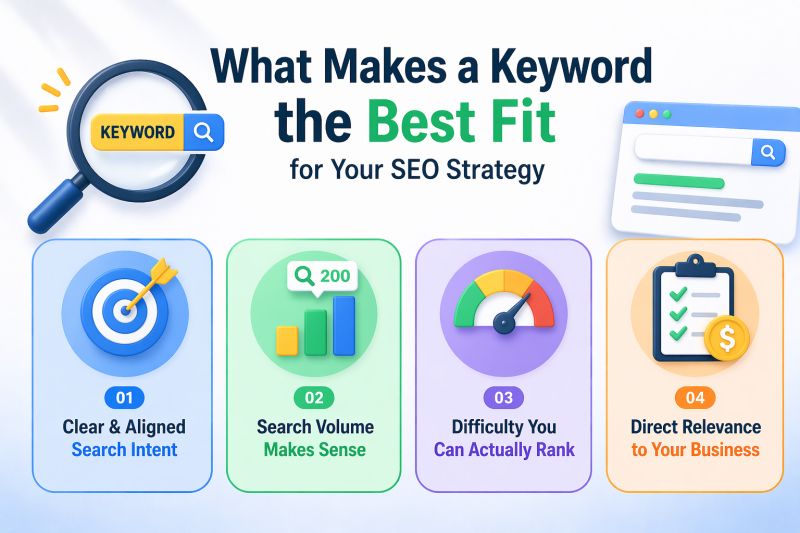
Keyword difficulty is realistic for your domain. If the top 10 results are all high-authority domains and you are working with a relatively new site, that keyword is not a good target right now. Ranking potential depends on where your domain actually stands, not where you want it to be.
Business relevance is direct. Traffic only matters if it can lead somewhere useful. The best keywords connect to your products, services, or content goals in a way that supports actual conversion, not just pageviews.
>>> EXPLORE FURTHER: Buy Backlinks, Buy Guest Posts & Backlink Services | SEONetwork
Step 1: Start with Seed Keywords
Seed keywords are the starting point. They are short, broad terms that describe what your site or business is about. You do not need a tool to generate them. You need to think clearly about what problems you solve and how your audience describes those problems.
A few practical approaches: list the core topics your site covers using the same language your audience uses rather than internal jargon; look at terms your existing customers use in support tickets, reviews, or onboarding conversations; and review competitor site navigation and category pages to identify the topical structure they are already targeting.
The goal here is not to build a large list. It is to build an accurate list you can expand from. Ten well-chosen seeds are more useful than fifty vague ones.
Step 2: Expand with Keyword Research Tools
Once you have your seeds, plug them into a keyword research tool to surface related terms, questions, and variations. The tool matters less than how you use it.
The main data points to evaluate are monthly search volume (a rough estimate of demand, treat it as directional not precise), keyword difficulty (a score estimating how competitive the SERP is, usually calculated from the backlink profiles of current top-ranking pages), and CPC. Cost per click is not directly useful for organic SEO, but high CPC reliably signals commercial intent, which is often a strong indicator of business value even in organic contexts.
When filtering results, start by removing anything clearly outside your topical scope. Then sort by a combination of volume and difficulty to surface candidates worth investigating. Do not stop at the data. Every shortlisted keyword needs a SERP check before you commit to targeting it.
A note on tool choice: free options like Google Search Console, Google Keyword Planner, and Google Trends cover the basics. Paid tools like Ahrefs and Semrush give you more complete competitor data and more reliable difficulty scores. Use what fits your budget, but use it consistently.
Step 3: Analyze Search Intent Before Committing
Search intent is the reason behind a query. Getting this wrong is one of the most common reasons a page fails to rank even when everything else looks technically sound. If you create a product page targeting a keyword that Google has consistently ranked informational guides for, you are not going to outrank those guides regardless of your on-page optimization.
The four intent categories are informational (the user wants to learn something), navigational (the user is looking for a specific site or page), commercial (the user is researching before making a decision), and transactional (the user is ready to act).
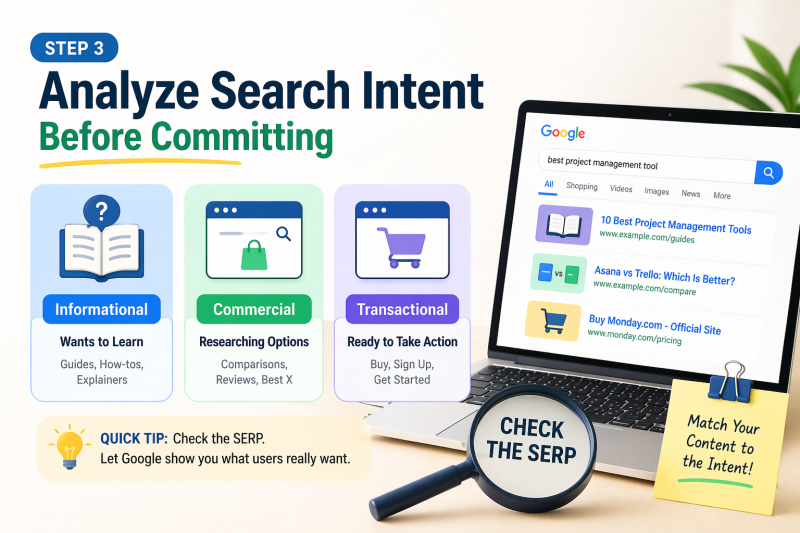
The most reliable way to verify intent is to look at the actual SERP. Open the top 5 to 10 results and ask what content format dominates and what these pages are trying to do. If they are all long-form educational guides, Google has signaled that informational content belongs here. If they are product pages or tool comparison articles, the intent leans commercial or transactional.
Match your content format to what already ranks. This is not about copying competitors. It is about meeting the intent that Google has already confirmed for that query.
>>> EXPLORE FURTHER: How to Do SEO Optimization: A Step-by-Step Guide
Step 4: Evaluate Ranking Potential Realistically
Keyword difficulty scores are useful but incomplete. Before committing to a keyword, check the domain authority and backlink profiles of the pages currently ranking for it. If every result in the top 10 has a domain rating significantly above yours, that keyword needs to be deprioritized until your authority catches up.
Keyword gap analysis is one of the most efficient ways to find realistic targets. Use a tool like Ahrefs or Semrush to find keywords where your competitors rank but you do not. These gaps represent opportunities with already-demonstrated search demand and proven ranking potential in your niche. Starting from proven gaps is more efficient than starting from zero.
Low-competition, clear-intent keywords are often underrated. Some of the best ranking opportunities are terms with moderate search volume, low competition, and very specific intent. These are typically long-tail variations that larger sites have not bothered to target properly. A focused, well-structured page can rank quickly for these and build authority over time.
Step 5: Prioritize Keywords by Impact and Effort
Once you have a refined list, you need to decide what to work on first. The practical approach is to map keywords against two axes: expected impact (volume, business relevance, conversion potential) and required effort (how competitive the keyword is, how much content work is needed to target it properly).
Prioritize keywords that fall into the high impact, lower effort quadrant. These give you the fastest path to ranking movement and the best return on content investment.
Group keywords into topic clusters rather than targeting them in isolation. One pillar page covers the broad topic; supporting pages go deeper on specific subtopics. Internal links connect them. This structure helps Google understand topical authority across your site and distributes ranking signals more effectively than a collection of unconnected pages.
Account for internal linking from the start. When you decide which pages to build around which keywords, map out how they will link to each other before you write a word. Pages that sit in well-connected clusters consistently outperform isolated pages targeting the same keywords. Internal linking is part of the keyword strategy, not an afterthought.
Common Mistakes in Keyword Selection
Even experienced SEO teams make these consistently.
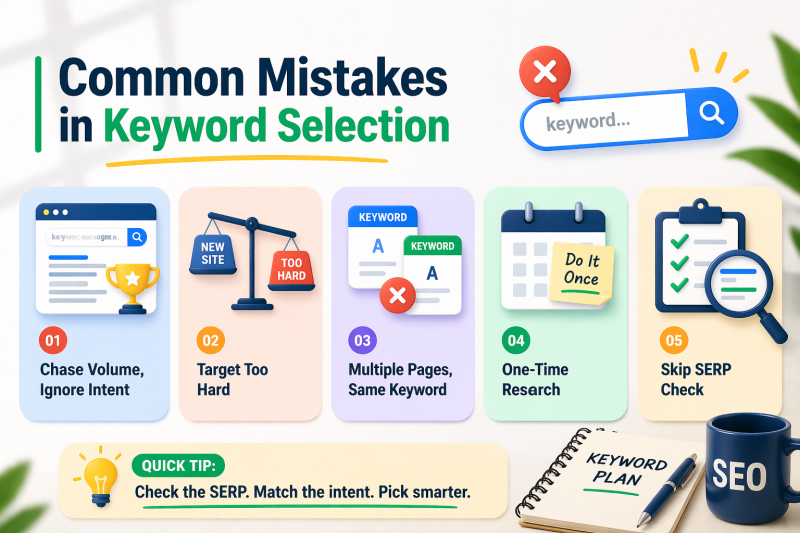
Chasing volume while ignoring intent produces traffic that does not engage and does not convert. A high-volume keyword with the wrong content format is not an opportunity. Targeting keywords beyond your current domain authority wastes content resources on pages unlikely to move for months, if ever. Treating keyword research as a one-time task is a mistake in any competitive niche. Search behavior shifts, terms gain and lose relevance, and new opportunities emerge. Revisiting your keyword strategy at least quarterly is not optional. Creating multiple pages targeting nearly identical keywords leads to cannibalization, where your own pages compete against each other and split the ranking signals that should be consolidated into one strong page.
>>> EXPLORE FURTHER: How Many SEO Keywords Per Page?
Keyword Research Tools Worth Using
You do not need every tool. You need the right combination for your workflow and budget.
For free options, Google Search Console shows what your site already ranks for and at what average position, which is especially useful for identifying quick-win keywords sitting just outside the top 10. Google Keyword Planner provides volume ranges and related terms. It is less precise than paid tools but free and data-backed. Google Trends is useful for identifying seasonal patterns and comparing relative interest between terms before you commit.
For paid options, Ahrefs is strong for keyword gap analysis, backlink data, and keyword difficulty scoring, and is generally the most reliable for competitive research. Semrush is a comprehensive platform covering keyword research, site audits, and competitor analysis, which suits teams that prefer everything in one place. Moz is more approachable for teams earlier in their SEO maturity, with solid keyword and ranking data even if it has less depth than the other two on competitive research.
The best tool is the one you use consistently. A well-maintained workflow in a free tool produces better results than sporadic use of an expensive one.
FAQ
What is the difference between a seed keyword and a target keyword?
A seed keyword is a broad starting term you use to generate ideas, for example “keyword research” or “SEO tools.” A target keyword is the specific term you optimize a page for after evaluating intent, volume, difficulty, and business relevance. Seeds feed the research process. Target keywords are the output of it.
How many keywords should I target per page?
One primary keyword per page, with a small set of semantically related secondary terms supporting it. Trying to target multiple unrelated keywords on a single page dilutes focus and makes it harder for Google to understand what the page is actually about. If two keywords are closely related and share the same intent, they can often be targeted together on one page. If they serve different intents, they need separate pages.
How do I know if a keyword is too competitive for my site?
Check the domain rating or domain authority of the pages currently ranking in the top 10 for that keyword. If they are all significantly above yours and have strong backlink profiles, the keyword is too competitive for now. A practical threshold: if you cannot see at least two or three results in the top 10 from sites with authority comparable to yours, deprioritize it.
What is keyword cannibalization and how do I avoid it?
Keyword cannibalization happens when multiple pages on your site target the same or very similar keywords, causing them to compete against each other in search results. Google has to choose which page to rank and often ranks neither well. Avoid it by mapping keywords to pages before you create content and consolidating any existing pages that overlap significantly in topic and intent.
How often should I update my keyword research?
At minimum, review your keyword strategy quarterly. Markets shift, new terms emerge, and competitor positioning changes. Your Google Search Console data is especially useful here. It will show you keywords you are already ranking for that you have not explicitly targeted, which are often worth developing further.
Does keyword research still matter with AI-driven search?
Yes, and in some ways more than before. AI Overviews and conversational search surfaces pull from pages that clearly address a specific question or topic. If your content is well-structured, intent-matched, and genuinely useful, it is more likely to be surfaced. The fundamentals of keyword research, understanding what people are searching for and why, feed directly into that. The execution may look different, but the underlying logic stays the same.
What is the best free tool for keyword research?
Google Search Console is the most underused free tool available. It shows real performance data for your own site, which is more actionable than volume estimates from any external tool. For finding new keyword opportunities, Google Keyword Planner gives you volume ranges and related terms without any cost. These two together cover most basic research needs.
Once you have a keyword strategy in place, the next challenge is execution. On the off-page side, building links at scale requires its own process. SEONetwork makes that part more structured by connecting advertisers with publishers in a transparent, organized way, which is considerably easier to manage than manual outreach at volume.